
Maze Therapeutics Heads Into Q1 Print With Short Interest at a Six-Week High
Produced automatically from ORTEX data and published under the ORTEX News editorial standards set by Peter Hillerberg, Editor, ORTEX News. How we publish
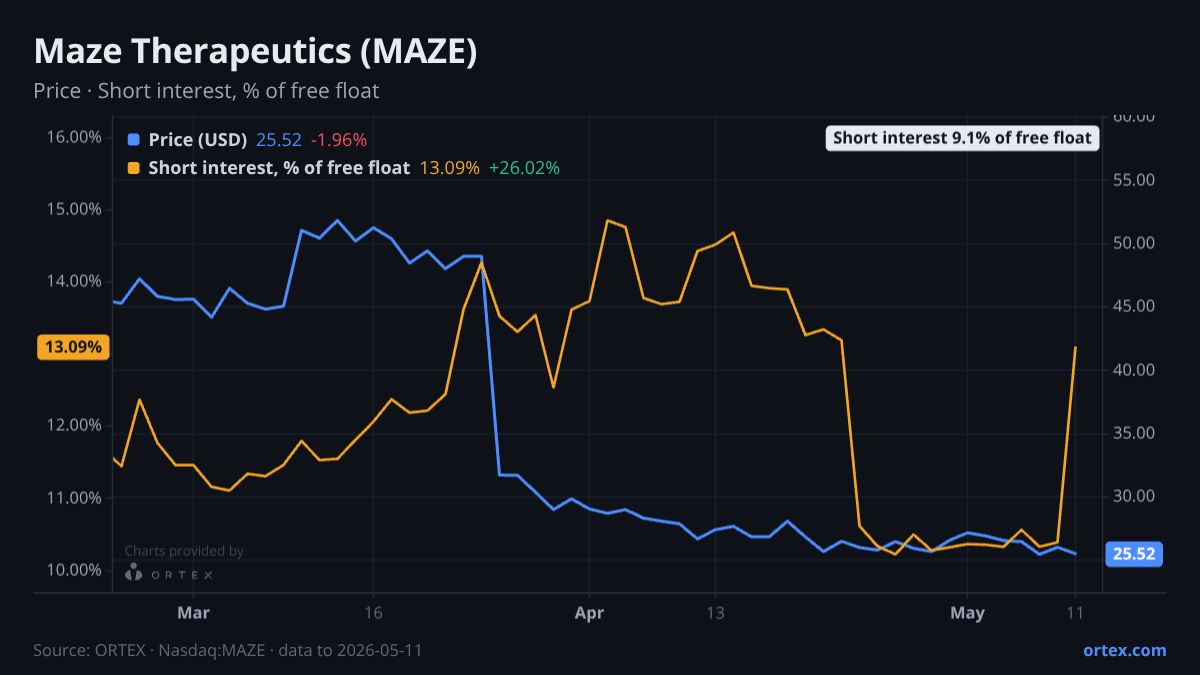
Maze Therapeutics reports Q1 2026 results on May 14 with short sellers freshly emboldened — and analysts split on how far the MZE829 story can run.
The most striking pre-print development is in short positioning. Short interest jumped 26% in a single session on May 11, pushing to 9.1% of the free float — the highest level in roughly six weeks. That one-day move matters more than the modest month-long rise of 6%, suggesting a deliberate, concentrated bet against the stock. Despite the surge, borrow conditions remain relaxed: availability runs at a wide 580% of short interest, and the cost to borrow is just 0.64% annualised. That combination — rising short interest alongside plentiful, cheap borrow — points to a conviction-driven directional trade rather than any mechanical squeeze dynamic. Options positioning has also tilted more cautious. The put/call ratio of 1.04 is running above its 20-day average of 0.87, though the z-score of 0.62 keeps it well short of alarm territory.
The bull and bear camps agree on the pipeline asset but diverge sharply on timing and competitive risk. Bulls focus on MZE829's dual mechanism — disrupting APOL1 pore assembly while blocking pore function — and the potential for accelerated approval if the HORIZON trial data support progression benefit in chronic kidney disease beyond FSGS. Analyst coverage has been broadly supportive: JP Morgan lifted its target to $58 in late March following strong data, Truist initiated coverage at Buy with a $68 target before trimming to $64 in April, and Mizuho came in with an Outperform and $97 target on initiation. The mean price target across analysts is approximately $63, roughly 2.5x the current price of $25.78 — a gap that reflects both the binary nature of a clinical-stage asset and the wide dispersion in views. Bears point to a crowded APOL1 field and the reality that HORIZON's read-out, not analyst enthusiasm, will determine whether that discount closes.
Institutional ownership adds a layer of stability to the register. Specialist biotech investors dominate the top of the share list: Third Rock Ventures holds 9.8% unchanged, while Paradigm Biocapital — a dedicated renal-disease investor — built an entirely new 5.5% stake as recently as March 25. BlackRock added nearly one million shares through April. That ownership profile is typical of clinical-stage names where conviction holders are comfortable riding trial volatility. Insider activity has leaned the other way: the Chief Medical Officer and Chief Strategy Officer both sold shares in late March and April, though the trades appear routine in size and have low assigned significance.
Wednesday's print will test whether the clinical narrative — HORIZON enrollment, MZE829 dosing data, and cash runway — still justifies the Street's wide range of price targets or gives the recent short-interest build its first fundamental validation.
Against its own history
This week's change in short interest is 2.4 standard deviations above the company's typical weekly move over the past year. Short interest is at its highest level in at least a year.
Against its peers
Shares moved -2.9% over the past week against a median of +0.3% for its closest peers.
Stocks in this article
See the live data behind this article on ORTEX.
Open MAZE on ORTEX →How this article was generated
- Generated
- 13 May 2026, 04:41
- Data as of
- 13 May 2026, 04:00
- Prompt version
- v1.0
- Data sources
- Short interestCost to borrowUtilizationOptions flowEarningsInstitutional positioningORTEX Alpha signals
ORTEX Market Intelligence content is generated by AI from a snapshot of ORTEX's proprietary data and reviewed by the ORTEX team. Content is informational only and does not constitute investment advice.