
Toast Heads Into Q1 Print With Short Interest Up 21% in a Month
Produced automatically from ORTEX data and published under the ORTEX News editorial standards set by Peter Hillerberg, Editor, ORTEX News. How we publish
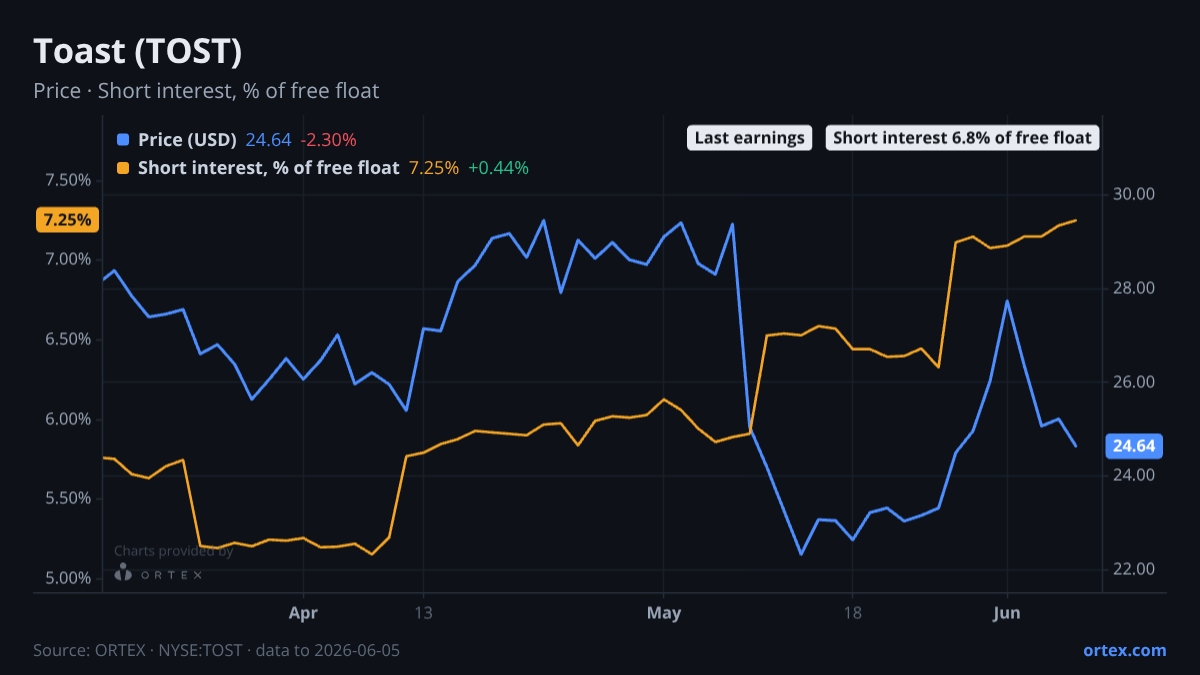
TOST arrives at its June 12 earnings report having shed 13% in a week and with bears adding meaningfully to their positions — a setup where the print carries real weight.
Short sellers have been accumulating steadily. Short interest has climbed 21% over the past month to 6.8% of the free float, with gains coming in nearly every session over the past two weeks. The move is notable for its persistence rather than any single spike. Despite that build-up, the lending market is nowhere near stressed: availability is extremely loose at over 2,200% — meaning shares to borrow vastly outnumber those already borrowed — and the cost to borrow barely registers at 0.41%. Bears face no friction getting in or out. Options positioning reinforces the picture of a market that is wary but not panicked. The put/call ratio at 0.63 is actually a tick below its 20-day average of 0.66, sitting roughly 0.7 standard deviations on the call-heavy side — suggesting that despite the sell-off, options traders have not rushed to load up on downside protection.
The analyst community is openly divided, and the direction of travel after the last print was decidedly bearish on targets. Following the most recent quarterly release in early May — when TOST dropped 11.5% on the day and shed a further 18.5% over the following week — the street broadly cut numbers while keeping ratings intact. UBS, Citi, and Truist all maintained Buy-equivalent ratings but trimmed targets into the $30–$36 range, while Mizuho's Outperform survived a cut from $45 to $38. One downgrade came through: Rothschild moved to Neutral with a fresh $35 target. DA Davidson stayed at Neutral, lowering to $28. The consensus mean target of roughly $34 implies about 40% upside from current levels — a large gap that reflects either deep undervaluation or stale optimism depending on which side of the debate you sit. Bulls point to market share gains in the SMB restaurant vertical, improving unit economics, and no debt on the balance sheet. Bears counter that the restaurant vertical concentrates risk, competition is intensifying, and the company's reliance on merchant processors adds execution uncertainty at a moment when small-business spending is uncertain.
Institutional holders offer one mildly constructive signal. FMR (Fidelity) added over 4.3 million shares in the most recent reported period, making it the largest institutional holder at 5.4% of shares. JP Morgan Asset Management added 6.8 million shares to reach 2.1% of shares. AllianceBernstein added 8.8 million shares in Q1. Those are meaningful accumulation moves from credible long-only investors. On the other side, co-founder Steven Papa trimmed his position by 10.4 million shares — a significant reduction, though it follows the broader pattern of routine insider sales also seen from the CEO, CFO, and General Counsel around early April. Net insider activity over 90 days shows a small net positive in shares but is driven by awards rather than open-market purchases, so it does not read as a strong conviction signal.
The June 12 print is therefore a direct test of whether TOST's growth trajectory — and specifically its subscription revenue progress among SMB restaurants — can justify a multiple that still prices in meaningful future expansion, against a backdrop where the last two quarters both delivered sharp post-earnings declines.
Against its own history
This week's change in short interest is 3.9 standard deviations above the company's typical weekly move over the past year. Short interest is at its highest level in at least a year.
Against its peers
Shares moved -13.1% over the past week against a median of -6.9% for its closest peers.
Stocks in this article
See the live data behind this article on ORTEX.
Open TOST on ORTEX →How this article was generated
- Generated
- 9 Jun 2026, 04:06
- Data as of
- 9 Jun 2026, 04:02
- Prompt version
- v1.0
- Data sources
- Short interestCost to borrowUtilizationOptions flowEarningsInstitutional positioningORTEX Alpha signalsRecent ORTEX notes
ORTEX Market Intelligence content is generated by AI from a snapshot of ORTEX's proprietary data and reviewed by the ORTEX team. Content is informational only and does not constitute investment advice.