
Visa Options Hit 52-Week Extreme as Bears Exit
Produced automatically from ORTEX data and published under the ORTEX News editorial standards set by Peter Hillerberg, Editor, ORTEX News. How we publish
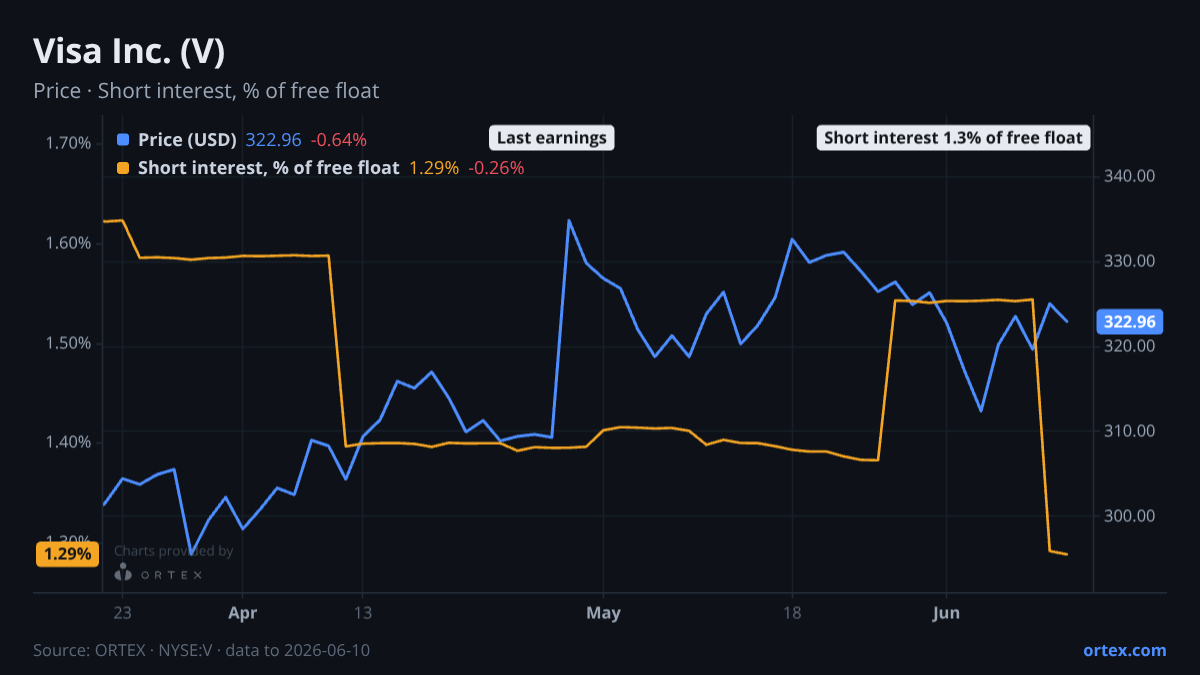
Visa is flashing an unusual alignment of signals into its July 21 earnings date. The options market just reached a 52-week bullish extreme. Short sellers have unwound the majority of a six-week position build in a single week. Both moves are pointing the same direction simultaneously.
PCR at the Year's Most Bullish Level
The put/call ratio fell to 0.72 on June 10. That is the lowest reading in 52 weeks — the prior floor was 0.78. It sits 3.7 standard deviations below the 20-day mean of 0.83. This is not a gentle drift toward calls. It is an abrupt, statistically extreme shift.
The June 8 stock report noted the PCR had dropped to 0.80, itself the lowest level at that point in the year. It has now extended that move sharply. Call buyers are crowding in ahead of Q3 results. The last Visa earnings print — April 29 — delivered an 8.1% one-day gain and a further 4% over the following five days. Options traders appear to be positioning for a repeat.
Shorts Confirm the Direction
Short interest now stands at 1.27% of free float, down 16.4% on the week. The entire May-June position rebuild — which peaked near 25.6 million shares — has been unwound in roughly three sessions. Estimated shares short sit at approximately 21.4 million, the lowest level in over six weeks.
The borrow market corroborates the exit. Cost to borrow has fallen 52% in a week to just 0.27% — its lowest level since late April. Availability stands at 1,162%, meaning more than eleven shares are available to lend for every one currently borrowed. There is no friction in exiting a short here, and none in adding one. The bears are simply choosing to leave.
Analysts Remain Firmly Behind the Stock
Consensus sits at buy, with 29 buy-rated analysts on record. Since the April 29 earnings beat, target prices have risen at multiple firms: Macquarie to $420, UBS to $410, Oppenheimer to $403, and Cantor reiterating $400. The mean target stands at $398.64 — roughly 23% above the current price of $322.96. Truist followed up in May with a further raise to $371. The analyst community has not flinched.
- PCR: 0.72 (52-week low; z-score –3.69)
- SI % of float: 1.27%, down 16.4% on the week
- Cost to borrow: 0.27%, down 52% on the week
- Availability: 1,162% — lending market fully unconstrained
- Next earnings: July 21, 2026
- Analyst consensus: Buy; mean target $398.64
Against its own history
This week's change in short interest is 3.3 standard deviations below the company's typical weekly move over the past year. Short interest is at its lowest level in at least a year.
Against its peers
Shares moved +3.4% over the past week against a median of +3.6% for its closest peers.
Stocks in this article
See the live data behind this article on ORTEX.
Open V on ORTEX →How this article was generated
- Generated
- 11 Jun 2026, 11:03
- Data as of
- 11 Jun 2026, 11:02
- Prompt version
- v1.0
- Data sources
- Short interestCost to borrowUtilizationOptions flowEarningsAnalyst consensusInstitutional positioningORTEX Alpha signalsRecent ORTEX notesPrevious Mi Articles
ORTEX Market Intelligence content is generated by AI from a snapshot of ORTEX's proprietary data and reviewed by the ORTEX team. Content is informational only and does not constitute investment advice.