
DHR: Street Trims Targets but Holds the Line After Brutal Q2 Drop
Produced automatically from ORTEX data and published under the ORTEX News editorial standards set by Peter Hillerberg, Editor, ORTEX News. How we publish
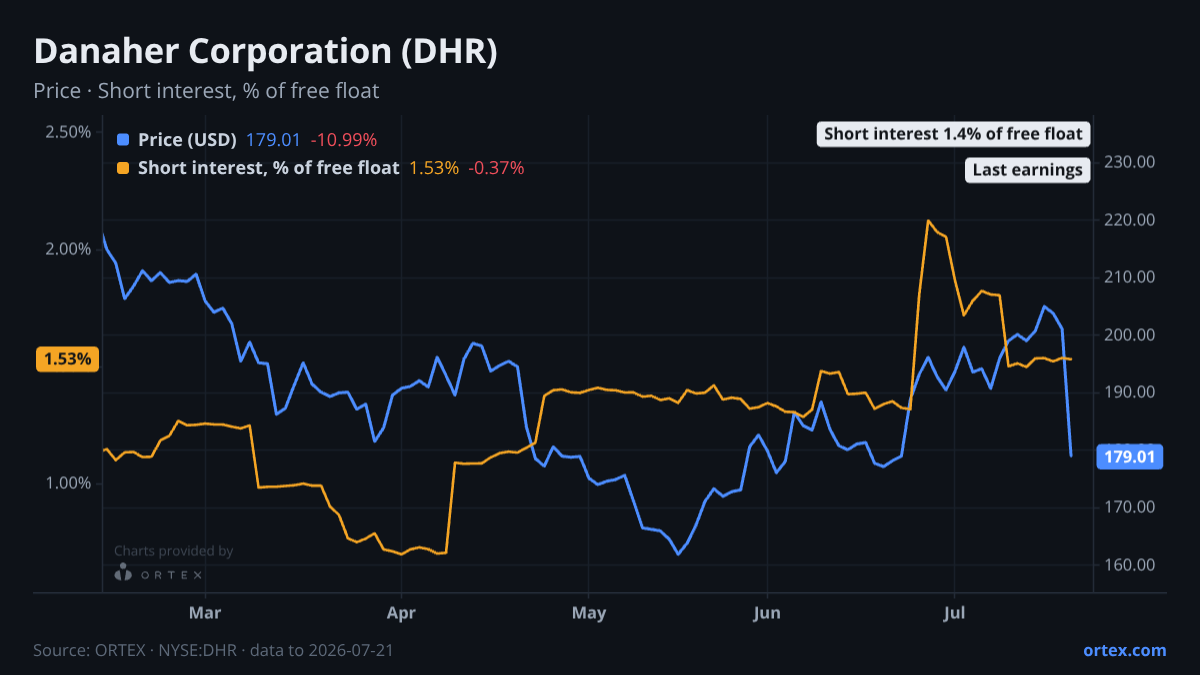
Danaher Corporation is now in damage-assessment mode — down 11% in a single session after Q2 results that exposed the bioprocessing recovery as slower and bumpier than the bulls had priced in.
The analyst response on July 22 was rapid, coordinated, and telling in its nuance. Stifel cut its target from $260 to $220, Guggenheim trimmed from $235 to $200, and TD Cowen edged lower from $240 to $236 — all maintaining Buy ratings. RBC Capital moved the other way, raising its target from $200 to $215, also staying at Outperform. The message from the Street is unified in direction even if divergent in magnitude: the bull thesis survives, the timeline does not. With the consensus mean target around $229 against a close of $179, there is implied upside of nearly 28% — but that figure has been revised down sharply in a single morning, and the bears will note that analyst targets have been cut repeatedly since late 2025 without the stock finding a durable floor.
Options positioning had been flagging this outcome for days. The put/call ratio finished Tuesday at 0.74, running 2.4 standard deviations above its 20-day average of 0.56 — the sharpest defensive lean in months. The PCR had been building steadily from sub-0.50 levels in late June, and in the 48 hours before the print the drift accelerated. The 52-week high on the PCR is 1.63, so the absolute level is not extreme — but the velocity of the move ahead of results, and the subsequent 11% gap lower, confirm the options market was reading the setup correctly. Post-earnings, the question is whether that defensive positioning unwinds now that the event risk has cleared, or whether fresh hedging rebuilds as investors wait for clarity on the bioprocessing trajectory.
Short interest tells a less alarming story than the price action might suggest. At 1.4% of the free float — down roughly 15% from the late-June peak near 2% — bears had actually been reducing exposure into the print, not adding to it. Borrow availability remains abundant, with over 700 million shares in the lending pool and a cost to borrow of just 0.43%. There is no squeeze pressure in either direction. The short score from ORTEX sits at 29.7, near the low end of its recent range and well below the mid-31 readings seen in early July. Bears who wanted to press the stock heading into Q2 largely didn't — making the selloff more of a long-side derating than a short-side pile-on.
Among close peers, Repligen fell 5.8% on the day — the most direct bioprocessing read-across — while Avantor and Revvity actually closed higher by 3.1% and 3.8% respectively, suggesting the DHR-specific bioprocessing miss is being treated as idiosyncratic rather than sector-wide. Thermo Fisher Scientific shed just 0.5% on the session. The divergence matters: if peers are holding up, the pressure on Danaher's management to demonstrate a credible recovery path in October is intensified rather than shared.
The next formal catalyst is the Q3 print scheduled for October 20. Between now and then, the debate is less about whether bioprocessing eventually recovers — the Street broadly believes it will — and more about whether the guidance for that segment offered on Tuesday holds or gets trimmed again. The pattern of cutting and pushing out the timeline has now repeated across several consecutive quarters, and how management frames the H2 setup in the coming weeks will determine whether $179 becomes a base or a staging point for further re-rating.
Against its own history
This week's change in short interest is 2.0 standard deviations above the company's typical weekly move over the past year. Short interest is at its highest level in at least a year.
Against its peers
Shares moved -10.1% over the past week against a median of -1.9% for its closest peers.
Stocks in this article
See the live data behind this article on ORTEX.
Open DHR on ORTEX →How this article was generated
- Generated
- 22 Jul 2026, 18:16
- Data as of
- 22 Jul 2026, 18:15
- Prompt version
- v1.0
- Data sources
- Short interestCost to borrowUtilizationOptions flowEarningsAnalyst consensusInstitutional positioningORTEX Alpha signalsRecent ORTEX notesPrevious Mi Articles
ORTEX Market Intelligence content is generated by AI from a snapshot of ORTEX's proprietary data and reviewed by the ORTEX team. Content is informational only and does not constitute investment advice.