
Ventas Rallies Into Earnings With Bulls in the Driver's Seat
Produced automatically from ORTEX data and published under the ORTEX News editorial standards set by Peter Hillerberg, Editor, ORTEX News. How we publish
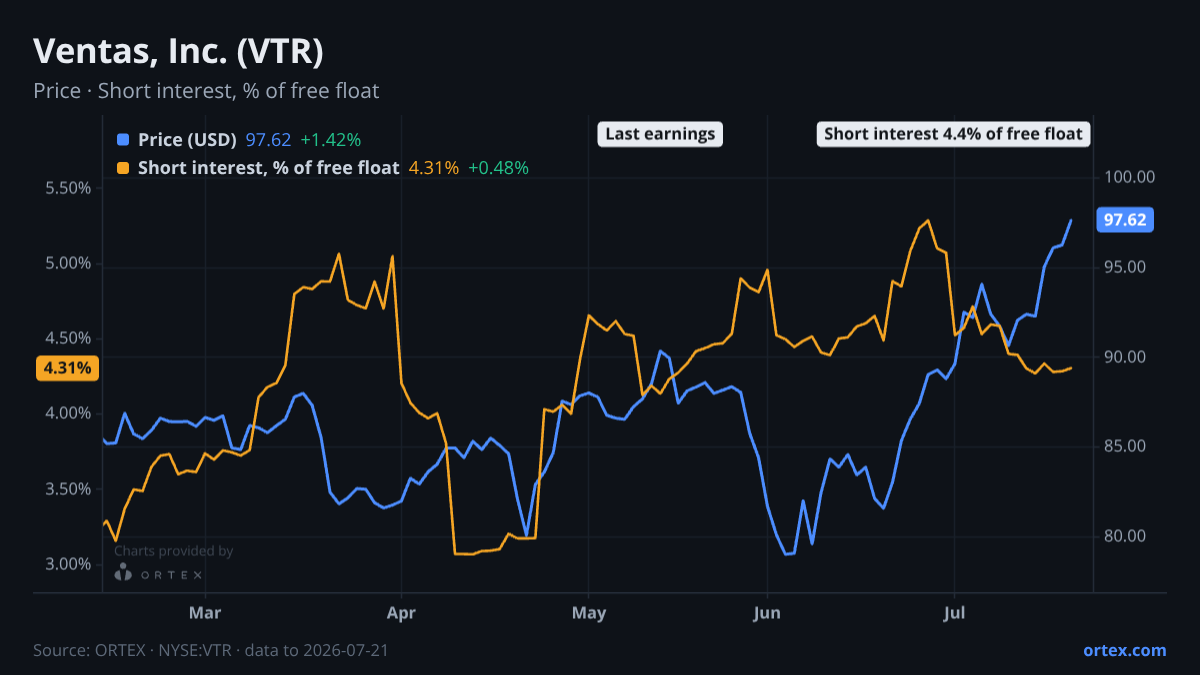
VTR heads into its July 27 earnings print with the stock up nearly 20% over the past month and options traders positioned more bullishly than at almost any point in the past year.
The options market is the loudest signal right now. The put/call ratio has dropped to 0.34, more than two standard deviations below its 20-day average of 0.46 — a reading that places call demand near its most dominant level of the past 12 months. That's not a hedging posture. Options traders are leaning into the rally, not protecting against a reversal ahead of results. The shift is sharp: the PCR ran above 0.50 through most of late June, meaning sentiment flipped decisively as the stock moved from the low $80s to the high $90s.
Short positioning reinforces the bullish lean rather than complicating it. Bears have been retreating. Short interest as a percentage of free float now runs at 4.4%, down roughly 6% over the past month. The sharper data point is that shorts peaked near 25.6 million shares in late June and have since unwound more than 4.7 million shares — a meaningful exit as the stock climbed. The borrow market is loose throughout: availability is running above 1,000% of outstanding short interest, meaning lenders have no shortage of supply, and cost to borrow remains negligible at 0.54%. There is no squeeze mechanic in play here. The short-side retreat looks like a rational cover rather than a forced unwind.
The Street is cautiously warming up. Mizuho raised its target to $104 just this week, keeping an Outperform — the most recent and aggressive published target in the recent cluster. Barclays initiated at Equal-Weight with a $99 target earlier this month, while Evercore ISI lifted its target to $96 at the start of July. The consensus is officially "Hold," shaped partly by neutral-leaning initiations, but the direction of active target revisions has been uniformly upward for months. The stock at $97.62 has already cleared most of the targets set before July. Bulls point to Ventas's diversified portfolio of nearly 1,400 healthcare properties and exposure to senior housing demand tailwinds. Bears flag Medicare and Medicaid reimbursement risk and the stock's sensitivity to rate movements — a valid concern for a REIT trading near 22.5x EV/EBITDA and a price-to-book above 3.5x. The EPS momentum factor score for the 30-day window has jumped to the 91st percentile, a sharp contrast to the weaker 90-day reading, suggesting the recent estimate revisions are fresh rather than entrenched.
The sector-wide bid has been real. Closest peer WELL gained 4.4% on the week while SBRA surged 11.6% — suggesting a broad rotation into healthcare REITs rather than VTR-specific enthusiasm. OHI, AHR, CTRE and NHI all posted gains of 4–7% on the week, broadly in line with VTR's 5.6%. The tide lifted the whole sector.
Earnings history for VTR shows modest single-day moves: the last three prints each produced 1-day gains ranging from 0.3% to 3.2%, with the five-day window similarly contained. None of those set-ups carried the same pre-print momentum the stock now carries heading into July 27. The question that print has to answer is whether senior housing occupancy improvement is translating into margin recovery — or whether wage inflation is still consuming the gains.
Against its peers
Shares moved +5.6% over the past week against a median of +5.9% for its closest peers.
Stocks in this article
See the live data behind this article on ORTEX.
Open VTR on ORTEX →How this article was generated
- Generated
- 22 Jul 2026, 18:53
- Data as of
- 22 Jul 2026, 18:51
- Prompt version
- v1.0
- Data sources
- Short interestCost to borrowUtilizationOptions flowEarningsAnalyst consensusInstitutional positioningORTEX Alpha signalsRecent ORTEX notes
ORTEX Market Intelligence content is generated by AI from a snapshot of ORTEX's proprietary data and reviewed by the ORTEX team. Content is informational only and does not constitute investment advice.