
JCI Bulls in Charge, but Options Tell a Different Story
Produced automatically from ORTEX data and published under the ORTEX News editorial standards set by Peter Hillerberg, Editor, ORTEX News. How we publish
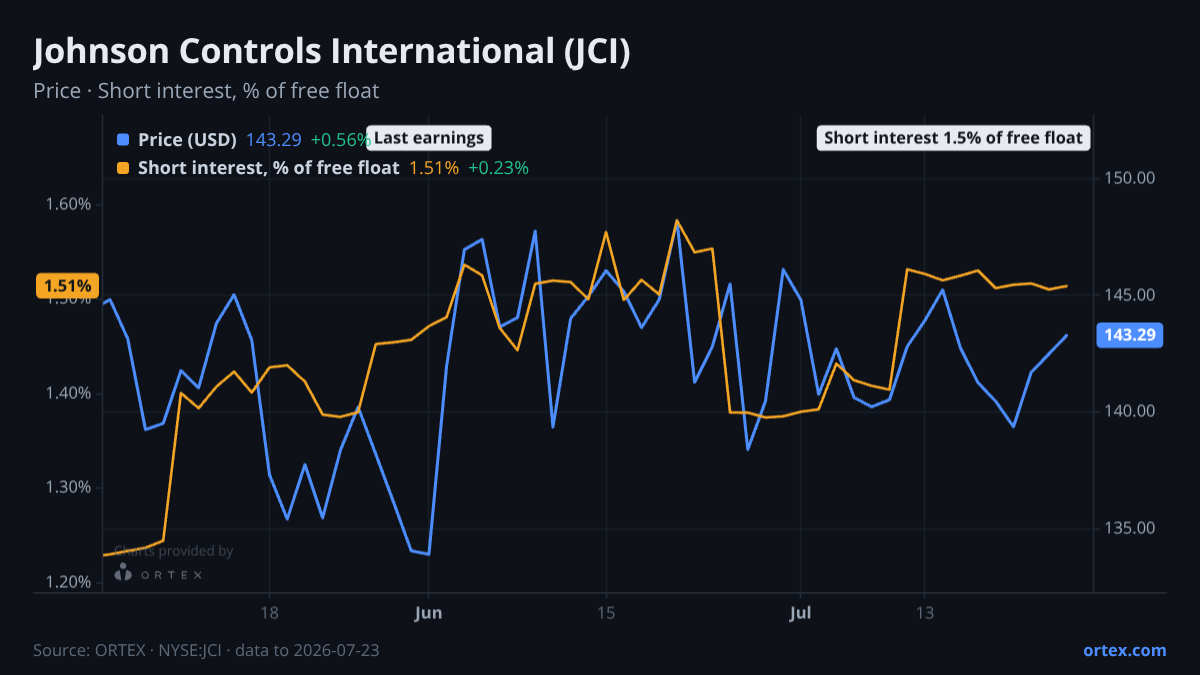
Johnson Controls International heads into its July 29 Q3 print with analysts firmly in the upgrade cycle — yet options traders just flipped sharply more bullish in a single session.
The options shift is striking. The put/call ratio dropped to 0.53 on July 24, more than two standard deviations below its 20-day average of 0.66 — the most call-heavy positioning in over a year. That's a hard pivot from mid-June, when the PCR ran above 1.30 as investors loaded up on protection. One session's data can reflect rolling or hedging activity rather than a clean directional bet, but the magnitude of the move — the largest single-day drop in the ratio over the past 30 days — makes it worth watching heading into the report.
The bull case has real support from the analyst community. Following stronger-than-expected Q2 results in early June, Morgan Stanley raised its target to $175 while maintaining Overweight. UBS lifted to $180, also Buy. Wells Fargo moved to $160, Overweight. The consensus target now sits at roughly $156, about 9% above the current price of $143.37. Bulls point to accelerating datacenter-related HVAC demand, lean manufacturing gains, and a high-margin backlog building under the OpenBlue digital platform. Bears counter with a familiar concern: JCI has excluded restructuring charges for seven consecutive years, earnings quality metrics are below-average (EPS surprise ranks only in the 46th percentile), and free cash flow margins remain under pressure. The Street is largely constructive but not uniformly so — RBC has held its Sector Perform rating and $154 target unchanged through three separate reiterations since May, a quiet signal of skepticism about the pace of improvement.
Insider activity adds a mild cautionary note. The 90-day net selling picture shows divisional presidents collectively offloaded well over $10 million in shares since early May, with Lei Zhang Schlitz selling roughly $12.4 million alone across a single day in early May. These trades carry low significance scores and coincide with the stock trading near current levels, so they read more as routine exercise-and-sell than a directional signal — but no insider buying has appeared to counterbalance them. Meanwhile, short interest is a non-story: SI is just 1.5% of the free float, down slightly over the past month, with borrow availability essentially unlimited and cost to borrow well under 0.5%. There is no short-side pressure to factor into the setup. Closest peer TT gained 2.3% on the week, broadly in line with JCI's 2.1% move, suggesting the sector bid is intact rather than stock-specific.
The July 29 print is therefore less a test of whether JCI's business is recovering — that much seems priced in — and more a question of whether the company can demonstrate the margin and free cash flow trajectory that would close the gap between the bear case on earnings quality and the bull case on structural demand.
Against its peers
Shares moved +2.1% over the past week against a median of +1.1% for its closest peers.
Stocks in this article
See the live data behind this article on ORTEX.
Open JCI on ORTEX →How this article was generated
- Generated
- 26 Jul 2026, 04:20
- Data as of
- 26 Jul 2026, 04:01
- Prompt version
- v1.0
- Data sources
- Short interestCost to borrowUtilizationOptions flowEarningsAnalyst consensusInstitutional positioningORTEX Alpha signalsRecent ORTEX notes
ORTEX Market Intelligence content is generated by AI from a snapshot of ORTEX's proprietary data and reviewed by the ORTEX team. Content is informational only and does not constitute investment advice.