
AMP Options Mood Darkens After Earnings — But Bears Lack Conviction
Produced automatically from ORTEX data and published under the ORTEX News editorial standards set by Peter Hillerberg, Editor, ORTEX News. How we publish
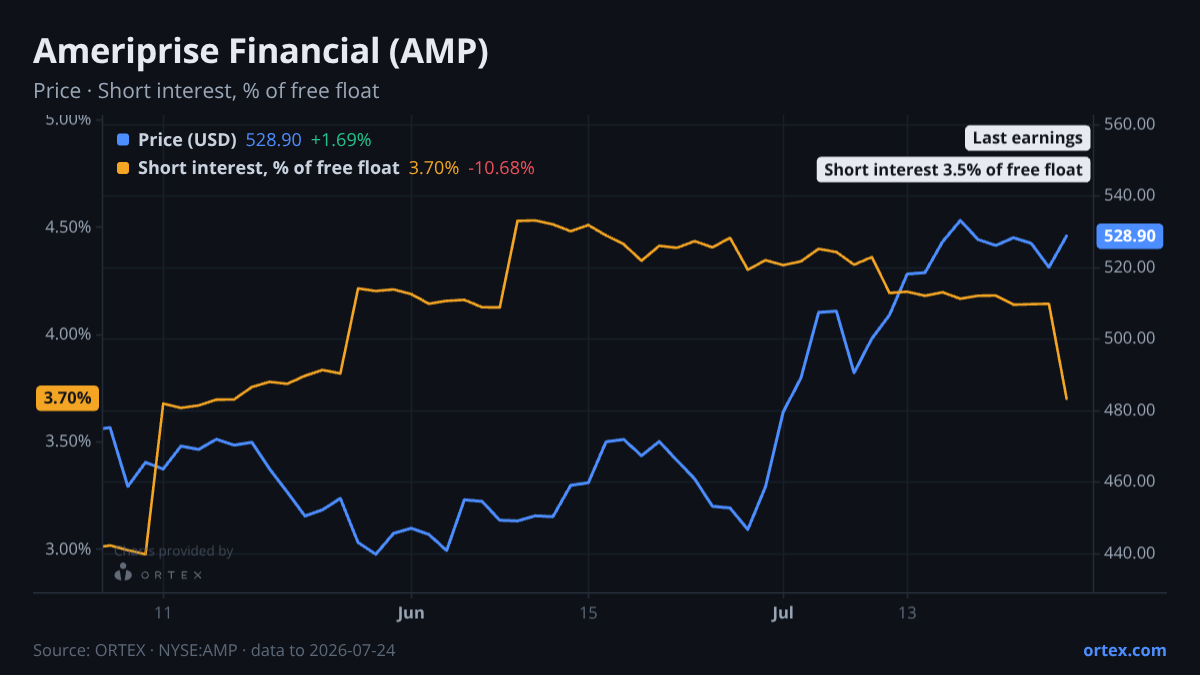
AMP just reported Q2 results. The stock is up 1.7% on the day. Yet options traders have quietly shifted defensive since the print.
The put/call ratio hit 0.42 on July 24. That's 2.1 standard deviations above its 20-day mean of 0.30. For a stock that spent most of June and early July printing PCRs in the 0.26–0.29 range, this is a meaningful rotation. Heading into earnings, the options market was relaxed and bullishly skewed. Post-print, protective puts have picked up sharply.
Analysts Still Lifting Targets
The analyst community read the quarter positively. Keefe, Bruyette & Woods raised its target to $545 from $515 on July 24 — the day of the PCR spike — while maintaining a Market Perform rating. That follows Evercore ISI raising to $625 and Piper Sandler raising to $518, both on July 13. The consensus target now sits at $572. The stock at $528.90 implies roughly 8% upside to that mean.
Morgan Stanley remains the outlier. The firm holds an Underweight rating, raising its target only to $489. That ceiling sits below the current price — the most bearish framing on the street.
Short Sellers Retreating, Not Pressing
Short interest fell 12.7% in a single week to 3.5% of the free float. The month-long decline is now 16%. This is continued covering, not new positioning. Bears are not pressing the name after earnings.
The borrow market is extraordinarily loose. Availability stands at 6,053% — roughly 60 shares available to lend for every one currently borrowed. That means the post-earnings PCR shift is coming from options buyers, not from a tightening short book.
Cost to borrow rose 64% on the week to 0.52%. That sounds dramatic. In absolute terms it remains firmly cheap — this is still an easy stock to borrow.
The Disconnect Worth Watching
The unusual signal here is the gap between the options market and everything else. Short sellers are covering. Analysts are lifting targets. The stock gained 13% over the past month. Yet put buying has picked up to a two-week high at 2.1 standard deviations above normal.
One explanation: options traders are hedging gains post-earnings rather than expressing a directional bear view. The Q2 print produced only a 0.4% move — tame given the 13% run-up. Some of that put buying may simply be profits being protected.
The bear case flagged by analysts — declining brokerage cash balances, weakening asset management flows — has not gone away. Morgan Stanley's sub-$489 target suggests at least one major house thinks the earnings strength is already priced.
What to watch: Whether the PCR normalises back toward 0.30 in the coming sessions. A sustained elevated reading would suggest the defensive shift is genuine rather than post-earnings hedging noise.
Against its own history
This week's change in short interest is 2.1 standard deviations below the company's typical weekly move over the past year.
Against its peers
Shares moved +0.2% over the past week against a median of +0.8% for its closest peers.
Stocks in this article
See the live data behind this article on ORTEX.
Open AMP on ORTEX →How this article was generated
- Generated
- 27 Jul 2026, 11:12
- Data as of
- 27 Jul 2026, 11:06
- Prompt version
- v1.0
- Data sources
- Short interestCost to borrowUtilizationOptions flowEarningsAnalyst consensusInstitutional positioningORTEX Alpha signalsRecent ORTEX notesPrevious Mi Articles
ORTEX Market Intelligence content is generated by AI from a snapshot of ORTEX's proprietary data and reviewed by the ORTEX team. Content is informational only and does not constitute investment advice.