
Disney's August 5 Print Tests Whether the Gap Between Price and Target Can Close
Produced automatically from ORTEX data and published under the ORTEX News editorial standards set by Peter Hillerberg, Editor, ORTEX News. How we publish
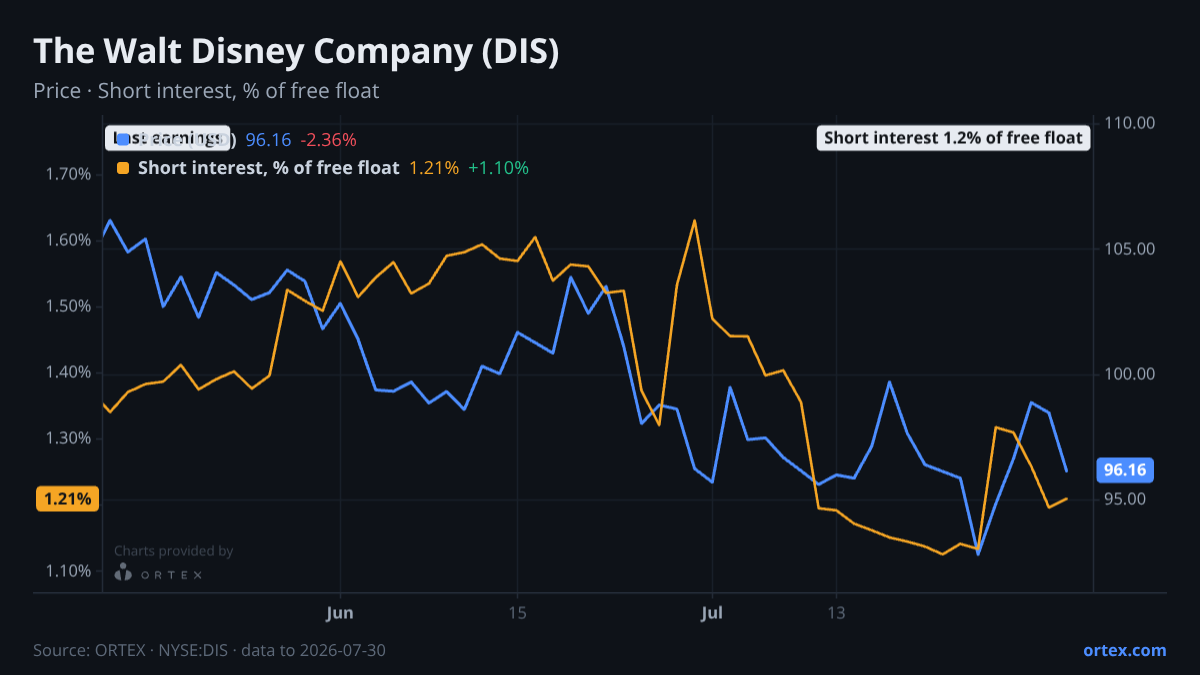
DIS heads into Wednesday's earnings report with the Street broadly bullish but increasingly impatient — a combination that puts unusual pressure on execution rather than narrative.
The positioning data reinforces that calm. Short interest is only 1.2% of the free float — too small to be a meaningful story — and has actually fallen roughly 20% over the past month after peaking near 28 million shares in late June. Borrow conditions are effectively frictionless, with availability running far above any historically tight level and cost to borrow a negligible 0.38%. Options traders are equally unbothered: the put/call ratio at 0.67 sits fractionally below its 20-day average, essentially flat, and well below the 0.97 high touched earlier in the year. None of this looks like a market bracing for a shock.
The real tension lives in the gap between price and analyst conviction. Targets have been trimmed steadily across July — Citigroup cut to $135 this week, UBS to $133, Wells Fargo from $146 to $125, and Barclays made the sharpest move of the month, dropping from $135 to $110. All maintained positive ratings. The consensus mean now sits near $126.50, implying roughly 31% upside to the current $96.19 close. Bulls point to the streaming transition finally delivering meaningful direct-to-consumer profitability, a durable intellectual property moat, and compelling valuation at under 14x earnings. Bears counter that linear TV is in structural decline, park cost dynamics remain uncertain, and forward earnings momentum is still negative — the 12-month forward EPS growth estimate ranks in just the 28th percentile. The analyst recommendation score, by contrast, ranks in the 99th percentile, meaning the Street's directional conviction is near its highest level even as targets drift lower.
Disney's most recent earnings reaction, in May, produced an 8% single-day gain and held most of those gains through the following week. That reaction narrowed the year-to-date gap meaningfully but didn't close it — the stock remains down roughly 15% for 2026. Wednesday's print is therefore less a test of whether Disney's turnaround is real and more a test of whether the company can deliver results credible enough to start collapsing the wide gap between where it trades and where analysts think it belongs.
Against its own history
This week's change in short interest is 1.6 standard deviations below the company's typical weekly move over the past year.
Against its peers
Shares moved +1.4% over the past week against a median of +2.6% for its closest peers.
Stocks in this article
See the live data behind this article on ORTEX.
Open DIS on ORTEX →How this article was generated
- Generated
- 2 Aug 2026, 04:09
- Data as of
- 2 Aug 2026, 04:01
- Prompt version
- v1.0
- Data sources
- Short interestCost to borrowUtilizationOptions flowEarningsAnalyst consensusInstitutional positioningORTEX Alpha signalsRecent ORTEX notesPrevious Mi Articles
ORTEX Market Intelligence content is generated by AI from a snapshot of ORTEX's proprietary data and reviewed by the ORTEX team. Content is informational only and does not constitute investment advice.