
CIFR Bears Press as Retail Attention Spikes
Produced automatically from ORTEX data and published under the ORTEX News editorial standards set by Peter Hillerberg, Editor, ORTEX News. How we publish
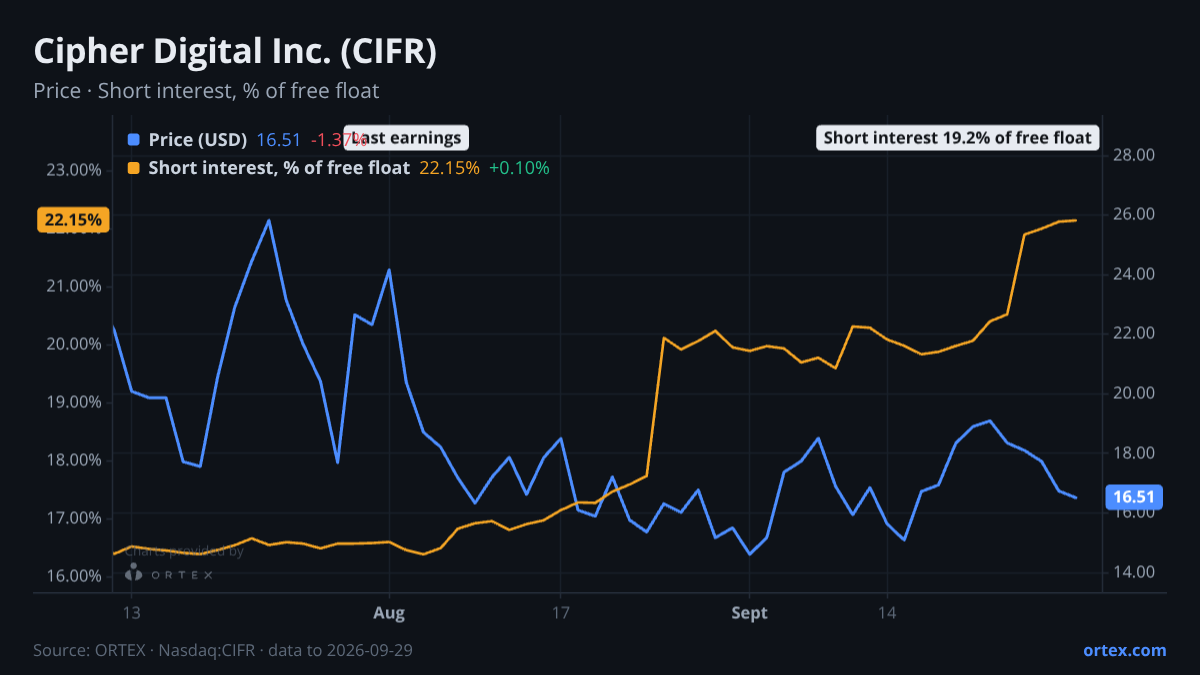
Short sellers who were adding into last week's rally are now getting rewarded. CIFR has dropped 13.5% over the past week, and the short position has kept climbing regardless.
Shorts Build Through the Sell-Off
Short interest has reached 19.2% of the free float, up 10.4% over the past week. A week ago, when the prior note was written, it stood at 17.7%. Bears did not cover into the rally and are not covering into the retreat either. The position is simply growing.
The borrow market tells a more nuanced story. Availability has tightened to 120.5%, down from around 150% a week ago, a 19.5% drop week-on-week. There is still more than one share available for every one already borrowed, so the lending pool is not yet constrained. But the direction of travel is clear. Cost to borrow remains low at 0.53%, so the incremental cost of holding a short position is not a deterrent.
The ORTEX short score sits at 66.1, up steadily from 62.9 ten days ago. It ranks in the seventh percentile for short score intensity within its sector.
Options and Retail Pull in Different Directions
The put-call ratio hit 0.42 on September 29, the highest reading in nearly four standard deviations above its 20-day mean, before pulling back to 0.30 on the latest close. That one-day spike captured a rush for protective puts as the stock fell 5.6% intraday. The 52-week PCR range runs 0.27 to 0.56, so a reading of 0.42 was elevated but not at the outer extreme.
On the other side, retail attention is running hot. ORTEX Alt Data shows Wikipedia views and ORTEX page traffic running 2.67 standard deviations above their own 90-day average as of September 27. This is an attention reading, not a revenue indicator, but elevated retail curiosity into a falling stock with rising short interest is worth flagging as a source of potential volatility.
Analysts Diverge, Earnings Loom
A wave of analyst initiations landed this month. UBS started with a Buy and a $23 target. Wells Fargo initiated at Overweight with a $25 target. Rothschild came in at Neutral with an $18 target. Morgan Stanley, already at Overweight, raised its target to $54 from $43.50. The consensus sits at Buy across 15 analysts, with a mean target of $30.93 against a current price of $16.51.
V3 Holding remains the largest holder on the register with a Schedule 13D filing, last disclosing a 14.6% stake as of June 2026. Stakes in 13D filings are as last disclosed; positions can move without a further filing unless the threshold is crossed again.
Earnings are due October 27. The last print on August 4 sent the stock down 22.6% on the day and 28.8% over the following five sessions.
Data Summary
- SI % of FF: 19.2%, up 10.4% in one week and 25.4% in one month
- Availability: 120.5%, down 19.5% week-on-week (tightening)
- Cost to borrow: 0.53% (low)
- Short score: 66.1, up from 62.9 over ten days
- PCR: 0.30 (Sept 30), spiked to 0.42 on Sept 29
- Retail attention z-score: 2.67 vs 90-day average (as of Sept 27)
- Price: $16.51, down 13.5% on the week, up 8.8% on the month
- Next earnings: October 27
Against its own history
Short interest is at its highest level in at least a year.
Against its peers
Shares moved -13.5% over the past week against a median of -13.1% for its closest peers.
Stocks in this article
See the live data behind this article on ORTEX.
Open CIFR on ORTEX →How this article was generated
- Generated
- 30 Sept 2026, 19:04
- Data as of
- 30 Sept 2026, 19:03
- Prompt version
- v1.0
- Data sources
- Short interestCost to borrowUtilizationOptions flowEarningsAnalyst consensusInstitutional positioningORTEX Alpha signalsRecent ORTEX notesAlt DataPrevious Mi Articles
ORTEX Market Intelligence content is generated by AI from a snapshot of ORTEX's proprietary data and reviewed by the ORTEX team. Content is informational only and does not constitute investment advice.