
KO Falls 4% Into Earnings — Bears Trim, Bulls Raise Targets
Produced automatically from ORTEX data and published under the ORTEX News editorial standards set by Peter Hillerberg, Editor, ORTEX News. How we publish
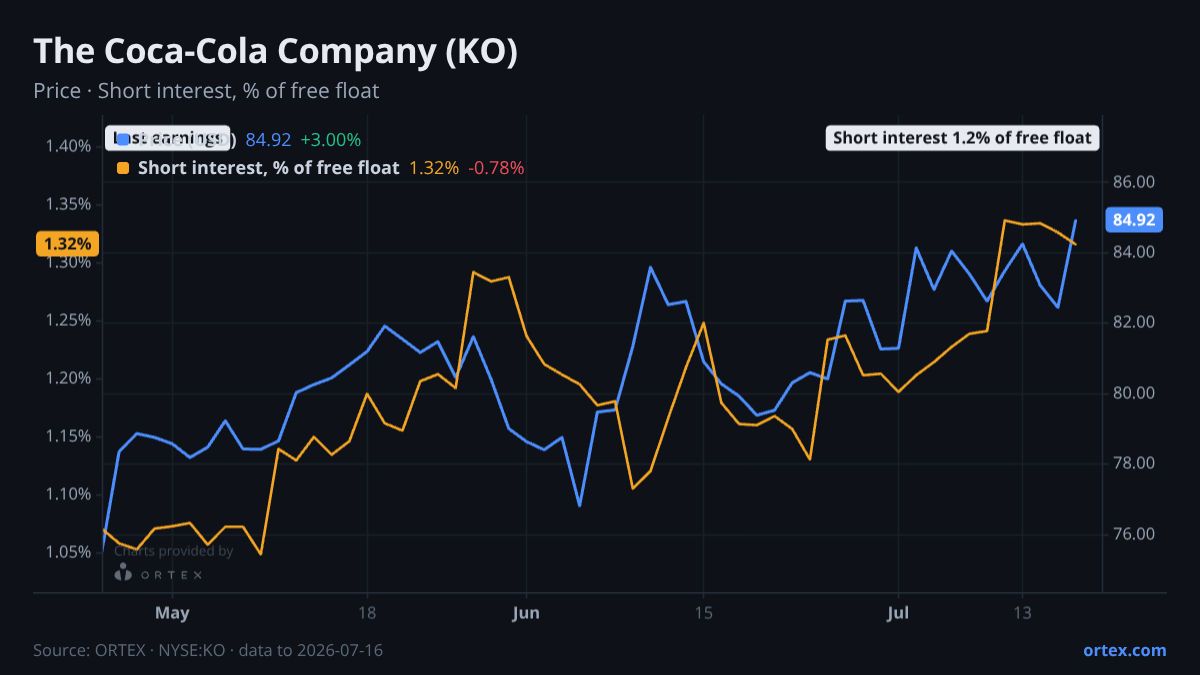
KO heads into Tuesday's Q2 print having shed nearly 4% on Thursday alone, handing back most of its recent gains three days before the report.
The price move is the sharpest development since the last preview. KO closed at $81.56 on July 17 — down 3.96% on the day and 2.3% on the week — after trading as high as $84.14 earlier this month. That single-session drop is notable context: it arrived just as short sellers appear to be standing down. Short interest pulled back modestly to 1.19% of free float on July 16, down from the 1.34% peak logged on July 10 that the previous article flagged as the highest in the 90-day window. Bears built aggressively through early July; they appear to have trimmed slightly into the decline. The borrow market remains structurally loose — availability is effectively unlimited relative to shares borrowed — and cost to borrow is a negligible 0.44%, easing from earlier-month highs. There is no squeeze dynamic here. Options positioning is almost exactly in line with recent norms: the put/call ratio is 0.80, barely a quarter of a standard deviation above its 20-day average of 0.79. Neither side is making an aggressive directional bet through derivatives.
The analyst community, by contrast, has been unambiguously constructive in the run-up. UBS raised its target to $98 on July 16 — the day after Citi lifted to $97 on July 14, and five days after B of A Securities moved to $95. Three bellwether firms raised targets within a week of the print, and the consensus mean now sits at $87.35, implying roughly 7% upside from Thursday's close. The bull case centres on pricing power, international reach, and a lower-tax-rate tailwind that has been nudging EPS estimates higher. Bears point to Latin American organic growth running at only 4%, unfavourable volume mix in key markets, and a valuation that still prices in a lot of good news — the forward P/E is near 25x and EV/EBITDA sits at 22.4x. Bernstein's market-perform initiation at $84 in mid-June captures the sceptic's view neatly: it's a quality business, but at a price that leaves limited margin of safety.
The divergence between peer performance and KO on Thursday sharpens the setup. PEP fell 3.0% on the day, KDP gained 3.6%, and European beverage names like CCEP and CCH were broadly flat to slightly positive — suggesting Thursday's KO decline was at least partly stock-specific rather than purely sector-driven. The most recent comparable earnings print, on April 29, produced a modest 0.5% one-day gain and a 1.1% five-day gain — a restrained reaction for a stock that had been moving more sharply in prior quarters. CEO James Quincey and EVP Jennifer Mann both sold shares in early June at prices in the $79–$83 range, adding up to roughly $50 million in combined proceeds — a cluster worth noting, though the trade significance scores are low and such sales are common for executives at this compensation level.
Tuesday's print will test whether the 4% Thursday drop was rational pricing-in of risk, or an overreaction that the numbers themselves will correct.
Against its peers
Shares moved -2.3% over the past week against a median of +2.1% for its closest peers.
Stocks in this article
See the live data behind this article on ORTEX.
Open KO on ORTEX →How this article was generated
- Generated
- 18 Jul 2026, 04:02
- Data as of
- 18 Jul 2026, 04:00
- Prompt version
- v1.0
- Data sources
- Short interestCost to borrowUtilizationOptions flowEarningsAnalyst consensusInstitutional positioningORTEX Alpha signalsRecent ORTEX notesPrevious Mi Articles
ORTEX Market Intelligence content is generated by AI from a snapshot of ORTEX's proprietary data and reviewed by the ORTEX team. Content is informational only and does not constitute investment advice.