
P&G Slips Back Below $150 as Earnings Loom Three Days Out
Produced automatically from ORTEX data and published under the ORTEX News editorial standards set by Peter Hillerberg, Editor, ORTEX News. How we publish
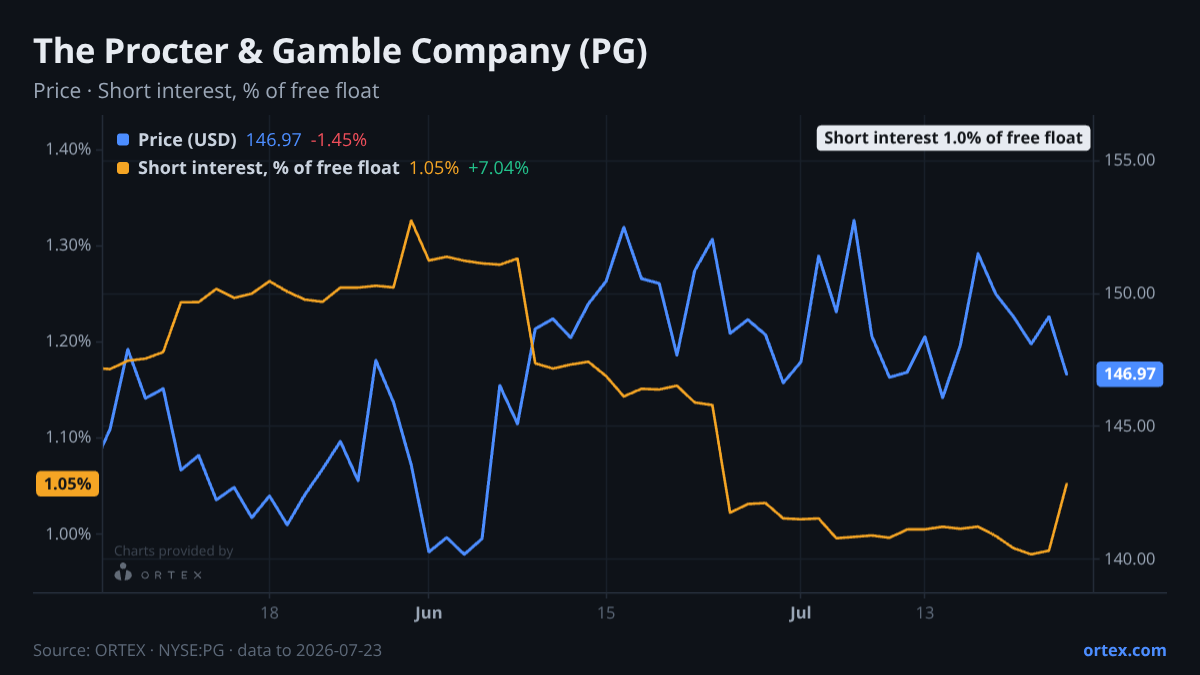
Procter & Gamble heads into its July 28 quarterly report having given back the $150 recovery celebrated just days ago, with options positioning now the calmest it has been all cycle.
The stock closed at $147.41 on July 24, down 1.7% on the week and 2.3% over the past month. That reversal unwound the gains flagged in last week's report, when P&G briefly reclaimed $150 on the back of call-heavy options flow. That call skew has since faded. The put/call ratio sits at 0.617 — roughly 1.2 standard deviations below its 20-day mean of 0.687. Ordinarily a bullish read, the context matters: the PCR swung from its 52-week high of 1.106 in mid-June to its 52-week low of 0.535 weeks later, and has now settled into a calmer middle ground rather than a conviction signal in either direction. With the borrow market entirely unthreatening — availability is at the maximum reading, cost to borrow is just 0.33%, and short interest is a structurally irrelevant 1.05% of float — there is no pressure from the lending side of the market.
Analyst direction into the print has been a mild drift lower. Barclays raised its target to $152 from $146 this week while holding an Equal-Weight rating — a modest tweak that still implies only 3% upside from current levels. JPMorgan trimmed its target to $162 from $164 earlier in July, keeping its Overweight. Bank of America also cut to $166 from $170 while staying at Buy. The pattern is consistent: bellwether firms still lean positive but are paring back targets ahead of the report, with the consensus mean now at $163.61, representing roughly 11% upside to the current price. Bulls point to the 5% sales growth delivered in early 2026, improving market share, and positive momentum building in Europe and Latin America. Bears focus on the 30% collapse in SK-II brand sales in Greater China and the 15% drop in U.S. category growth rates in December — data points that point to structural weakness in two of the company's most important regions. Note that the Benzinga bull/bear case data carries a late-2025 timestamp, so some of those specific figures may be dated relative to the upcoming print.
The peer group has moved in the same direction this week, but P&G has held up better than several close comparisons. Clorox fell nearly 5% on the week and Colgate-Palmolive dropped 4.2%, against P&G's 1.7% decline. That relative resilience is consistent with P&G's historically lower volatility profile — its last two earnings prints produced gains of 1.8% and 2.8% in the session following results, with five-day moves in the same direction, suggesting the stock has rewarded near-term holders on recent reports.
The July 28 print will test whether the combination of geographic headwinds in China and softening U.S. consumer trends is already priced into a stock trading at 20x earnings, or whether P&G's volume recovery and share-gain narrative can justify a rerating back toward the $163 analyst consensus.
Against its peers
Shares moved -1.7% over the past week against a median of -3.2% for its closest peers.
Stocks in this article
See the live data behind this article on ORTEX.
Open PG on ORTEX →How this article was generated
- Generated
- 25 Jul 2026, 04:10
- Data as of
- 25 Jul 2026, 04:00
- Prompt version
- v1.0
- Data sources
- Short interestCost to borrowUtilizationOptions flowEarningsAnalyst consensusInstitutional positioningORTEX Alpha signalsRecent ORTEX notesPrevious Mi Articles
ORTEX Market Intelligence content is generated by AI from a snapshot of ORTEX's proprietary data and reviewed by the ORTEX team. Content is informational only and does not constitute investment advice.