
EQNR: Short Sellers Exit as Options Hedging Spikes
Produced automatically from ORTEX data and published under the ORTEX News editorial standards set by Peter Hillerberg, Editor, ORTEX News. How we publish
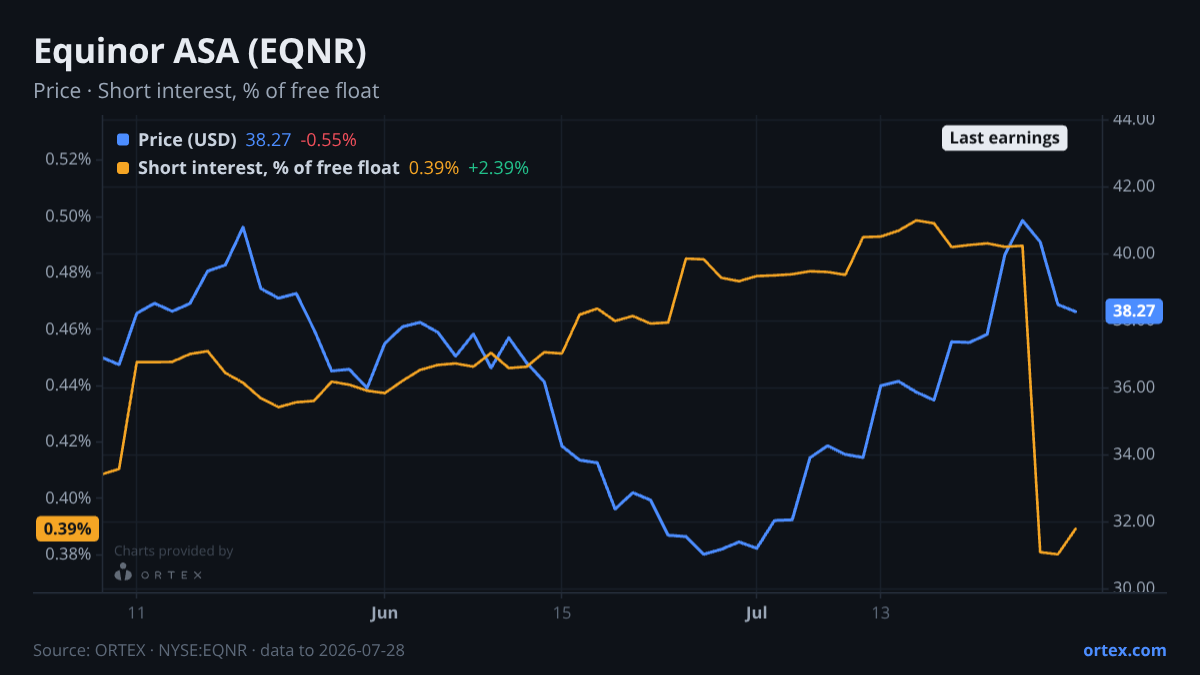
Three distinct signals aligned on EQNR over the past 48 hours. Short interest fell sharply. Borrow costs rose. The put/call ratio hit a 52-week extreme. Together, they paint an unusual picture for the Norwegian energy major.
Shorts Exit at Record Pace
Short interest dropped 20.6% over the past week to 19.4M shares. That is the steepest weekly decline since late June. Just one month ago, shorts held roughly 24.4M shares.
The single-session drop on July 23 was the sharpest on record. Shares fell from 24.4M to 18.9M overnight — a 22% reduction in one day.
Despite the scale of the exit, the borrow market remains open. Availability sits at 95.9%, meaning roughly equal shares are available to borrow versus those already borrowed. There is no supply squeeze driving this — shorts are choosing to close positions.
Borrow Costs Rise Against the Tide
The paradox: as shorts leave, borrow costs are climbing. Cost to borrow rose to 1.64% on July 28 — up 52% week-on-week.
That is still a low absolute level. One month ago CTB stood at 1.86%, so the current reading is not a new high. But the direction is notable. Fewer shorts, yet tighter pricing, suggests the remaining short book is concentrating in harder-to-borrow pockets.
Options Signal a Shift in Sentiment
The put/call ratio hit 0.77 on July 28 — the highest in 52 weeks, and 2.43 standard deviations above the 20-day mean of 0.59.
That sounds bearish. But in context, the 52-week range runs from 0.49 to 1.62. At 0.77, the ratio is elevated relative to recent norms but far from extreme on an absolute basis.
The jump from a 20-day mean of 0.59 is meaningful. It suggests options participants are adding protection — or positioning for a move — at the same moment short sellers are covering.
Valuation and Earnings Context
EQNR trades at a PE of 8.98 and EV/EBITDA of 2.32. The dividend score ranks at the 86th percentile. The stock is up 23% over the past month.
Q2 2026 earnings landed on July 22, with a 9% single-day move. Next earnings are not due until October 28.
TD Cowen lowered its price target from $42 to $37 on June 29, maintaining a Hold. The analyst consensus mean target stands at $34.74 — below the current price of $38.27.
- Short interest: 19.4M shares (Jul 28), down 20.6% in one week
- Cost to borrow: 1.64%, up 52% week-on-week
- Availability: 95.9% — lending market remains open
- Put/call ratio: 0.77, z-score +2.43 vs 20-day mean
- Price: $38.27, up 23% over one month
- Next earnings: October 28, 2026
Against its own history
This week's change in short interest is 3.0 standard deviations below the company's typical weekly move over the past year.
Stocks in this article
See the live data behind this article on ORTEX.
Open EQNR on ORTEX →How this article was generated
- Generated
- 29 Jul 2026, 11:15
- Data as of
- 29 Jul 2026, 11:07
- Prompt version
- v1.0
- Data sources
- Short interestCost to borrowUtilizationOptions flowEarningsAnalyst consensusInstitutional positioningORTEX Alpha signalsRecent ORTEX notes
ORTEX Market Intelligence content is generated by AI from a snapshot of ORTEX's proprietary data and reviewed by the ORTEX team. Content is informational only and does not constitute investment advice.