
UBS Upgrade Meets Rising Shorts as ETN Closes the Gap
Produced automatically from ORTEX data and published under the ORTEX News editorial standards set by Peter Hillerberg, Editor, ORTEX News. How we publish
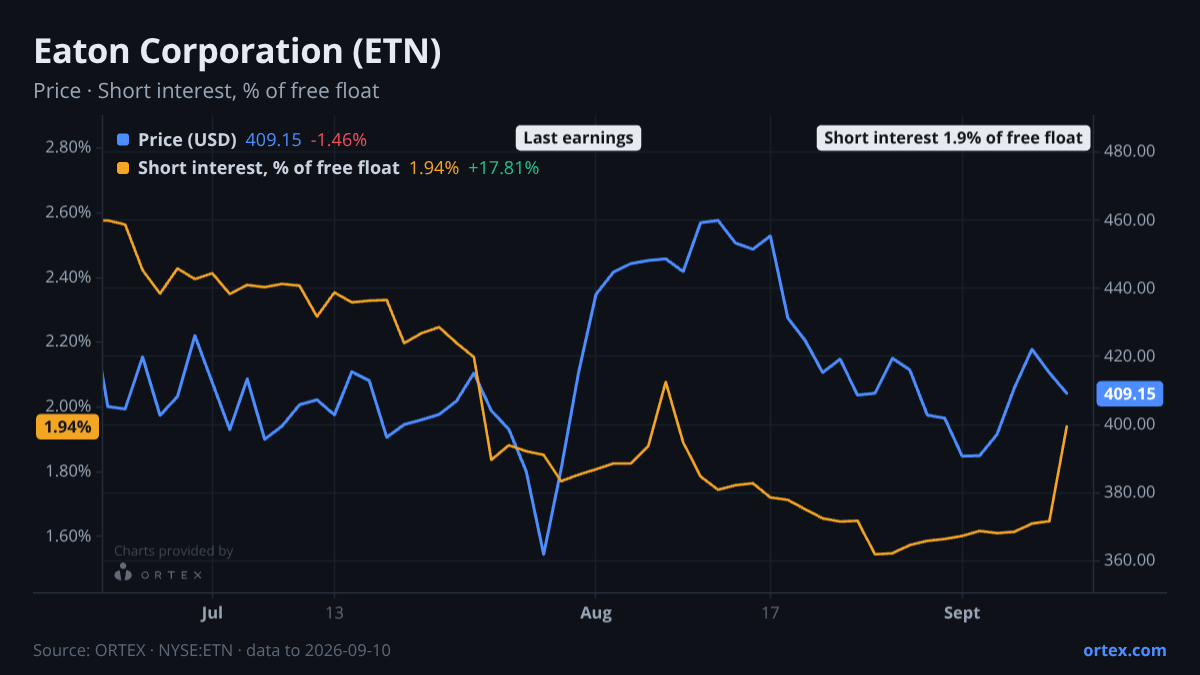
Three distinct signals have converged on Eaton Corporation this week. A major analyst upgrade, a jump in short positioning, and a cost-to-borrow move are all pointing in different directions — and the tension is worth examining.
UBS Breaks Ranks
The headline event is UBS. Analyst Amit Mehrotra upgraded ETN from Neutral to Buy on September 8, lifting his price target from $450 to $515. At Wednesday's close of $409.15, that target implies roughly 26% upside.
The upgrade doesn't stand alone. Morgan Stanley's Chris Snyder raised his target to $520 (Overweight) on August 28. Evercore ISI upgraded to Outperform in early August, citing post-earnings momentum. Citigroup, RBC Capital, and BMO Capital all raised targets on the same day. The analyst community has been moving in one direction for weeks.
The previous ORTEX note from September 2 flagged this same gap — stock retreating, analysts upgrading. That gap has now widened. ETN is up 3% on the week but still down 8% over the past month, trading well below the analyst consensus target near $456.
Shorts Push Back
Short interest jumped 18% in a single day on September 10, reaching 1.9% of free float — the highest level since early August. Over the past week, shorts are up 20%.
That said, context matters. At 1.9% of free float, short interest remains low in absolute terms. The borrow market is exceptionally loose: availability stands at 1,432% — roughly 14 shares available for every one already borrowed. There is no sign of a crowded short or a squeeze setup.
The cost to borrow ticked up earlier this week before easing to 0.45%. It remains historically low.
The most plausible read: some traders are using the UBS upgrade rally as an opportunity to initiate or add to short positions, fading the price-to-target gap on valuation grounds. The bear case — capacity ramp costs, price/cost headwinds, and uncertainty around data-center market uptake — gives those shorts a narrative to lean on.
What's Converging
The put/call ratio sits at 1.04, close to its 20-day average of 1.06 and well off its 52-week high of 1.52. Options positioning is neutral, not alarmed.
Earnings are next due October 26. The July 31 print moved the stock 13% in one session. That event reset the analyst targets upward and left a price gap the stock has spent August and September trying to recover.
What to watch: Whether short interest continues climbing toward or beyond its August peak (~7.9 million shares on August 7) — if it does while analyst targets hold, the analyst-vs.-bear standoff sharpens heading into October earnings.
Key data (as of Sep 10–11, 2026)
- Price: $409.15 | –8% over 1 month
- Short interest: 1.9% of free float | +18% in 1 day, +20% in 1 week
- Borrow availability: 1,432% (very loose)
- Cost to borrow: 0.45%
- UBS target: $515 | Mean analyst target: ~$456
- Next earnings: October 26, 2026
Against its own history
This week's change in short interest is 2.8 standard deviations above the company's typical weekly move over the past year.
Against its peers
Shares moved +3.0% over the past week against a median of +0.5% for its closest peers.
Stocks in this article
See the live data behind this article on ORTEX.
Open ETN on ORTEX →How this article was generated
- Generated
- 11 Sept 2026, 11:20
- Data as of
- 11 Sept 2026, 11:17
- Prompt version
- v1.0
- Data sources
- Short interestCost to borrowUtilizationOptions flowEarningsInstitutional positioningORTEX Alpha signalsRecent ORTEX notesPrevious Mi Articles
ORTEX Market Intelligence content is generated by AI from a snapshot of ORTEX's proprietary data and reviewed by the ORTEX team. Content is informational only and does not constitute investment advice.