
SEI Investments Heads Into Q3 Print With Analyst Confidence Rising
Produced automatically from ORTEX data and published under the ORTEX News editorial standards set by Peter Hillerberg, Editor, ORTEX News. How we publish
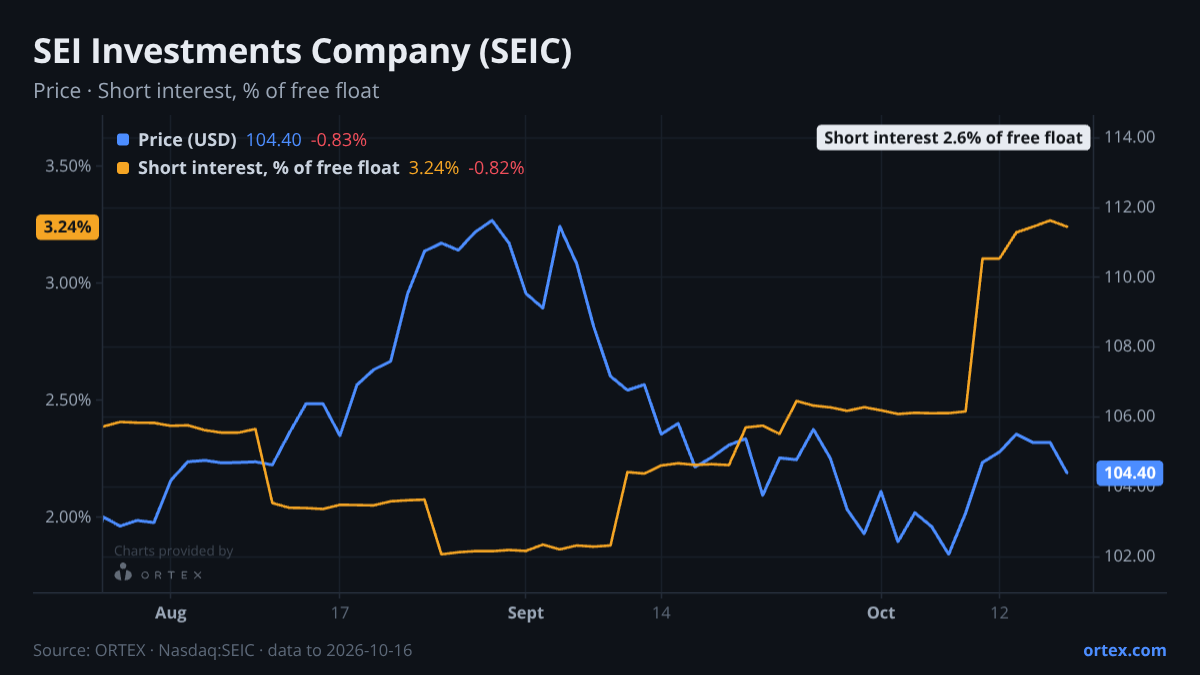
SEIC reports third-quarter results on October 21 against a backdrop that looks more constructive than cautious, with the Street lifting targets and short positioning modest despite a recent pickup.
The most striking pre-earnings signal is the direction of analyst opinion. Piper Sandler raised its target to $127 yesterday, maintaining an Overweight rating. Wells Fargo initiated coverage at Overweight with a $129 target earlier this month. The mean target across the consensus sits at $118.38, roughly 13% above the current price of $104.79. That gap suggests the Street sees room to run even after a flat month for the shares. The recent record at Piper Sandler came just 24 hours before the print, a show of conviction that sharpens the setup heading into the release.
The bull and bear cases converge on the same variable: margins. Bulls point to core operating margins hitting 32% in Q2 2026, the highest since 2009, alongside record sales events in Q1 and strong EPS outperformance in consecutive quarters. Bears acknowledge the profitability gains but argue the improvement has been uneven across segments, with private banks, investment advisors, and institutional investors all showing deterioration in Q1. Their concern is that margin expansion may have already peaked at 32%-plus, leaving a $1.9 trillion platform with little room for execution shortfalls. The print will settle whether the Q2 margin peak was a ceiling or a new floor.
Short positioning offers little drama heading into results. Short interest has risen 32% over the past week and nearly 48% over the past month, reaching roughly 2.6% of the free float. That is a meaningful move in relative terms, but the absolute level remains low. Borrow availability is extraordinarily loose at 2,308%, meaning the lending pool holds roughly 23 shares available for every one already borrowed. Cost to borrow is just 0.48%. This is not a stock where bears are paying a premium to press a thesis; the positioning looks more like a hedge than a conviction short.
Insider activity over the past 90 days adds a note of caution. Net selling came to roughly $23.9 million across the period, with founder Alfred West disposing of shares in late September and CEO Ryan Hicke exercising options and selling the underlying shares in early September. None of the trades were conducted under a 10b5-1 plan, though the option exercise and simultaneous sale is a routine compensation transaction rather than a directional bet. The heavier signal is West's open-market sales, though at 13.4% he remains far and away the largest single holder.
The Q3 print is therefore less a test of whether SEI is growing and more a test of whether the margin story can sustain breadth across all segments rather than concentrate in its strongest units.
Against its own history
Short interest is at its highest level in at least a year.
Against its peers
Shares moved -0.2% over the past week against a median of +0.2% for its closest peers.
Stocks in this article
See the live data behind this article on ORTEX.
Open SEIC on ORTEX →How this article was generated
- Generated
- 20 Oct 2026, 04:17
- Data as of
- 20 Oct 2026, 04:01
- Prompt version
- v1.0
- Data sources
- Short interestCost to borrowUtilizationOptions flowEarningsAnalyst consensusInstitutional positioningORTEX Alpha signalsRecent ORTEX notesAlt Data
ORTEX Market Intelligence content is generated by AI from a snapshot of ORTEX's proprietary data and reviewed by the ORTEX team. Content is informational only and does not constitute investment advice.