
Edison International Enters Earnings Week With Options Traders Turning Bullish
Produced automatically from ORTEX data and published under the ORTEX News editorial standards set by Peter Hillerberg, Editor, ORTEX News. How we publish
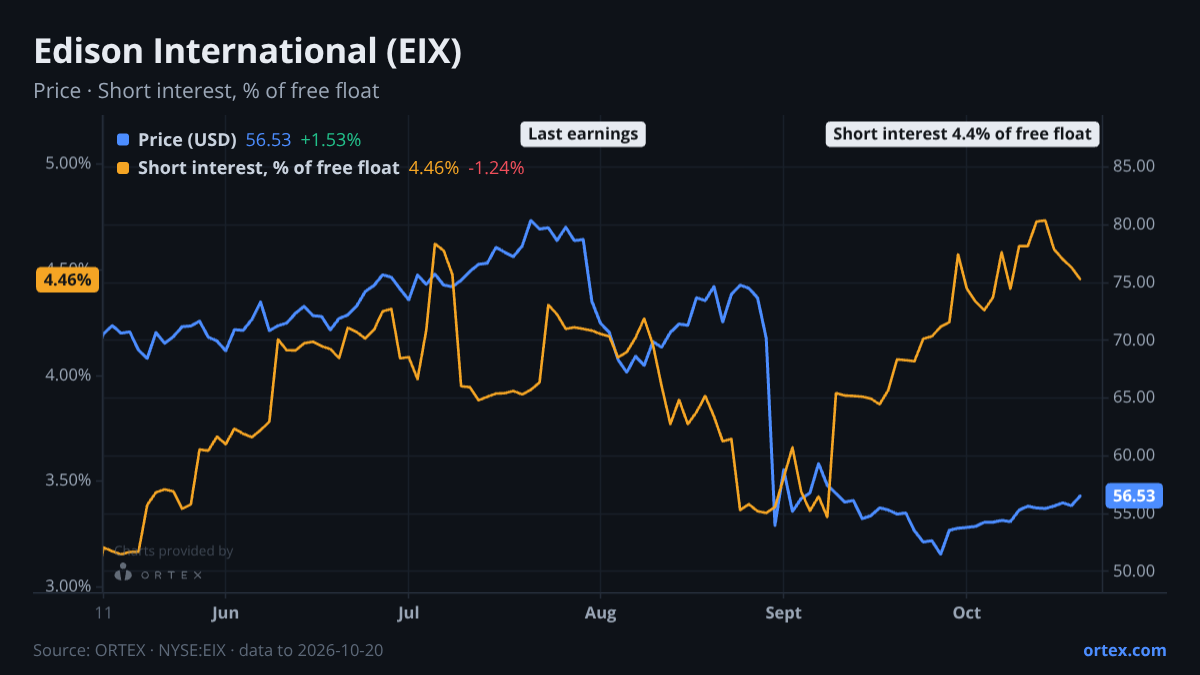
Edison International has spent much of 2026 on the defensive, weighed down by wildfire liability concerns in Southern California, but heading into its October 29 earnings release the signals are pointing in an unusually mixed direction: short positions are easing, options traders are the most bullish they have been in a year, yet the analyst community remains firmly cautious.
Against its closest peers, EIX looks lightly shorted. PCG, the most tightly correlated utility in the group at 89%, carries materially heavier short positioning. EIX's short interest stands at 4.4% of free float, roughly 17.1 million shares, and that number has been falling. Over the past week it dropped 3.4%, and it is down meaningfully from its mid-October peak near 18.2 million shares. The borrow market has followed the same direction: cost to borrow has fallen 28% over the past week to just 0.36%, one of its cheapest levels in six weeks. Availability is extremely loose at 3,304%, meaning shares are plentiful relative to existing short demand, confirming there is no squeeze dynamic in play. The ORTEX short score has drifted down to 37.9 over the same period, from a recent high near 39.6 on October 7, consistent with a market that is slowly reducing its short exposure.
The more striking development is in options. Call positioning has surged relative to puts, pushing the put/call ratio down to 0.69, more than 2.5 standard deviations below its 20-day average of 0.85. That is the most call-heavy reading EIX has seen in at least a year, with the 52-week low on the PCR reaching 0.66 just below current levels. Three weeks ago the PCR was running above 1.0, a range more consistent with defensive hedging. The rotation into calls is the single sharpest shift in the dataset this week, and it contrasts directly with the analyst tone described below.
The Street has spent the past two months cutting targets on Edison with notable consistency. Jefferies downgraded to Underperform in early October with a $42 target. JP Morgan and Barclays both trimmed, JP Morgan moving to $59 from $61 and Barclays cutting sharply from $75 to $53. This morning, Morgan Stanley raised its target a modest two points to $62 while keeping its Underweight rating, the only upward revision in a long string of reductions. The consensus target is $63.36 against a current price of $56.53, implying around 12% upside on paper. The disconnect between that target and the negative rating direction says a good deal: analysts see a floor but are not yet willing to call a turn. The EV/EBITDA multiple of 7.6 and a PE near 8.8 position EIX cheaply on earnings-based metrics, a view reinforced by EIX's 87th-percentile ranking on EV/EBIT across the ORTEX universe. The dividend factor score sits at the 90th percentile, though the dividend history in the dataset is stale and no recent payout data is available. Analyst conviction diverges sharply from the low consensus at just the 4th percentile.
EIX's closest peer by correlation moved differently on the week. PCG fell 1.1% over the past five sessions while EIX gained 1.9%. That outperformance is modest but notable given the wilfire liability narrative that has historically treated the two names as near-twins. Other sector peers such as SO and XEL also gained on the week, up around 3% each, so EIX's move partly reflects a broader utility rally rather than a stock-specific re-rating.
Insider activity offers little signal here. The only recent open-market transaction is a 500-share planned sale under a 10b5-1 programme by director Peter J. Taylor on October 12, valued at just under $28,000. Planned sales under pre-arranged programmes carry minimal information content.
On alt data, ORTEX records a fact worth noting ahead of the print: the June 2026 quarter produced the smallest gross capacity factor by operator since the EPA CAMPD series began in 2024. The reading of 0.55 is a record low for June. No dataset in EIX's alt-data coverage has been measured to lead its reported figures, so this is colour rather than a leading signal, but it does speak to operational conditions in the period that will be discussed on the October 29 call.
Earnings history adds another layer of caution. The July 2026 print sent EIX down 6.7% the next day and 14.5% over the following five sessions. The April event produced a negligible next-day move but still finished 10% lower over five days. Two consecutive earnings releases, two five-day declines of roughly 10% or more: the pattern is recent and consistent. The options market's current call-heavy tilt is either a deliberate bet against that pattern repeating or a hedge for investors who are short the stock and want upside protection. The balance between those two possibilities is what October 29 will resolve.
Against its peers
Shares moved +1.9% over the past week against a median of +1.4% for its closest peers.
Stocks in this article
See the live data behind this article on ORTEX.
Open EIX on ORTEX →How this article was generated
- Generated
- 21 Oct 2026, 18:23
- Data as of
- 21 Oct 2026, 18:16
- Prompt version
- v1.0
- Data sources
- Short interestCost to borrowUtilizationOptions flowEarningsAnalyst consensusInstitutional positioningORTEX Alpha signalsRecent ORTEX notesAlt Data
ORTEX Market Intelligence content is generated by AI from a snapshot of ORTEX's proprietary data and reviewed by the ORTEX team. Content is informational only and does not constitute investment advice.