
Lundin Gold Pulls Back With Earnings 11 Days Away
Produced automatically from ORTEX data and published under the ORTEX News editorial standards set by Peter Hillerberg, Editor, ORTEX News. How we publish
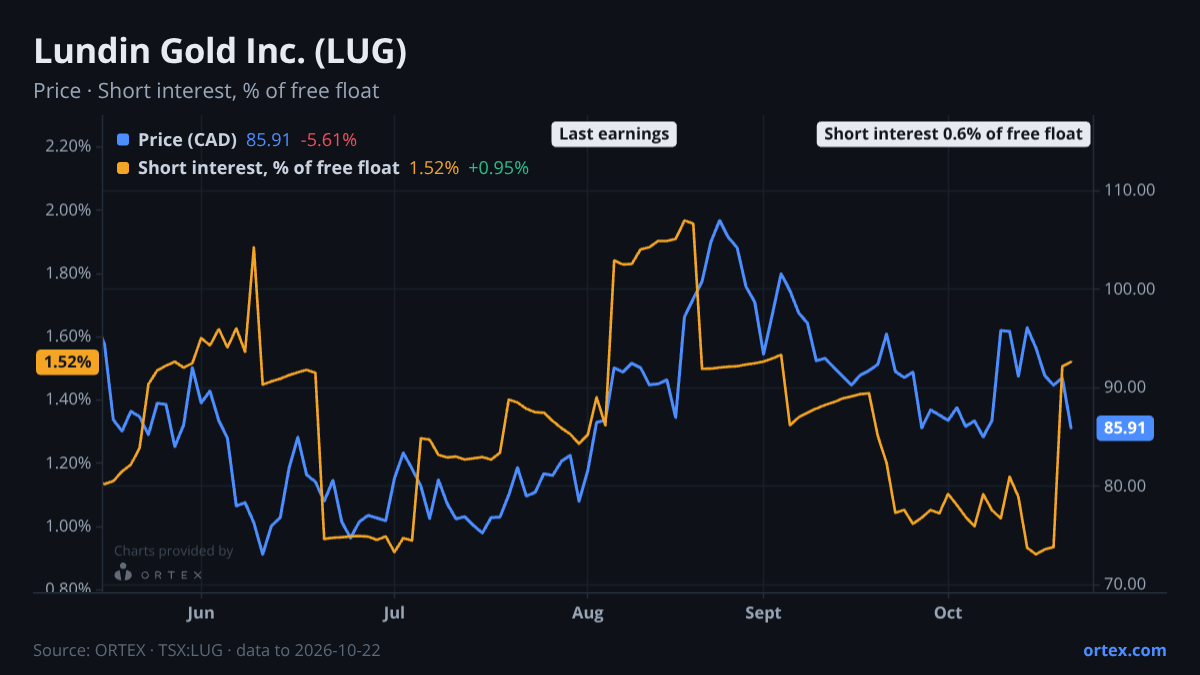
Lundin Gold heads into its November 4 earnings release down 10% on the week and 11% over the past month, even as short sellers remain a negligible presence and the borrow market stays wide open.
The price move is the story here, not the shorts. Short interest is just 0.63% of the free float, a level too low to carry much narrative weight on its own. What makes it worth noting is the pace of the change: shares short jumped 38% week-on-week to roughly 1.53 million shares, a sharp acceleration from the relatively flat readings seen through most of October. Even so, at 0.83% annualised, the cost to borrow barely registers. Availability is extraordinarily loose at 2,440% of short interest, meaning there are more than 71 million shares available to lend against fewer than 1.6 million already borrowed. The lending market offers no friction to either side. There is no squeeze dynamic here, and the short score of 31 sits in comfortable mid-range territory with only a modest two-point uptick over the past week.
The peer group tells a similar directional story but with a slightly softer drop. WPM fell 10.8% on the week, OGC lost 9.2%, and AEM shed 8.2%. ARIS fared worse at minus 12.3%. The shared direction points to a sector-wide gold-price pullback rather than anything idiosyncratic to Lundin. The analyst consensus price target of CAD 96.55 implies roughly 14% upside from the current CAD 84.52, with no recent target changes in the data. Valuation has compressed alongside the price: the PE ratio has slipped about 1.1 turns over the past week to 14.7x, and the EV/EBITDA multiple has eased to 8.5x. The dividend yield is running at around 5.5%, and Lundin scores in the 86th percentile on dividend quality, which gives the stock a degree of income support that purely growth-oriented gold peers lack.
The ownership structure introduces a notable anchor. Newmont Corporation holds 31.9% of shares and Nemesia S.à.r.l holds a further 26.3%, together accounting for more than 58% of the company. Neither changed their position in the last reported period. That concentration limits the tradeable float and helps explain why a relatively small shift in short positions produces a 38% week-on-week percentage move in shares short without any obvious dislocation in the borrow market.
The earnings history adds relevant colour. The three most recent post-result sessions all produced gains: the August 2026 print triggered a 6.4% next-day move and held 4.4% by day five; the May 2026 print rose 5.7% on the day before giving back 6.1% over the following week. That May pattern, up on the day then fading, is the one outlier in an otherwise consistently positive reaction record across recent quarters.
With the Q3 print due November 4, the question is whether the current 10% pre-announcement decline has moved the stock to a more attractive entry relative to that reaction history, or whether the sector-wide pressure reflects a deteriorating gold price backdrop that will show up in the numbers themselves.
Against its own history
This week's change in short interest is 4.0 standard deviations above the company's typical weekly move over the past year.
Against its peers
Shares moved -10.1% over the past week against a median of -9.2% for its closest peers.
Stocks in this article
See the live data behind this article on ORTEX.
Open LUG on ORTEX →How this article was generated
- Generated
- 24 Oct 2026, 17:31
- Data as of
- 24 Oct 2026, 17:30
- Prompt version
- v1.0
- Data sources
- Short interestCost to borrowUtilizationEarningsAnalyst consensusInstitutional positioningORTEX Alpha signalsRecent ORTEX notes
ORTEX Market Intelligence content is generated by AI from a snapshot of ORTEX's proprietary data and reviewed by the ORTEX team. Content is informational only and does not constitute investment advice.