
Oracle Bears Gain Nothing as Long Sellers Do the Work
Produced automatically from ORTEX data and published under the ORTEX News editorial standards set by Peter Hillerberg, Editor, ORTEX News. How we publish
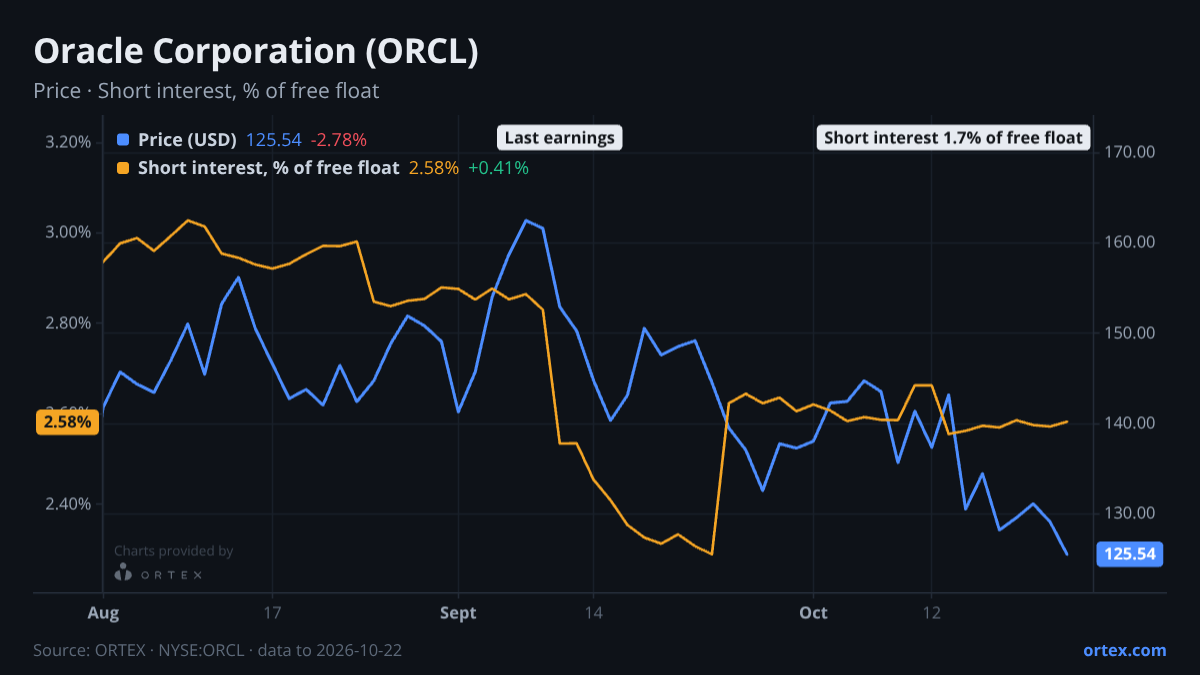
ORCL enters its October 28 earnings report having shed 15% over the past month, closing at $126.16, yet short sellers have barely moved. Short interest has edged up just 0.8% on the week to 48.1 million shares, equal to 1.7% of the free float. The borrow market remains frictionless: shares available to lend vastly outnumber those already borrowed, and the cost to borrow has only ticked up to 0.37%, barely above its month-ago level. This is not a bearish crowding story. The pressure on the stock has come from long holders selling down positions, not from fresh short conviction.
Options traders have turned more defensive into the print. The put/call ratio now reads 0.90, above its 20-day average of 0.87 and about 1.2 standard deviations elevated. That is a meaningful shift from the relaxed readings of a few weeks ago, though the ratio remains well below its 52-week high of 1.06, placing protection-buying in the cautious rather than alarmed camp. The stock's most recent earnings reaction is a relevant reference point: the September print sent shares down 7% on the day and a further 6.8% over the following five days, the kind of asymmetric reaction that tends to keep put demand firm into subsequent quarters.
The analyst debate centres on how much of Oracle's AI growth story the current price has already discounted. The bull case rests on exceptional cloud momentum: 41% year-on-year growth in cloud revenue to $8.9 billion, AI infrastructure up 243%, and remaining performance obligations up 325%, with management having raised FY27 revenue guidance to $90 billion. Goldman Sachs trimmed its target to $206 on October 23, maintaining a Buy, but the cut from $240 signals that even supportive analysts are marking down expectations after the selloff. The mean target across the Street sits at $237, implying the stock is deeply discounted against consensus, but that gap has historically been a function of where the stock came from rather than where it goes next. Bears point to execution risk on AI monetisation, foreign exchange exposure, and the prospect that large M&A or capital commitments could pressure near-term margins.
One piece of internal data sharpens the capital allocation picture. ORTEX's alt data layer shows that Oracle's Q2 buyback spend came to zero, the smallest Q2 figure on record going back to 2009, while remaining buyback authorisation fell to $6.3 billion, the smallest Q2 reading since 2015. That pair of records suggests the company chose to conserve cash or redirect it elsewhere precisely when the stock was under pressure, a contrast with the aggressive repurchase programmes of prior years that investors have come to expect.
Director Stephen Rusckowski made an open-market purchase of 25,000 shares at $139.35 on September 29, a $3.5 million discretionary buy that stands out against an otherwise quiet insider register. The CEO's same-period transactions were pre-arranged sales under a 10b5-1 plan and carry less signal. Rusckowski's purchase, made below current levels now that the stock has fallen further to $126, at least indicates one insider saw value closer to $140. Whether the Q2 print resets that calculus or validates it is what the release three days from now will test.
Against its peers
Shares moved -1.6% over the past week against a median of +3.9% for its closest peers.
Stocks in this article
See the live data behind this article on ORTEX.
Open ORCL on ORTEX →How this article was generated
- Generated
- 25 Oct 2026, 04:08
- Data as of
- 25 Oct 2026, 04:01
- Prompt version
- v1.0
- Data sources
- Short interestCost to borrowUtilizationOptions flowEarningsAnalyst consensusInstitutional positioningORTEX Alpha signalsRecent ORTEX notesAlt DataPrevious Mi Articles
ORTEX Market Intelligence content is generated by AI from a snapshot of ORTEX's proprietary data and reviewed by the ORTEX team. Content is informational only and does not constitute investment advice.