
ANET Heads Into Q3 Earnings With Analysts Trimming Targets
Produced automatically from ORTEX data and published under the ORTEX News editorial standards set by Peter Hillerberg, Editor, ORTEX News. How we publish
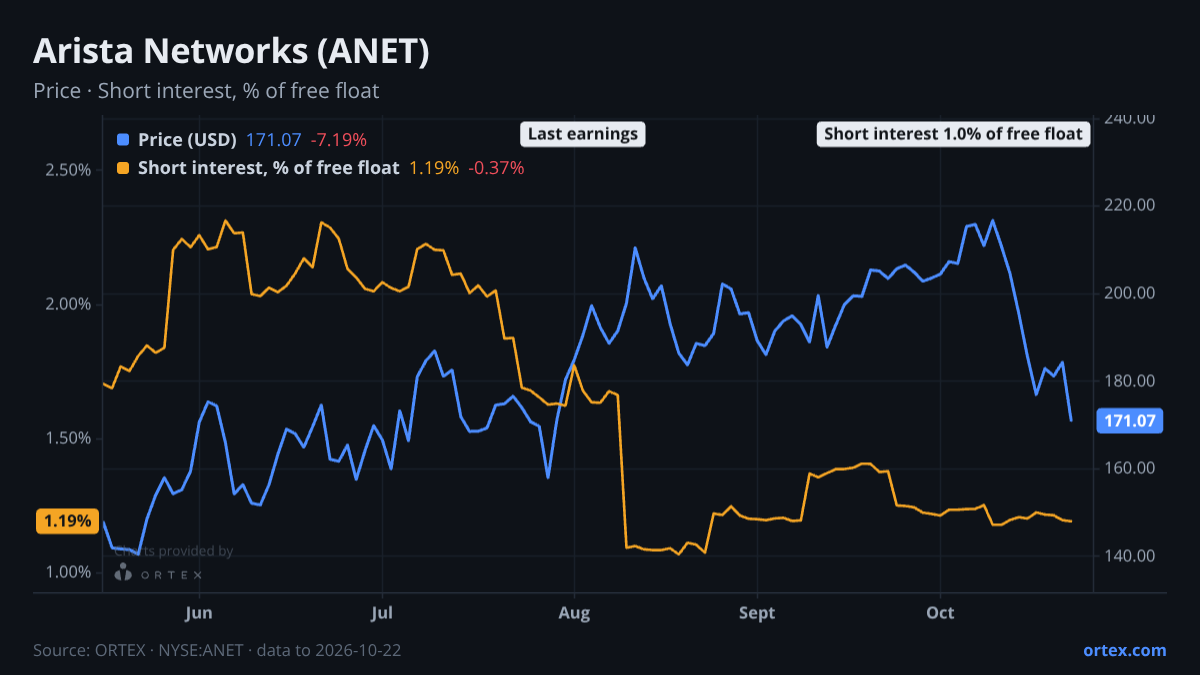
Arista Networks reports Q3 results on November 2 with the stock down 16% over the past month, Street targets coming in from post-earnings highs, and options traders increasingly cautious, yet short sellers largely absent from the picture.
The most telling signal this week is in the options market. Defensive positioning has built steadily since early October. The put/call ratio has climbed from around 0.85 in late September to 0.92, above its 20-day average of 0.89. That's not an extreme reading, the 52-week high is 1.05, but the direction of travel is clear: put demand has accelerated as the stock gave back ground ahead of the print.
Short positioning tells a different story, and the contrast matters. At roughly 1% of the free float, short interest is not a meaningful factor here. It has actually fallen about 14% over the past month, tracking steadily lower even as the stock dropped. Borrow costs remain minimal at 0.48%, and availability is effectively unlimited, lending pool capacity vastly exceeds what short sellers need. This is not a stock where bears are pressing. The weakness this month is a long-side reassessment, not a short-driven move.
The Street is broadly bullish but recalibrating after the stock's run from summer lows. TD Cowen cut its target to $205 from $250 last week while keeping its Buy rating, the clearest sign that even supporters see the post-August target lifts as having gotten ahead of where the stock can trade near-term. Citi moved the other way in early October, raising to $248 from $215. The mean target across the analyst base is around $244, which implies roughly 40% upside from Friday's close of $172. That gap reflects genuine conviction on the bull case: AI-driven switching demand, a $3.5 billion AI revenue target for 2026, nearly 47% operating margins, and $6.2 billion in deferred revenue providing visibility. Bears push back on customer concentration, with Microsoft and Meta accounting for an outsized share of revenue, and the risk that any pause in hyperscaler capex plans flows quickly to Arista's quarterly numbers. Valuation is not cheap: the price-to-book multiple has contracted about 22% over the past month to just under 10x, and the PE has compressed by roughly 7 points to 34x, but those moves reflect the stock falling, not multiples re-rating favourably. The factor score picture is mixed: analyst recommendation dispersion ranks in the 94th percentile, meaning the Street is unusually clustered in the bullish direction, while the sector score ranks 88th. The earnings yield ranks at the 50th percentile, consistent with premium-but-not-extreme pricing.
One data point worth flagging from the ownership side: CEO Jayshree Ullal's reported shareholding fell by about 2.9 million shares as of early October, a notable reduction though the position at roughly 25 million shares remains substantial. The CTO, Kenneth Duda, executed a series of pre-planned 10b5-1 sales on October 20, selling a combined total of around $2.6 million at prices in the $177 to $183 range. All the recent insider activity carries the 10b5-1 tag, meaning these are scheduled disposals under pre-arranged plans rather than discretionary sells, which limits the informational content significantly.
Retail attention has picked up sharply: Wikipedia pageviews for Arista are running more than two standard deviations above the company's own 90-day baseline, the highest attention reading on record in this dataset. That kind of pre-earnings spike in retail interest is worth noting as context, though it carries no measured link to the company's financials.
History suggests the stock moves decisively on results. The last two earnings prints both produced gains above 6% on the day, with the moves extending further over the following week. The setup into November 2 is therefore less about whether AI-driven demand is real and more about whether the company's 2026 guide already prices in enough of it, and whether concentration in two or three hyperscaler customers leaves the quarter exposed to any spending timing shift.
Against its peers
Shares moved -2.6% over the past week against a median of -4.4% for its closest peers.
Stocks in this article
See the live data behind this article on ORTEX.
Open ANET on ORTEX →How this article was generated
- Generated
- 25 Oct 2026, 17:36
- Data as of
- 25 Oct 2026, 17:35
- Prompt version
- v1.0
- Data sources
- Short interestCost to borrowUtilizationOptions flowEarningsAnalyst consensusInstitutional positioningORTEX Alpha signalsRecent ORTEX notesAlt Data
ORTEX Market Intelligence content is generated by AI from a snapshot of ORTEX's proprietary data and reviewed by the ORTEX team. Content is informational only and does not constitute investment advice.