
TFI International Heads Into Earnings With Shorts Doubling
Produced automatically from ORTEX data and published under the ORTEX News editorial standards set by Peter Hillerberg, Editor, ORTEX News. How we publish
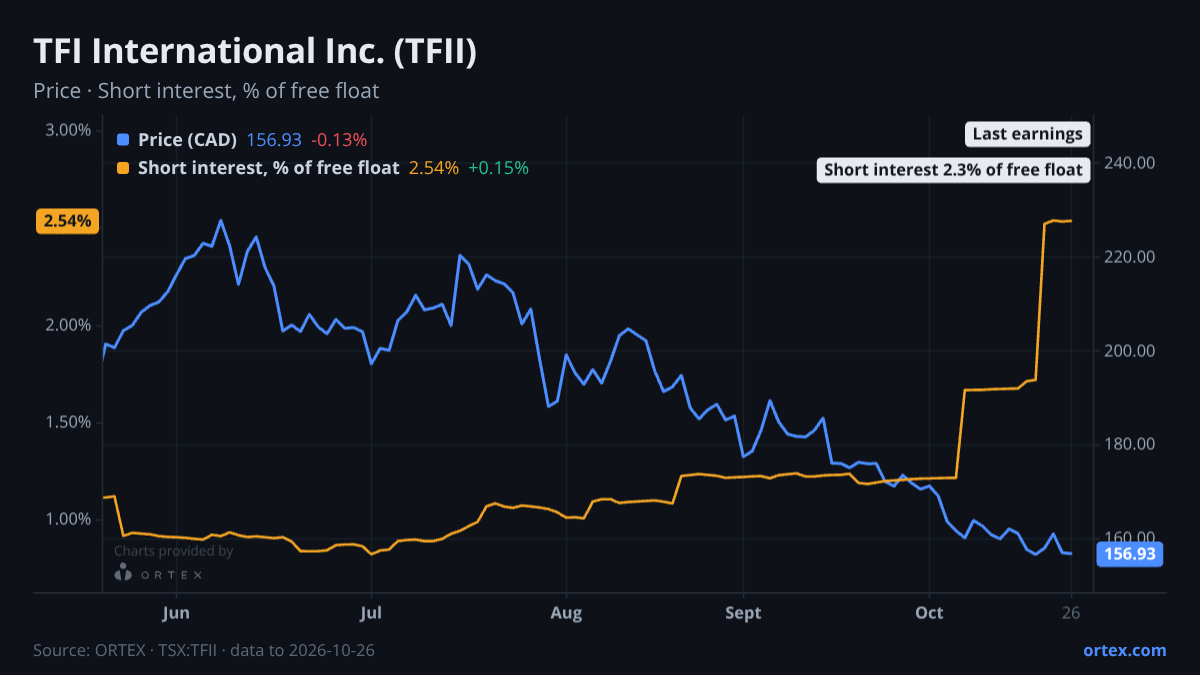
TFI International reports its next quarterly results on October 29, and the week heading into the print has been shaped by one striking data point: short interest has more than doubled in a month while the stock has quietly lost ground.
The short-side build is the defining feature of this week's setup. Short interest has climbed to 2.35% of the free float, up 52% over the past week alone and 106% over the past month. In absolute terms, borrowed shares have risen from roughly 920,000 in early October to just under 1.93 million. That said, 2.35% of float remains a low absolute level and the borrow market is extraordinarily relaxed: availability is running at nearly 6,919% of short interest, meaning there are roughly 70 million shares available to borrow against fewer than two million already out. Cost to borrow has actually fallen sharply to 0.37%, down 35% on the week, reaching its lowest point in the 30-day window. The ORTEX short score has crept higher in recent sessions, now at 34.2, but sits near the 49th percentile of its universe. The overall picture is of a modest and inexpensive short position building into a catalyst, not a crowded or constrained one.
The Street view is difficult to assess cleanly. Analyst data on TFII is stale (the most recent consensus information is from 2023 and should not be treated as current), so the price target mean of approximately C$132 against a current price of C$156.93 looks misaligned and is best ignored. What the factor scores do offer is a mixed read on the company's positioning: the forward earnings growth percentile rank is very high at 93, and the 90-day EPS momentum rank is solid at 72, suggesting the earnings revision trend has been constructive. Against that, the 30-day EPS momentum rank is weaker at 28, and the EV/EBIT percentile sits at 28 as well, pointing to a valuation that is not cheap on a traditional earnings-power basis. The PE multiple has compressed by just over 1.5 turns in the past 30 days, consistent with a stock that has given back 8.4% over the past month. Peers were broadly softer on the week: HTLD fell 4.8%, KNX dropped 4.4%, and ODFL shed 2.3%, so TFII's 0.6% weekly decline looks like relative resilience within a sector that has been under pressure.
Ownership is worth a brief note. Founder and chairman Alain Bedard holds approximately 5.99% of shares, with no change reported in his latest filing dated October 15. La Caisse de dépôt et placement du Québec is the largest institutional holder at just under 7.7%, with its Schedule 13G/A reflecting a stake that rose from 6.9% to 8.6% earlier in 2026. No 13D activist is on the register. The most recent open-market insider purchase was by Rosemary Turner in August, who bought around 7,150 shares across two transactions at roughly US$140 per share. Net insider activity over the past 90 days is negative: net sales of around 51,800 shares worth approximately US$11.6 million, though the insider data covers a period that ends in August and the composition reflects a mix of open-market sales and compensation mechanics.
Earnings history offers a consistent pattern without being dramatic. The two most recent prints both produced next-day declines: roughly 2.6% after the October 23 release and 1.6% after the July 27 release, with the latter extending to a 6.2% loss over the subsequent five days. The October 2026 print has already occurred (October 23), with the next event scheduled for October 29. That proximity matters: the stock is being tested again within days, and the short interest build of the past week sits squarely on top of that date.
What to watch on October 29 is whether the volume of newly established short positions reflects a directional view on results or whether the borrow cost and availability conditions made it simply convenient to add exposure ahead of a known catalyst, with the answer likely visible in whether shorts hold or cover in the two sessions that follow the release.
Against its own history
This week's change in short interest is 4.4 standard deviations above the company's typical weekly move over the past year. Short interest is at its highest level in at least a year.
Against its peers
Shares moved -0.6% over the past week against a median of -1.5% for its closest peers.
Stocks in this article
See the live data behind this article on ORTEX.
Open TFII on ORTEX →How this article was generated
- Generated
- 27 Oct 2026, 17:33
- Data as of
- 27 Oct 2026, 17:31
- Prompt version
- v1.0
- Data sources
- Short interestCost to borrowUtilizationEarningsInstitutional positioningORTEX Alpha signalsRecent ORTEX notes
ORTEX Market Intelligence content is generated by AI from a snapshot of ORTEX's proprietary data and reviewed by the ORTEX team. Content is informational only and does not constitute investment advice.