
Fortinet drops 6% on results day as peers rally and valuation debate sharpens
Produced automatically from ORTEX data and published under the ORTEX News editorial standards set by Peter Hillerberg, Editor, ORTEX News. How we publish
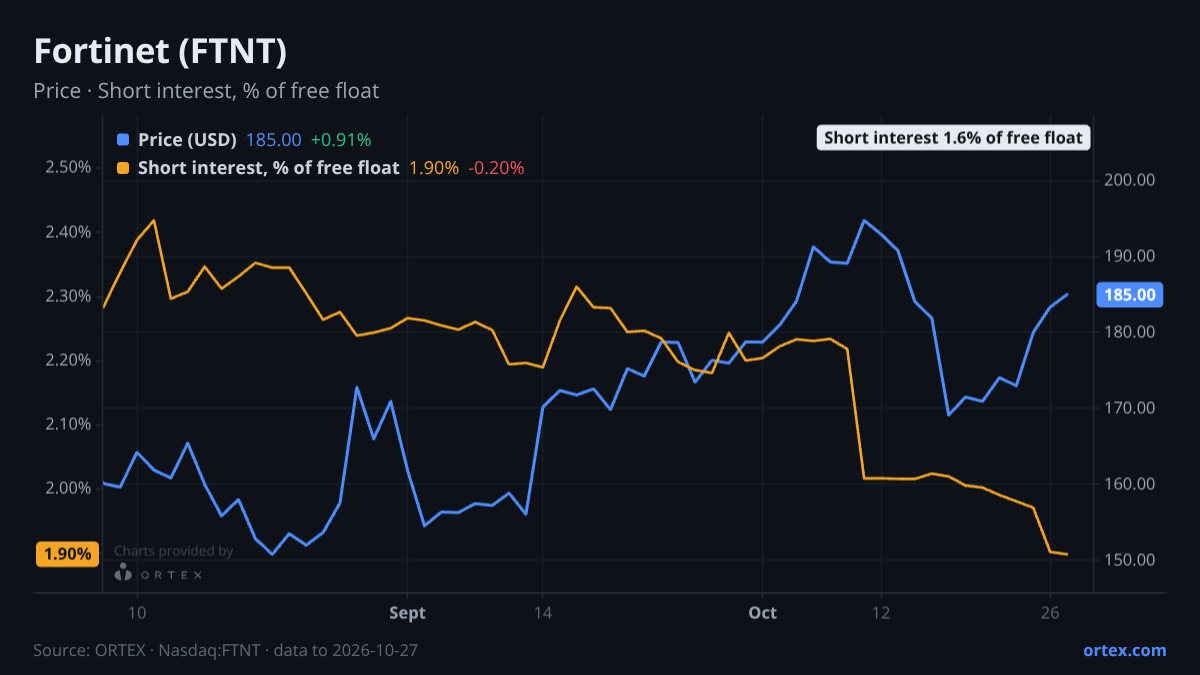
Fortinet fell nearly 6% on Wednesday to $174.08, the sharpest single-session decline in months, even as close cybersecurity peers held flat or gained ground, a split that puts the valuation premium squarely on trial as Q3 results land after the close today.
The peer divergence is striking. CRWD lost just 0.5% on the day and is up 11% for the week. PANW fell under 2% and is up 14% over the same stretch. TENB and NTSK both gained on the week, up roughly 20% and 22% respectively. Fortinet is essentially flat over the past week, which means its 6% drop on Wednesday was not a sector-wide move. The market is making a specific judgment about this stock, not the group.
The debate is almost entirely about price. Bears point to a valuation running at roughly 7.6x forward revenue and 23x forward free cash flow, well above the broader security group at 4.1x revenue and around 19x FCF. The analyst consensus reflects the tension: the mean price target of $169.44 is already below Wednesday's close of $174.08, implying the average analyst sees the stock as slightly overvalued right now. JP Morgan maintained its Underweight at a $140 target on October 23, raising the number reluctantly as the stock climbed. Mizuho and Wells Fargo also hold below-market targets with negative ratings. Against that, Truist Securities lifted to $200 and TD Cowen raised to $225, both retaining Buy ratings, arguing the platform's momentum justifies a premium. The bull case rests on Q1's 30.6% billings growth, $7.35 billion in deferred revenue, and accelerating product revenue. The bear case is simply that the stock has priced all of it in, and then some.
Short positioning offers no directional read here. Short interest has retreated 15% over the past month to just 1.58% of the free float, the lowest level in the 30-session history available, and borrow availability is effectively unconstrained. The cost to borrow is down 24% over the past week to 0.26%, with no squeeze dynamics anywhere in the lending market. Options are only modestly more cautious than usual: the put/call ratio at 1.04 is about 1.3 standard deviations above its 20-day mean, nudged higher but nowhere near the 52-week peak of 1.48. Retail attention is elevated, with Wikipedia views running at a z-score of 2.1 against the prior 90 days, which reflects the run-up in the stock rather than anything more fundamental.
Insider activity over the past 90 days has been net negative to the tune of roughly $36 million in value, driven largely by planned 10b5-1 sales from the COO and a small CFO disposal, both pre-arranged and therefore limited as sentiment signals. BlackRock added just over one million shares in Q3, and Vanguard added roughly 870,000, consistent with passive inflows rather than active conviction.
The print will test whether Fortinet's billings trajectory and margin profile can sustain a valuation that the median analyst no longer endorses at current prices, particularly on a day when the stock already underperformed every close peer by a wide margin before the numbers were out.
Against its own history
Short interest is at its lowest level in at least a year.
Against its peers
Shares moved +0.0% over the past week against a median of +11.9% for its closest peers.
Stocks in this article
See the live data behind this article on ORTEX.
Open FTNT on ORTEX →How this article was generated
- Generated
- 29 Oct 2026, 04:42
- Data as of
- 29 Oct 2026, 04:10
- Prompt version
- v1.0
- Data sources
- Short interestCost to borrowUtilizationOptions flowEarningsAnalyst consensusInstitutional positioningORTEX Alpha signalsRecent ORTEX notesAlt DataPrevious Mi Articles
ORTEX Market Intelligence content is generated by AI from a snapshot of ORTEX's proprietary data and reviewed by the ORTEX team. Content is informational only and does not constitute investment advice.