
SFM shorts pull back, but put buyers step in ahead of earnings
Produced automatically from ORTEX data and published under the ORTEX News editorial standards set by Peter Hillerberg, Editor, ORTEX News. How we publish
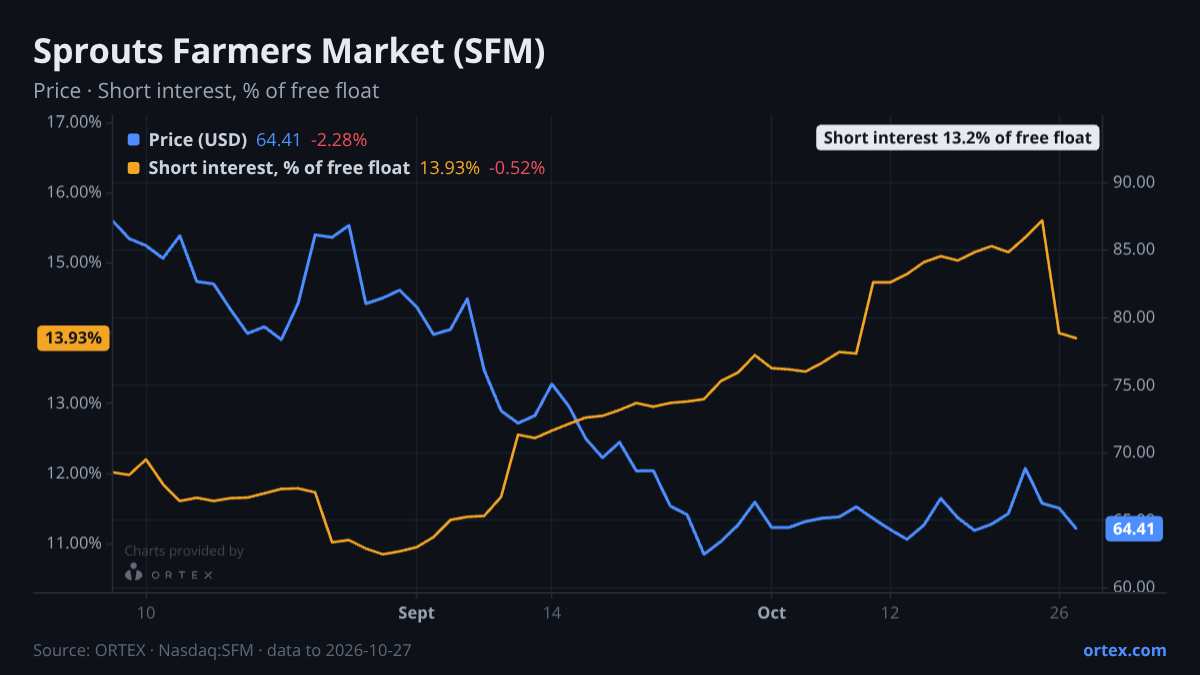
Sprouts Farmers Market carries one of the heavier short positions in US food retail into Wednesday's Q3 print, with 13.2% of the free float sold short. That number has eased meaningfully over the past week, falling 8% to around 12.9 million shares, though it remains 7% above where it stood a month ago.
Options positioning tells a more cautious story than the short interest alone. The put/call ratio has climbed to 0.66, more than two standard deviations above its 20-day average of 0.58, a level of defensive skew not seen for most of the past year. That drift toward protection has accelerated as the stock fell 3.7% on Tuesday and 5.4% across the week, underperforming the median of its closest peers by roughly 6.8 percentage points. Borrow costs remain low at 0.53% and availability of roughly 106% means new short positions can be established without friction, so the lending market is not flashing a squeeze signal.
The analyst community has been trimming its expectations without abandoning positive ratings. RBC Capital cut its target from $114 to $111 in the week before the print while keeping an Outperform rating. JPMorgan lowered from $103 to $90 in early October. The mean target across the consensus now sits at $90.86, against a close of $62, a gap that normally implies material upside but in this case partly reflects targets set when the stock was trading in the $80s. The bear case centres on a Cyclospora outbreak that weighted more heavily on produce comps than management initially flagged, a $5 million EBIT guidance revision driven entirely by fuel costs, and the risk that trip consolidation at $4.43 per gallon gas pressures a format that shoppers treat as supplementary. Bulls point to a differentiated wellness-focused model, roughly 8% to 10% expected unit growth, and an EV/EBITDA multiple that has compressed to 8.4x from its recent highs as potential value for patient holders.
Fidelity (FMR LLC) remains the largest disclosed holder at around 13.3% of shares. The most recent 13D/G filing, from FMR in August, showed its stake rising from 13.5% to 15.0%, though that reading predates the stock's slide from the $80s. CEO Jack Sinclair has been executing regular option-exercise-and-sale transactions under a pre-arranged 10b5-1 plan throughout September and October, selling at prices between $64 and $83. Planned sales carry less informational weight than discretionary ones, so the CEO activity does not change the fundamental read. Wikipedia attention for SFM has spiked to a z-score of 3.8 against its own 90-day history, pointing to elevated retail interest in the stock ahead of the number.
The print will test whether the produce comp drag is stabilising, whether fuel headwinds have been fully absorbed into guidance, and whether the speciality grocery format can defend traffic at a moment when traditional grocers are pushing harder into organic and attribute-based offerings.
Against its own history
This week's change in short interest is 1.7 standard deviations below the company's typical weekly move over the past year.
Against its peers
Shares moved -5.4% over the past week against a median of +1.4% for its closest peers.
Stocks in this article
See the live data behind this article on ORTEX.
Open SFM on ORTEX →How this article was generated
- Generated
- 29 Oct 2026, 04:44
- Data as of
- 29 Oct 2026, 04:11
- Prompt version
- v1.0
- Data sources
- Short interestCost to borrowUtilizationOptions flowEarningsAnalyst consensusInstitutional positioningORTEX Alpha signalsRecent ORTEX notesAlt Data
ORTEX Market Intelligence content is generated by AI from a snapshot of ORTEX's proprietary data and reviewed by the ORTEX team. Content is informational only and does not constitute investment advice.