
OKTA shorts retreat to two-month low as options lean bullish
Produced automatically from ORTEX data and published under the ORTEX News editorial standards set by Peter Hillerberg, Editor, ORTEX News. How we publish
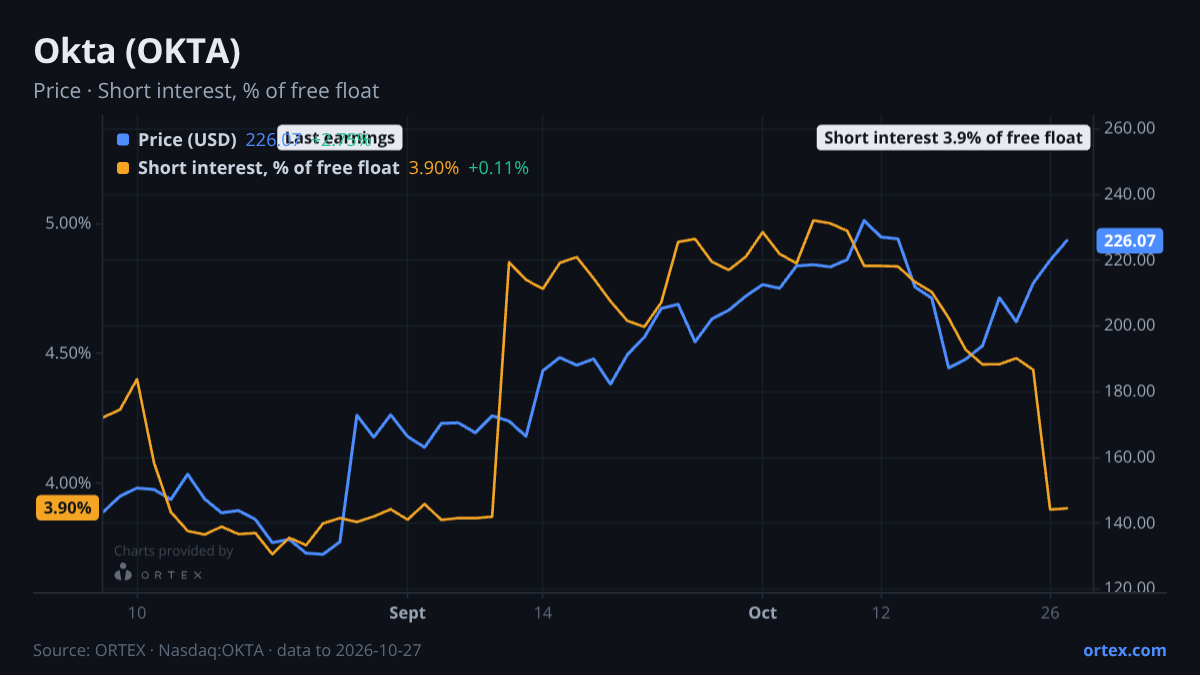
Short sellers have been cutting exposure to OKTA at an unusual pace. Among its closest peers, NET and MDB carry heavier short positioning. OKTA's own short interest has fallen to 3.86% of free float, the lowest in two months, with a weekly decline running 1.9 standard deviations below its typical move.
Shorts pulled back hard
Shares short dropped 13.5% in the week to 27 October. Over the past month the decline reaches 15.6%. The fall comes as the stock added 6.7% in the same week, roughly in line with the peer median of 5.9% but well ahead of TWLO, which slipped 1.6%.
The lending market tells the same story from the other direction. Availability stands at 8,470%, meaning there are roughly 85 shares available to borrow for every one already shorted. That is exceptionally loose. The ORTEX short score has drifted down to 33.9 from 37.0 two weeks ago, consistent with the unwinding.
Options traders favour calls
The put-call ratio came in at 1.02 on 28 October, below its 20-day mean of 1.04. The direction of travel matters: the PCR reached 1.08 on 19 October and has been fading since, a period that overlaps directly with the short covering. Neither positioning shift is extreme in isolation, but they are pointing the same way.
Cost to borrow edges up, context matters
Cost to borrow rose 76% in a week to 0.56%, which sounds dramatic until the absolute level is considered. At 0.56% it remains in the "low" bracket and is still well below its own September readings, which touched 0.53% on 24 September. The move reflects a modest uptick in borrow demand, not a squeeze.
S&P 500 candidacy adds a mechanical angle
ORTEX forecasts a 58% probability that OKTA joins the S&P 500 at the December 2026 Quarterly Review, with rank date 1 December and a potential trade date of 18 December. The stock is currently 42.6% above the entry price line at $129.85, meaning the market cap has well cleared the threshold. If confirmed, index trackers would need to buy the equivalent of 9.7 days of normal volume. Past comparable additions have seen median gains of 6.7% from announcement to effective date across 23 prior events, though 48% moved the expected way, barely a coin flip. That caveat aside, the mechanical buying flow of $7.8B would be the clearest near-term catalyst on the calendar.
The number to watch is the short interest level at the next FINRA fortnightly print. The most recent official figure put shares short at 7.0 million as of 15 October. If the daily estimate's fall to 6.5 million is confirmed, it would mark a clean break from the range that held through September.
Data summary
- Short interest: 3.86% of free float (27 Oct), down 13.5% in a week
- Lending availability: 8,470%, very loose
- Cost to borrow: 0.56% (27 Oct), up 76% week on week but at low absolute levels
- Put-call ratio: 1.02 (28 Oct), below 20-day mean of 1.04
- ORTEX short score: 33.9 (27 Oct), down from 37.0 on 14 Oct
- S&P 500 addition: ORTEX forecast probability 58%, December 2026 Quarterly Review
Against its own history
This week's change in short interest is 1.9 standard deviations below the company's typical weekly move over the past year.
Against its peers
Shares moved +6.7% over the past week against a median of +5.9% for its closest peers.
Stocks in this article
See the live data behind this article on ORTEX.
Open OKTA on ORTEX →How this article was generated
- Generated
- 29 Oct 2026, 06:14
- Data as of
- 29 Oct 2026, 06:09
- Prompt version
- v1.0
- Data sources
- Short interestCost to borrowUtilizationOptions flowEarningsAnalyst consensusInstitutional positioningORTEX Alpha signalsRecent ORTEX notesAlt DataIndex Rebalance
ORTEX Market Intelligence content is generated by AI from a snapshot of ORTEX's proprietary data and reviewed by the ORTEX team. Content is informational only and does not constitute investment advice.