
PEG Reactor Blip Meets a Short Squeeze as Earnings Near
Produced automatically from ORTEX data and published under the ORTEX News editorial standards set by Peter Hillerberg, Editor, ORTEX News. How we publish
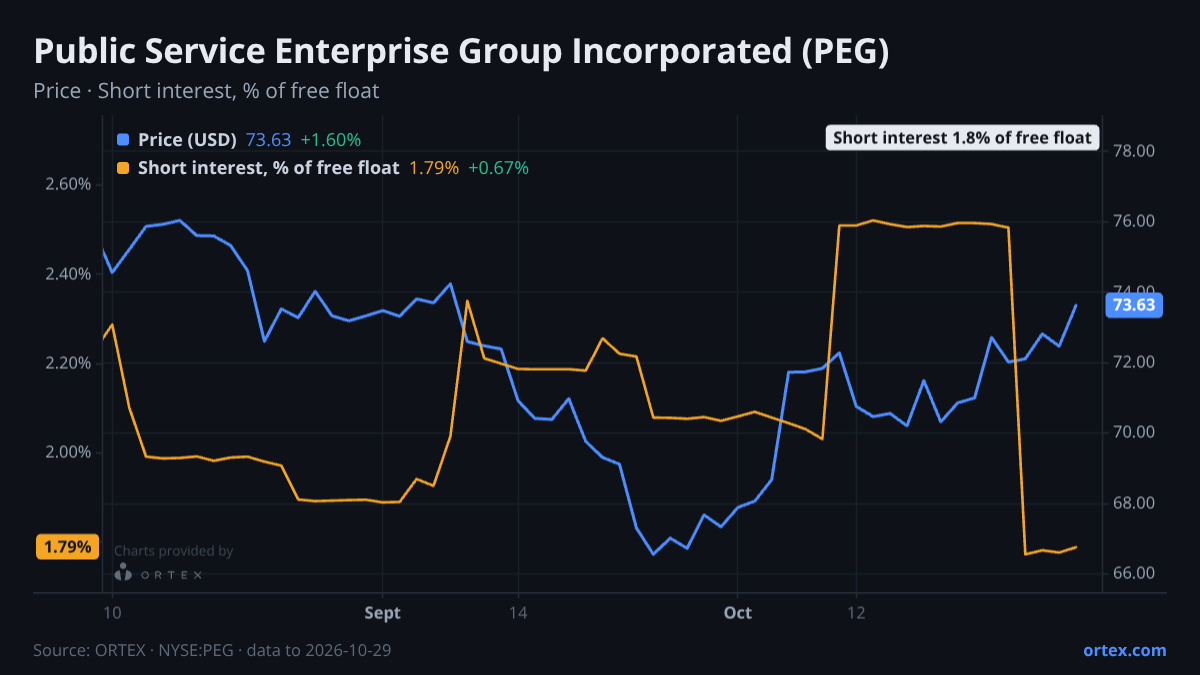
Why this matters: Three separate data streams converged on Public Service Enterprise Group this week. Nuclear output fell to a 4.8 standard deviation low versus its own history. Short interest collapsed 29% in a week. And the cost to borrow ticked up even as the broader lending market stayed wide open. With Q3 earnings on November 2, the signals are pointing in different directions at once.
Converging Signals
The reactor story is the most unusual element. Per US Nuclear Regulatory Commission data tracked by the ORTEX Alt Data layer, PEG's reactor output hit 4.8 standard deviations below its own trailing history on October 24, 25 and 26 in sequence. That is outage-level territory by the deviation measure. The signal persisted for three consecutive days, which rules out a one-day data anomaly.
At the same time, short interest dropped sharply. From roughly 12.5 million shares on October 23, the short position fell to 8.9 million by October 29, now 1.78% of free float. That weekly move is 3.4 standard deviations below PEG's typical weekly shift over the past year. This is not a gradual unwind. It is an abrupt exit. Among PEG's closest peers, short interest is running at meaningfully higher levels in most cases, making PEG one of the least shorted names in its regulated-utility peer group even before this week's drop.
The cost to borrow rose 69% over the past week to 0.36%. That sounds dramatic as a percentage. In absolute terms it is 36 basis points annually, and the borrow market remains extremely loose: over 405 million shares are available to lend against roughly 8.9 million short. A 69% move from near-zero to near-zero is noise in the lending market, not a squeeze signal.
Corroborating Context
Analysts trimmed targets this week without changing their ratings. B of A Securities lowered its target to $85 from $87, maintaining Buy. Morgan Stanley cut to $85 from $88, also maintaining Overweight. JP Morgan moved to $77 from $81, holding Neutral. The consensus target stands at $81.42, against a closing price of $73.63 on October 29.
The options market leans constructively. The put/call ratio of 0.19 is near its 52-week low and sits roughly one standard deviation below its 20-day average. Call activity is dominant going into the earnings date. The short score has also moved: from 34.1 on October 19 down to 31.1 on October 28. That decline reflects the short interest compression directly.
Retail attention has climbed. Wikipedia page views are running 2.0 standard deviations above their trailing 90-day average as of October 22, per the ORTEX Alt Data layer. The timing aligns with the reactor output news and the earnings approach.
Insider activity is not a signal here. The October 16 filings were tax-withholding transactions coded "F", routine compensation mechanics, not open-market conviction trades.
Data Summary
- Short interest: 1.78% of free float as of October 29, down 29% on the week from a one-year high of approximately 2.5%
- Weekly short interest change: 3.4 standard deviations below the company's typical weekly move
- Reactor output: 4.8 standard deviations below own history (October 24 to 26), per NRC data via ORTEX Alt Data
- Cost to borrow: 0.36%, up 69% on the week; borrow availability remains extremely loose
- Put/call ratio: 0.19, near its 52-week low of 0.19
- Analyst consensus target: $81.42; stock at $73.63
- Next earnings: November 2
The price or data point to watch is the November 2 print. That is when the reactor output deviation either becomes a reported earnings headwind or does not.
Against its own history
This week's change in short interest is 3.4 standard deviations below the company's typical weekly move over the past year.
Against its peers
Shares moved +1.3% over the past week against a median of +1.2% for its closest peers.
Stocks in this article
See the live data behind this article on ORTEX.
Open PEG on ORTEX →How this article was generated
- Generated
- 30 Oct 2026, 11:18
- Data as of
- 30 Oct 2026, 11:08
- Prompt version
- v1.0
- Data sources
- Short interestCost to borrowUtilizationOptions flowEarningsAnalyst consensusInstitutional positioningORTEX Alpha signalsRecent ORTEX notesAlt DataPrevious Mi Articles
ORTEX Market Intelligence content is generated by AI from a snapshot of ORTEX's proprietary data and reviewed by the ORTEX team. Content is informational only and does not constitute investment advice.