
GLD borrow market seizes up as short interest nearly doubles in a week
Produced automatically from ORTEX data and published under the ORTEX News editorial standards set by Peter Hillerberg, Editor, ORTEX News. How we publish
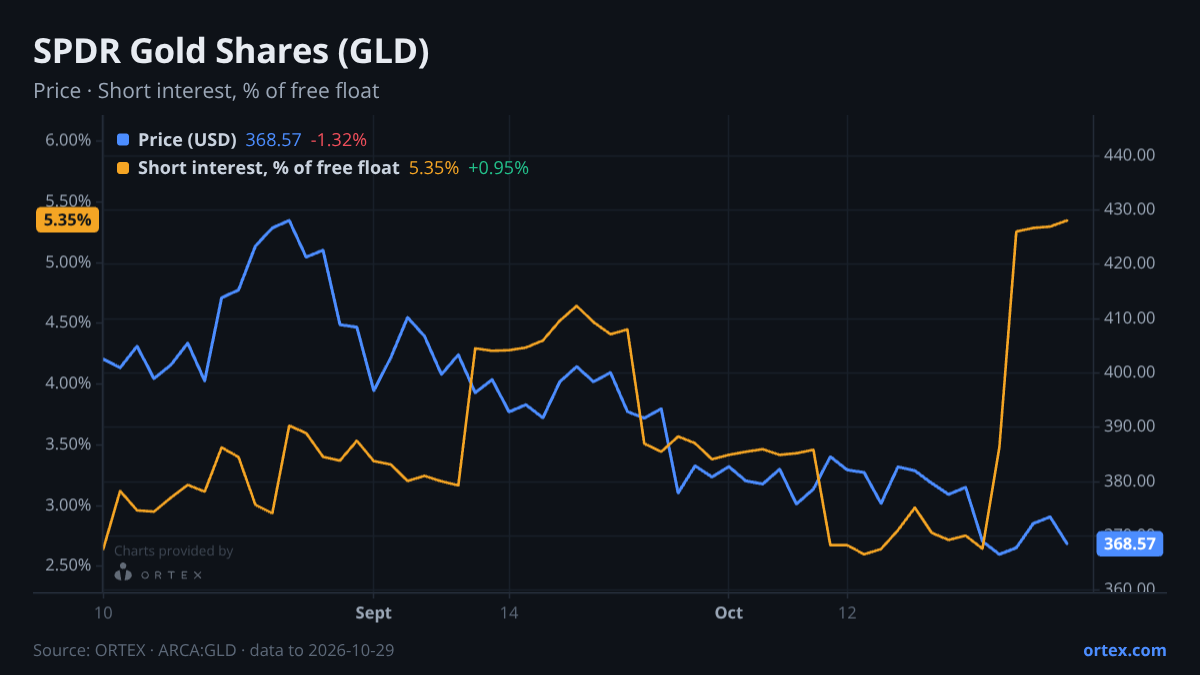
Short sellers have piled into GLD at a pace rarely seen for the world's largest gold ETF. Short interest has risen 94% over the past week to 18.84 million shares, and the lending pool is now almost fully drained.
A borrow market flipped in days
On 22 October, availability stood at 509%, meaning lenders held more than five shares available for every one already borrowed. By 29 October that figure had collapsed to 59%, the tightest reading in at least 52 weeks. That is fewer than two-thirds of a share still available for every share already out on loan. The cost to borrow has followed: at 0.69%, it is up 88% over the past week and 46% over the past month.
The ORTEX short score has moved in step. On 22 October it sat at 39.0. By 29 October it had risen to 56.5, a jump of more than 17 points in seven sessions. That move represents the signal the composite score is designed to capture: a sudden, broad-based tightening of the borrow market combined with a rapid acceleration in short positioning.
The context behind the positioning
The editorial brief flags that this week's change in short interest is 5.5 standard deviations above GLD's typical weekly move over the past year, and that current positions are the highest in at least 12 months. That is an unusual clustering of short demand for a fund that normally sees gradual, modest swings in its lending market.
GLD closed at $368.57 on 29 October, down roughly 2.5% over the past month. A recent note in the ORTEX system cited a strong October for gold driven by dollar weakness and central bank demand. Short sellers appear to be betting against a continuation of that move, or hedging long gold exposure elsewhere. The put-to-call ratio on GLD options is 0.478, below its 20-day mean of 0.505 and near the bottom of its 52-week range of 0.39 to 0.70. Options positioning has been drifting away from puts even as short interest surged, the two markets pointing in different directions.
BlackRock added 1.53 million shares as of 30 September, the largest change among the top 15 holders reported. Most other large holders trimmed modestly in the June quarter.
What to watch
Availability at 59% is now at its 52-week low. The next threshold to watch is whether it falls below 50%, where fewer than one share remains lendable for every two already borrowed. At that level, the cost to borrow typically accelerates faster than the gradual drift seen so far this week. Short interest has now been flat for three consecutive sessions after the sharp jump on 23 October. If it resumes climbing while availability stays pinched, the cost to maintain those positions will rise with it.
Data summary
- Short interest: 18.84 million shares, up 94% week on week, highest in at least 52 weeks
- Weekly change is 5.5 standard deviations above GLD's typical weekly move
- Availability: 59%, the 52-week low, down from 509% on 22 October
- Cost to borrow: 0.69%, up 88% week on week
- ORTEX short score: 56.5 as of 29 October, up from 39.0 on 22 October
- Options PCR: 0.478, below the 20-day mean of 0.505
Against its own history
This week's change in short interest is 5.5 standard deviations above the company's typical weekly move over the past year. Short interest is at its highest level in at least a year.
Stocks in this article
See the live data behind this article on ORTEX.
Open GLD on ORTEX →How this article was generated
- Generated
- 30 Oct 2026, 19:14
- Data as of
- 30 Oct 2026, 19:09
- Prompt version
- v1.0
- Data sources
- Short interestCost to borrowUtilizationOptions flowEarningsInstitutional positioningORTEX Alpha signalsRecent ORTEX notes
ORTEX Market Intelligence content is generated by AI from a snapshot of ORTEX's proprietary data and reviewed by the ORTEX team. Content is informational only and does not constitute investment advice.