
Spotify Shorts Exit at Record Pace Ahead of Monday's Print
Produced automatically from ORTEX data and published under the ORTEX News editorial standards set by Peter Hillerberg, Editor, ORTEX News. How we publish
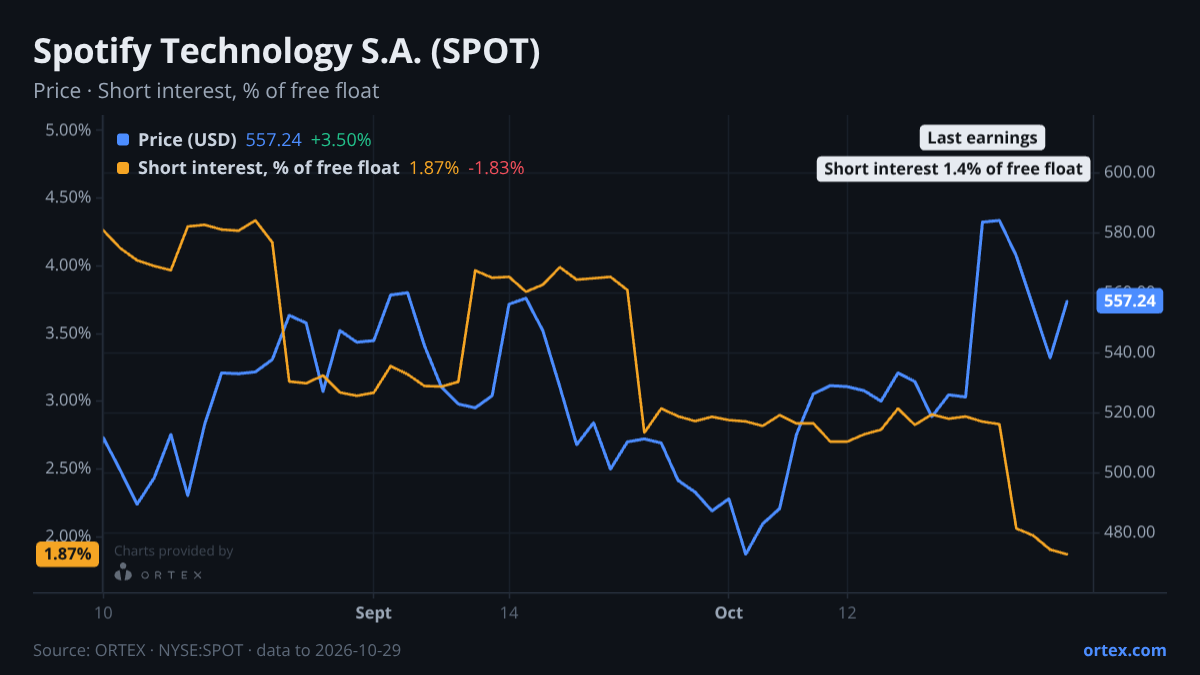
Spotify enters its November 3 earnings report with short sellers pulling back at a pace that stands 3.6 standard deviations below the stock's typical weekly move: short interest has collapsed 35% over the past week to 1.4% of free float, the lowest level in at least a year, while the stock itself gained 1.6% on the week against a median decline of 4.2% across its closest peers.
The scale of the short exit is the defining feature of this setup. From roughly 3% of free float in mid-September, positions have been cut in half, with most of the move concentrated in the past two weeks. Borrow conditions confirm there is no mechanical pressure forcing the unwind: cost to borrow is just 0.54%, up only modestly on the month, and availability has widened sharply to 2,792% (more than 75 million shares available against current short interest), the loosest the lending market has been in over a year. Short sellers are leaving voluntarily, not being squeezed out.
That exit followed a strong Q3 print on October 22, when the stock jumped 11.2% in a single session and held most of the gain over the subsequent five days. The October earnings history is the only comparison available, and the prior print in August produced a much smaller move of minus 0.8% on the day. The October rally appears to have triggered the mass short covering, with the ORTEX short score dropping from 35 to 31 in the week since. Options positioning has normalised alongside: the put/call ratio now sits at 0.99, less than one standard deviation above its 20-day average of 0.95, a marked shift from the near-three-standard-deviation spike logged in the previous article ahead of the October print.
The analyst community moved decisively after that October release. Morgan Stanley lifted its target to $700 and JPMorgan matched it, while Evercore set the high-water mark at $750. Most of the upgrades came from firms already at Overweight or Outperform, with targets revised up by $60 to $100 in a single session. The mean consensus target now sits at $570, below the current price of $593, which reflects a consensus that was anchored before the post-earnings rally rather than one that has fully caught up. The bear case centres on content cost inflation, licensing leverage and whether subscriber growth can sustain without further price increases. Bulls point to the 751 million monthly active user record, the 290 million premium subscribers, and the trajectory of gross margin expansion.
Retail attention, tracked via Wikipedia pageview data, registered a z-score of 4.6 against Spotify's own 90-day history as of October 21. That level of attention is notable colour heading into a print, though the dataset has not been measured to lead the company's reported figures. The Monday release will test whether the margin expansion story that drove the October rally has continued into the current quarter, and whether the Street's still-anchored price targets need another significant reset.
Against its own history
This week's change in short interest is 3.6 standard deviations below the company's typical weekly move over the past year. Short interest is at its lowest level in at least a year.
Against its peers
Shares moved +1.6% over the past week against a median of -4.2% for its closest peers.
Stocks in this article
See the live data behind this article on ORTEX.
Open SPOT on ORTEX →How this article was generated
- Generated
- 31 Oct 2026, 04:25
- Data as of
- 31 Oct 2026, 04:03
- Prompt version
- v1.0
- Data sources
- Short interestCost to borrowUtilizationOptions flowEarningsAnalyst consensusInstitutional positioningORTEX Alpha signalsRecent ORTEX notesAlt DataPrevious Mi Articles
ORTEX Market Intelligence content is generated by AI from a snapshot of ORTEX's proprietary data and reviewed by the ORTEX team. Content is informational only and does not constitute investment advice.