
EchoStar shorts keep retreating as options turn bullish
Produced automatically from ORTEX data and published under the ORTEX News editorial standards set by Peter Hillerberg, Editor, ORTEX News. How we publish
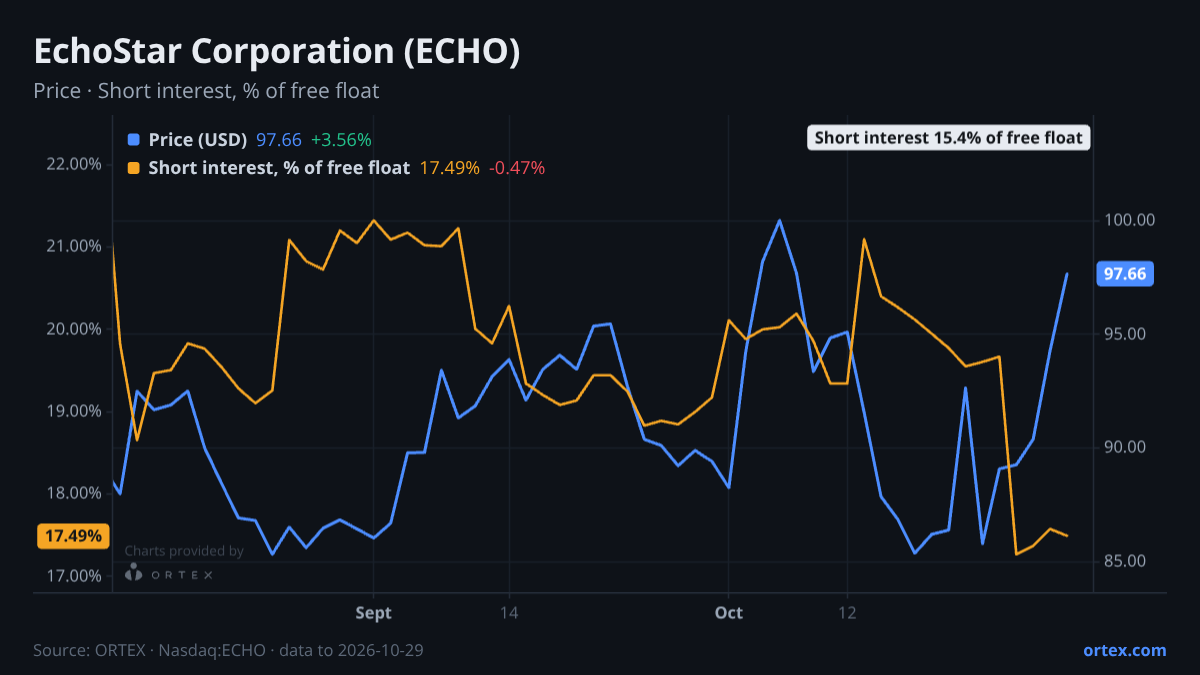
EchoStar has watched its short book shrink for a third consecutive week, with short interest now at 15.4% of free float, down from 17.4% a week ago and well off the 19.6% cited in notes from earlier this month.
The covering pace remains statistically unusual. This week's decline is 1.9 standard deviations below the stock's typical weekly short-interest move over the past year, which means the retreat is not normal position trimming. Shorts have returned roughly 3.2 million shares to the lending pool since late October, a mechanical tailwind that has helped push the stock up 8.8% on the week to $96.94, against a median decline of about 1.5% for its closest peers. The borrow market has tightened in tandem: availability has dropped to 152%, down from 182% a week ago, as more of the lending pool gets absorbed. Cost to borrow remains low at 0.53%, so the tightening reflects demand rather than a squeeze in supply.
Options positioning has moved in the same direction. The put/call ratio has dropped to 0.46, more than two standard deviations below its 20-day mean of 0.50, the lowest defensive reading in the past year. Taken together, a shrinking short book, tighter availability, a rising stock price, and call-heavy options flow all point to a market leaning constructively into Monday's Q3 print.
The analyst backdrop reinforces that tilt. JP Morgan's two-notch flip from Underweight to Overweight with a $144 target on October 16 was the most aggressive single move, following Morgan Stanley's Overweight initiation at $134 in September and UBS's upgrade to Buy at $150 in early September. The consensus stands at Buy, with a mean target of $130.20, around 34% above Friday's close. Charles Ergen holds a 13D activist filing covering 50.9% of the company's shares as last disclosed, giving him dominant influence over the outcome of any strategic decisions the print might frame. That stake has not changed in the most recent filing, though 13D positions are event-driven disclosures and may not reflect real-time holdings.
The print on November 3 will test whether the operational results justify the pace at which short sellers have chosen to step aside.
Against its own history
This week's change in short interest is 1.9 standard deviations below the company's typical weekly move over the past year.
Against its peers
Shares moved +8.8% over the past week against a median of -1.5% for its closest peers.
Stocks in this article
See the live data behind this article on ORTEX.
Open ECHO on ORTEX →How this article was generated
- Generated
- 31 Oct 2026, 04:33
- Data as of
- 31 Oct 2026, 04:04
- Prompt version
- v1.0
- Data sources
- Short interestCost to borrowUtilizationOptions flowEarningsInstitutional positioningORTEX Alpha signalsRecent ORTEX notesAlt DataPrevious Mi Articles
ORTEX Market Intelligence content is generated by AI from a snapshot of ORTEX's proprietary data and reviewed by the ORTEX team. Content is informational only and does not constitute investment advice.