
Teladoc Surges 34% After Earnings Beat, But Shorts Keep Building
Produced automatically from ORTEX data and published under the ORTEX News editorial standards set by Peter Hillerberg, Editor, ORTEX News. How we publish
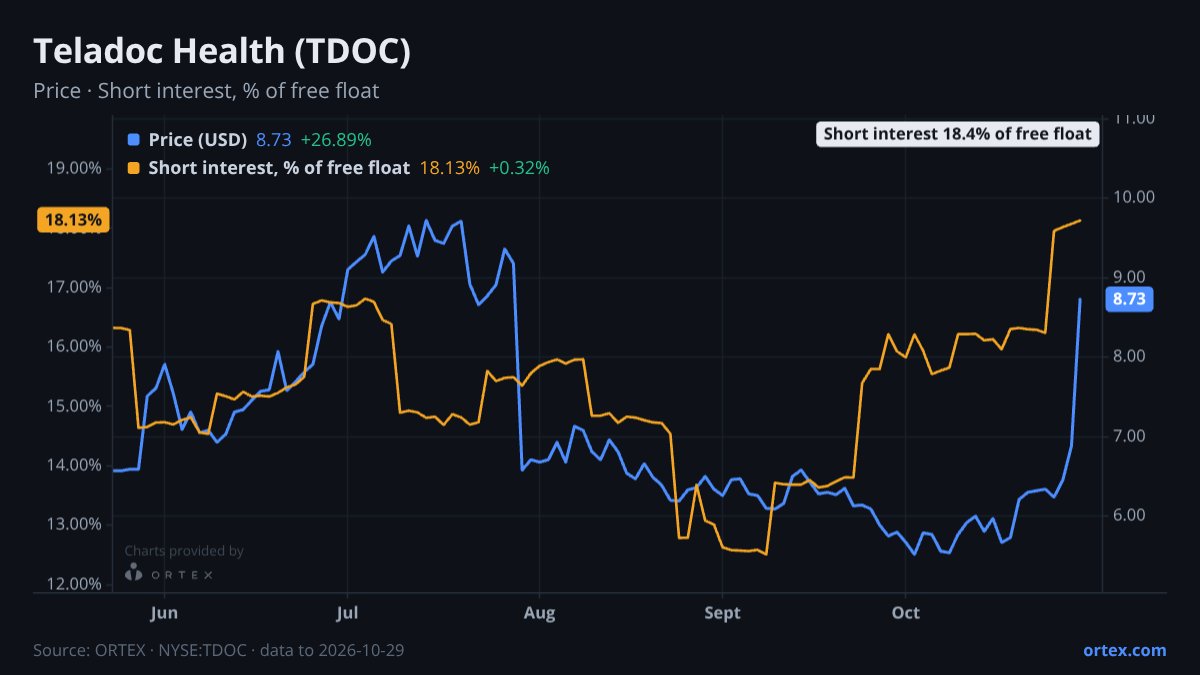
TDOC posted its biggest weekly gain in years on Wednesday's earnings beat, yet short sellers responded by adding to positions rather than retreating, a split that defines where the stock sits heading into November.
The stock closed the week at $8.51, up 34% from the prior Friday after Q3 results landed better than feared. The move was anchored by a single-day surge of 35% on October 28, the day after the print. That is the largest earnings reaction in the recent history available. By Friday, the stock had already given back 2.5% from the post-earnings peak, and it closed above the analyst mean price target of $7.94, a level the stock had not been near for months.
Short sellers did not use the rally to exit. Short interest was at 18.4% of the free float as of October 29, up 11% on the week and 31% over the past month, now at its highest level in at least a year. That weekly move is roughly 2.1 standard deviations above the typical weekly change in short positions, meaning this week's build is historically unusual even accounting for the general upward trend. Critically, the lending market offers no friction to either side: availability is 348%, roughly 3.5 shares still lendable for every one already borrowed, and borrowing costs run at just 0.48%. There is no short squeeze setup here. The short book can grow further at negligible cost, and the ORTEX short score of 67.4 puts TDOC in the bottom seventh percentile of the universe by that measure. The options market has moved only modestly more cautious, with the put/call ratio at 0.48, about 1.7 standard deviations above its 20-day average of 0.45, a mild tilt toward protection but far from extreme.
The Street's reaction to the print was more constructive, though still firmly neutral on the balance. JP Morgan's Lisa Gill raised her target from $8 to $10 on October 30 while holding a Neutral rating, and Stifel lifted its target from $5.50 to $6.50. Needham reiterated Hold without a target. No firm moved to Buy in the immediate post-earnings window. The consensus bull case rests on BetterHelp's early insurance pivot showing traction, with cash-pay revenue holding up better than feared, and on the Integrated Care segment continuing to carry the business. Management tightened FY26 guidance to revenue of $2,395 million to $2,441 million, implying a 4.4% year-over-year decline at the midpoint. That is the bear case in a sentence: the company beat a low bar but is still shrinking, BetterHelp's direct-to-consumer revenue fell 25% year-over-year, and the insurance ramp is still only $32.1 million or 15% of BetterHelp revenue. The EV/EBITDA multiple has expanded to 6.3x on the price move, up about 1.0 turn on the week.
The peer comparison sharpens how isolated this week's move was. PHR fell 2% on the week, WAY fell 3%, and AMWL dropped 6%. TDOC's 34% gain against a median of roughly minus 2% for its closest peers is the kind of divergence that typically invites mean-reversion attention, and the continuing short build suggests at least some market participants are making that bet. Dimensional Fund Advisors filed a new Schedule 13G on October 8, disclosing a 5% passive stake, joining BlackRock at 8.9% and two Vanguard entities totalling around 12% of shares. All positions are as-last-disclosed and subject to change without a further filing below the 5% threshold.
The next scheduled print is February 22, 2027, giving both sides 114 days to reassess. Between now and then, the key variables are how quickly BetterHelp's insurance revenue scales, whether Integrated Care bookings show any acceleration beyond management's "generally in line" description, and whether the short book, now at a year high in absolute terms, begins to cover as the post-earnings rally fades or continues building on the view that the beat changes nothing structural.
Against its own history
This week's change in short interest is 2.1 standard deviations above the company's typical weekly move over the past year. Short interest is at its highest level in at least a year.
Against its peers
Shares moved +34.2% over the past week against a median of -1.6% for its closest peers.
Stocks in this article
See the live data behind this article on ORTEX.
Open TDOC on ORTEX →How this article was generated
- Generated
- 31 Oct 2026, 20:46
- Data as of
- 31 Oct 2026, 20:46
- Prompt version
- v1.0
- Data sources
- Short interestCost to borrowUtilizationOptions flowEarningsAnalyst consensusInstitutional positioningORTEX Alpha signalsRecent ORTEX notesAlt DataPrevious Mi Articles
ORTEX Market Intelligence content is generated by AI from a snapshot of ORTEX's proprietary data and reviewed by the ORTEX team. Content is informational only and does not constitute investment advice.