
QXO Up 27% in a Month, Yet Short Sellers Hold 17.8% of the Float
Produced automatically from ORTEX data and published under the ORTEX News editorial standards set by Peter Hillerberg, Editor, ORTEX News. How we publish
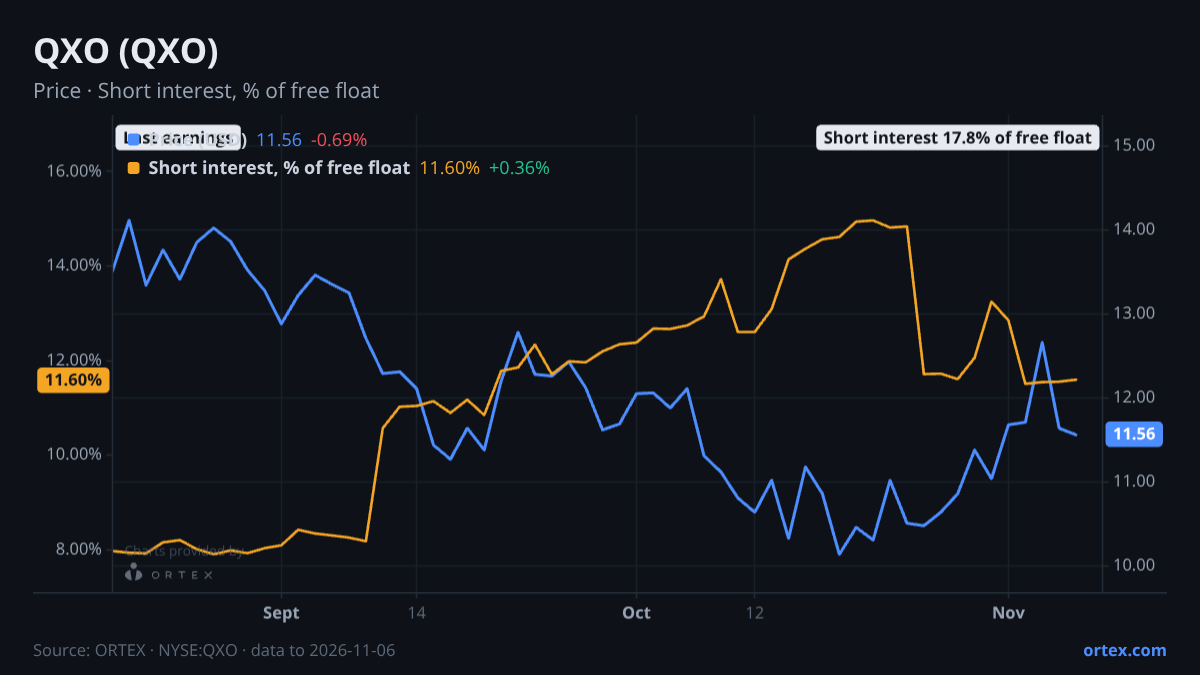
QXO jumped 19% on Monday alone, extending a 27% one-month rally to $13.78, yet short sellers still hold 17.8% of the free float, nearly 120 million shares, going into Wednesday's earnings print.
That gap between price action and positioning is the defining tension. The short position peaked above 154 million shares in late October and has since unwound by roughly 22%. But the retreat has slowed: shares short edged up 0.4% in the most recent session, and the ORTEX short score remains at 71.6, a level consistent with meaningful bearish conviction. Borrow conditions are relaxed enough that adding new short exposure carries little friction. Cost to borrow is below 1%, and availability at 80% means plenty of lending supply remains for anyone wanting to press the trade. The options market is not flashing alarm either: the put/call ratio at 0.36 is barely above its 20-day average, well below any reading that would suggest defensive crowding.
Analysts are broadly bullish but have been cutting their numbers. Wells Fargo trimmed its target twice in October, landing at $15, while Truist slashed from $26 to $15 and RBC came down from $27 to $18. The mean target across the consensus is $24, implying roughly 74% upside from current levels, but that figure has been drifting lower for months. The bull case rests on QXO's acquisition strategy in the fragmented $800 billion building products distribution market, with CEO Brad Jacobs targeting nearly $50 billion in annual revenues within a decade. The TopBuild deal and the ongoing Beacon technology rollout are the near-term milestones the market is tracking. Bears focus on a different set of numbers: the stock trades around 18x NTM pro forma adjusted EBITDA on a framework that assumes $5.5 billion of EBITDA by 2030, leaving thin margin for integration missteps, ERP disruption, or any softening in roofing demand.
Bradley Jacobs remains the dominant presence on the register, with a Schedule 13D showing 35.9% of shares as last disclosed, down from 49% at the prior filing. That drawdown in his disclosed stake is worth noting in the ownership context. Jared Kushner also holds a 13D position, most recently disclosed at 4.9%. As with all Schedule 13D/G filings, these figures reflect positions around the time of disclosure; holders who drop below 5% are not required to file again. Among institutional names, Orbis holds roughly 10% per its last 13G, while Morgan Stanley, Invesco, and Baillie Gifford have each reduced their disclosed stakes in recent months.
The past three earnings prints have all produced negative one-day reactions, ranging from roughly 1% to 4% down, with five-day moves mixed but mostly soft. Wednesday's release is the first print since the Beacon acquisition materially changed the company's revenue base, so the historical reaction pattern offers only limited guidance. The print tests whether the integration is tracking toward the $1.05 billion adjusted EBITDA target modelled for 2026, and whether demand signals in roofing justify the trajectory Jacobs has laid out for the decade ahead.
Against its own history
This week's change in short interest is 1.5 standard deviations below the company's typical weekly move over the past year.
Against its peers
Shares moved +18.0% over the past week against a median of +1.2% for its closest peers.
Stocks in this article
See the live data behind this article on ORTEX.
Open QXO on ORTEX →How this article was generated
- Generated
- 10 Nov 2026, 04:10
- Data as of
- 10 Nov 2026, 04:01
- Prompt version
- v1.0
- Data sources
- Short interestCost to borrowUtilizationOptions flowEarningsAnalyst consensusInstitutional positioningORTEX Alpha signalsRecent ORTEX notesPrevious Mi Articles
- Validation notes
- soft: missing section mentions: short interest (informational only)
ORTEX Market Intelligence content is generated by AI from a snapshot of ORTEX's proprietary data and reviewed by the ORTEX team. Content is informational only and does not constitute investment advice.