
PANW Drops 22% in a Month, Options Defensiveness Hits Near-Annual High
Produced automatically from ORTEX data and published under the ORTEX News editorial standards set by Peter Hillerberg, Editor, ORTEX News. How we publish
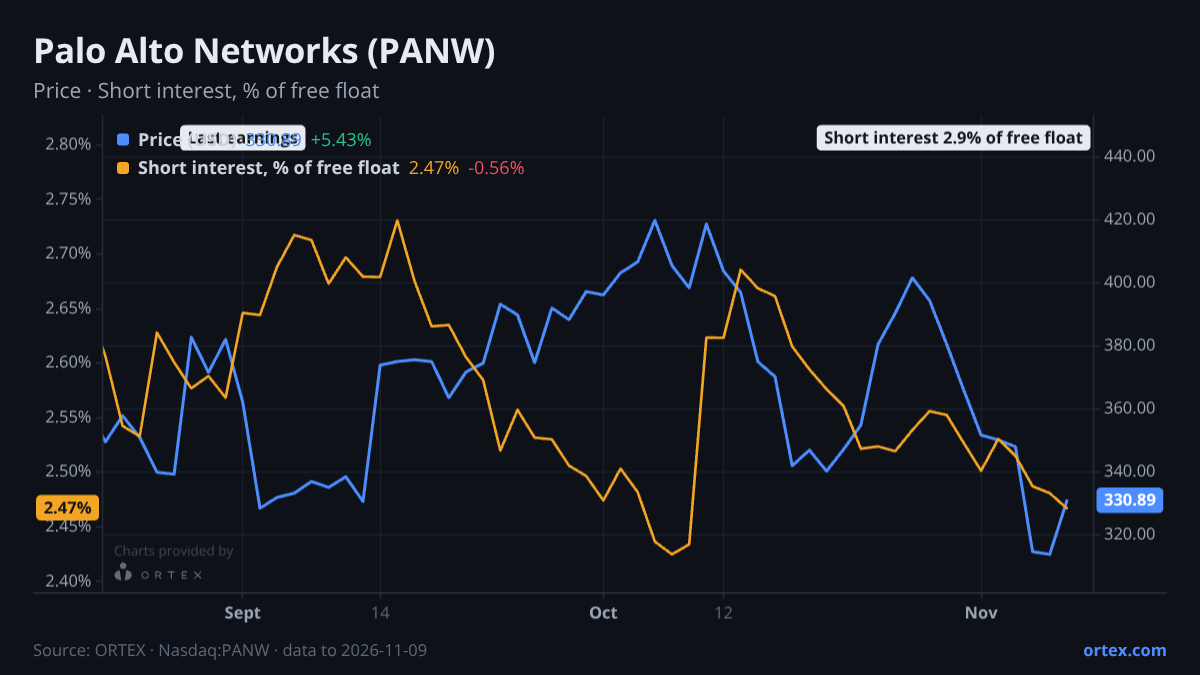
Palo Alto Networks has shed 22% over the past month, closing at $326.36 on November 10, a further leg down from the $365.87 reported two weeks ago, as the cybersecurity sector selloff deepens ahead of Thursday's print.
Options positioning captures how much the mood has shifted. Demand for downside protection has climbed to its most elevated level in nearly a year: the put/call ratio of 0.98 is running almost 1.8 standard deviations above its 20-day average of 0.91. For context, the 52-week high is 1.19, so the current reading is well inside panic territory, but the direction is clear and the move is recent. The PCR was sitting below 0.87 as recently as mid-October; it has drifted steadily higher through November as the stock slid. Peer action reinforces the caution. CrowdStrike fell 7.7% on the week, Tenable lost 10.8%, and Qualys was down 16.8%. PANW's 6.8% weekly decline is softer than the peer median of roughly 4.8% to the downside, but the cohort is broadly under pressure, not staging a recovery.
The short-selling picture offers a sharp contrast to that defensive options posture. At 2.9% of the free float, short interest is modest and has been falling steadily, down about 2.5% over the past week and 1.5% over the past month. Borrow cost has collapsed, dropping roughly 70% over the past week to just 0.15%, the lowest level in the 30-day history of the data. Availability is effectively unconstrained, with far more shares available to lend than are currently borrowed. That combination tells a specific story: whoever is nervous about PANW ahead of Thursday is buying puts, not building a short position. The two signals are pointing in different directions, and that divergence is itself informative.
The debate among analysts is split across a wide price range, though the majority direction remains constructive. Several Buy-rated firms raised targets in October, with Wells Fargo moving to $525 and Citigroup to $440 in the two weeks around mid-month. Morgan Stanley lifted to $410 in late September. Set against that, Bernstein downgraded to Market Perform in September after raising its target to $351, a price now only modestly above where the stock is trading. The bull case rests on platformization momentum: 220 net new platform deals, 120% net revenue retention among platformized customers, and roughly 46% of a $20 billion NGS ARR target already in hand. The bear case is simpler: core revenue growth slowed from 14.1% to 13.0% last quarter, macro headwinds are real, and a renewed M&A posture adds integration risk on top of a P/E that remains above 74 times even after the selloff.
The last time PANW reported, in September, the stock fell 14% on the day and lost nearly 12% over the subsequent five sessions. The print before that produced a 2.6% one-day decline and an 8.7% five-day slide. Thursday's release will test whether the recent month-long selloff has already priced in the slowdown that bears expect, or whether guidance on platform deal trajectory and ARR growth can shift the conversation back toward the figures that bulls are underwriting.
Against its peers
Shares moved -6.8% over the past week against a median of -4.8% for its closest peers.
Stocks in this article
See the live data behind this article on ORTEX.
Open PANW on ORTEX →How this article was generated
- Generated
- 11 Nov 2026, 04:11
- Data as of
- 11 Nov 2026, 04:01
- Prompt version
- v1.0
- Data sources
- Short interestCost to borrowUtilizationOptions flowEarningsInstitutional positioningORTEX Alpha signalsRecent ORTEX notesAlt DataPrevious Mi Articles
ORTEX Market Intelligence content is generated by AI from a snapshot of ORTEX's proprietary data and reviewed by the ORTEX team. Content is informational only and does not constitute investment advice.