
HGV shorts surge as the stock bounces 32% in a month
Produced automatically from ORTEX data and published under the ORTEX News editorial standards set by Peter Hillerberg, Editor, ORTEX News. How we publish
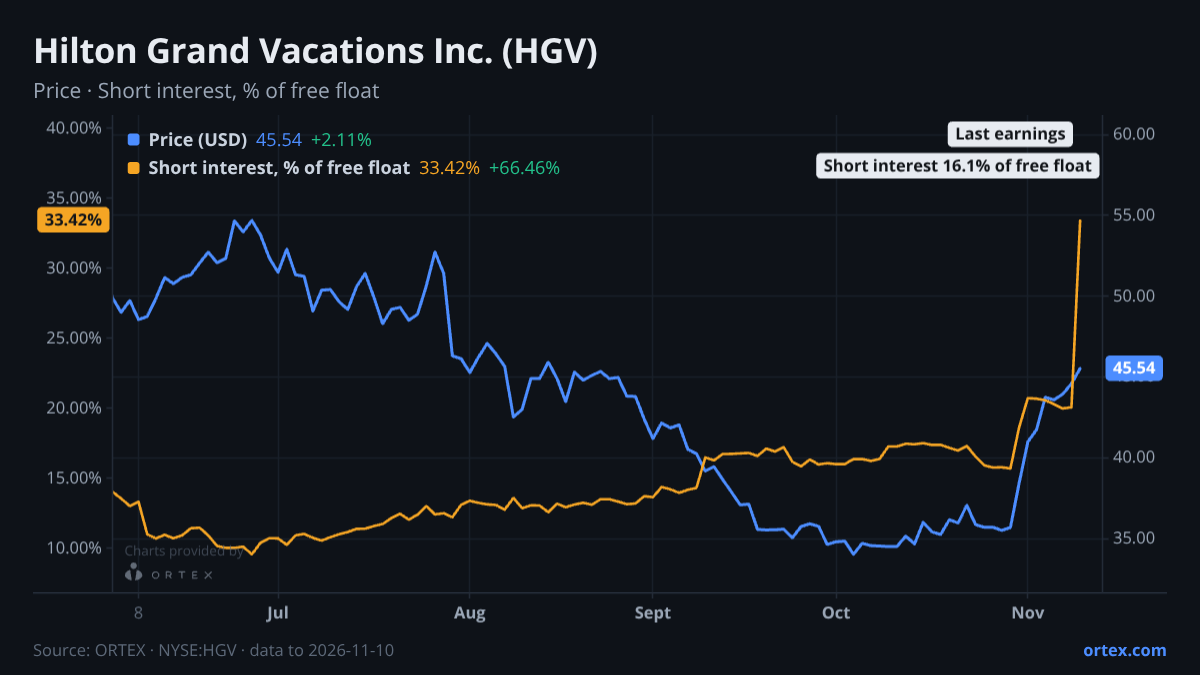
Hilton Grand Vacations is trading at an uncomfortable intersection this week: short interest has jumped 61% in seven days to its highest level in months, yet the stock itself is up 9% on the week and 32% over the past month, and insiders were buying in the open market just days ago.
The short positioning story is striking in its size and speed. Short interest now accounts for 16.1% of the free float, up from roughly 8.2% a week ago, with the daily estimate surging 66% on November 10 alone. That takes the one-month increase to 76%. For context, the official FINRA fortnightly figure put SI at 13.9 million shares with a days-to-cover of 11.2, confirming that shorts have meaningful ground to cover if they need to exit. Despite the positioning, the borrow market remains far from stressed: availability has actually loosened sharply over the week, rising from 113% to 165%, meaning there is now more than one and a half shares available to borrow for every share currently shorted. Cost to borrow is a negligible 0.57%, barely moved from its recent range. This is not a squeeze-ready setup. The lending pool is comfortable. What it looks like instead is a fresh wave of conviction short-selling into the rally, not a trapped position scrambling to find shares.
Options positioning adds a nuanced signal. The put/call ratio has climbed to 0.11, well above its 20-day mean of 0.059, putting it about 1.4 standard deviations above average. That is elevated by recent standards, though the 52-week range runs from 0.005 to 1.02, so in absolute terms calls still dominate the flow heavily. Investors are adding a little more protection than they were a month ago, but the options market is not screaming fear. The ORTEX short score sits at 77.3, its highest reading in at least two weeks, driven primarily by the rapid increase in shares short rather than any tightening of the borrow.
The Street's posture is notably cautious relative to where the stock is now trading. Following the Q3 earnings print on October 29, which pushed the stock up 8% on the day and 23% over the following five days, analysts responded by cutting targets rather than raising them. Goldman Sachs lowered its target to $35 and JP Morgan moved to $38, both holding Neutral. Barclays trimmed to $39 while Citizens downgraded outright to Market Perform from Market Outperform, also in the first week of November. The consensus mean price target is $47.70, only about 5% above the current price of $45.54, leaving thin implied upside at the consensus level. Wells Fargo has the most aggressive cut on record over the past month, dropping its target from $51 to $38 in mid-October. Only Truist maintains a Buy, with a target of $69 that sits well above the pack. Factor scores reflect the same cautious tone: analyst recommendation differential ranks in just the 6th percentile, and earnings momentum over both 30 and 90 days ranks in the bottom quartile. The bull case rests on widening net interest spreads, a $13 billion inventory covering six years of sales, and improving securitisation cash flow. Bears point to weakened consumer sentiment, compressed spreads in existing portfolios, and foreign currency drag.
Insider activity in early November cuts against the analyst caution. CEO Mark Wang bought 12,200 shares in the open market on November 2 at $40.92, a discretionary purchase with no 10b5-1 plan attached, worth roughly $499,000. Director Leonard Potter added 2,500 shares the following day at $41.55, also outside any pre-arranged plan. Both trades were made before the stock cleared $45. Net 90-day insider activity is negative at around minus $3 million, partly reflecting an August sale by another insider, but those two November open-market buys from the CEO and a board member carry more signal weight than the aggregate. Apollo Global Management remains the dominant holder with 15.9% of shares as of its last 13D/A filing in June, itself an activist on the register alongside CAS Investment Partners, which filed a fresh Schedule 13D in August at 6.5%. Disclosure caveat applies: Schedule 13D positions are reported around the 5% threshold and may not reflect current holdings.
The setup to watch into the next quarter is whether the new short position that arrived in force on November 10 is a response to the post-earnings move running ahead of fundamentals, or whether it reflects concern about the company's near-term operating outlook ahead of the February 25 earnings date. With analysts clustered at or below the current price, a 32% monthly rally, and yet fresh insider buying at lower levels all in the same picture, the disagreement between different categories of market participant is as wide as it has been all year.
Against its own history
This week's change in short interest is 7.9 standard deviations above the company's typical weekly move over the past year. Short interest is at its highest level in at least a year.
Against its peers
Shares moved +9.1% over the past week against a median of +6.4% for its closest peers.
Stocks in this article
See the live data behind this article on ORTEX.
Open HGV on ORTEX →How this article was generated
- Generated
- 11 Nov 2026, 17:33
- Data as of
- 11 Nov 2026, 17:23
- Prompt version
- v1.0
- Data sources
- Short interestCost to borrowUtilizationOptions flowEarningsAnalyst consensusInstitutional positioningORTEX Alpha signalsRecent ORTEX notesAlt Data
ORTEX Market Intelligence content is generated by AI from a snapshot of ORTEX's proprietary data and reviewed by the ORTEX team. Content is informational only and does not constitute investment advice.