
Boeing Shorts Jump 17% in a Day as Peers Rally Past It
Produced automatically from ORTEX data and published under the ORTEX News editorial standards set by Peter Hillerberg, Editor, ORTEX News. How we publish
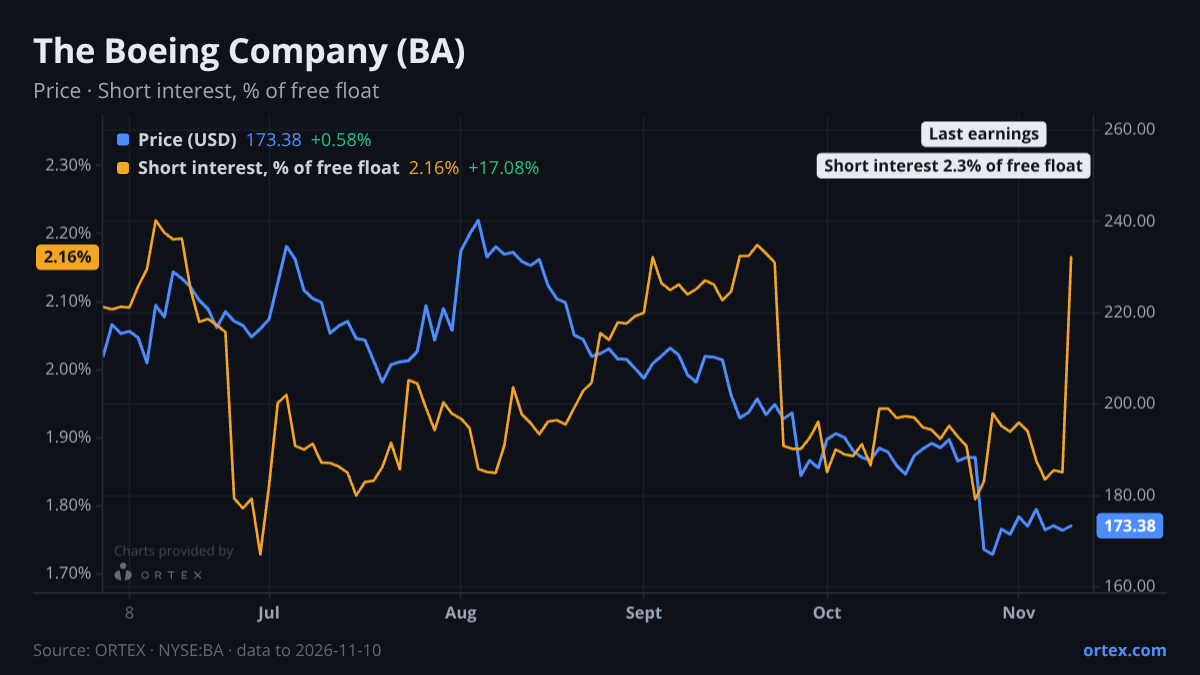
Short interest in BA rose 17% in a single session on November 10, the steepest one-day jump in at least a year, pushing the position to its highest level in that period at 2.25% of free float. That move arrives as the stock has gone essentially nowhere over the past week, up just 0.04%, while its closest correlated peers gained a median of 4.2%. The gap is hard to ignore.
The short position had been drifting between 14.5 million and 15.3 million shares for most of October, then broke higher abruptly. At 17.1 million shares, it now sits 2.2 standard deviations above Boeing's typical weekly move over the past year. This week's swing is therefore well outside the normal range, not a gradual build. The borrow market tells a different story on intensity: cost to borrow is 0.46%, up 54% over the past month but still firmly in the inexpensive range. Availability is effectively unconstrained at nearly 4,900%, meaning there are roughly 49 shares available to lend for every one already borrowed, so the new shorts faced no friction establishing positions. The lending market is not squeezed; this is fresh demand, not a forced cover.
Options positioning reinforces that the mood around Boeing is somewhat cautious, though not extreme. The put/call ratio has drifted to 0.77, a full standard deviation below its 20-day average of 0.80. That places it near the most call-heavy reading of the past year (the 52-week low is 0.72), which at first glance looks bullish. Reading it alongside the short-interest jump, though, the more natural interpretation is that options traders are using calls to bet on a recovery while a separate group is adding shorts as a hedge on execution risk. The two camps are co-existing rather than converging.
The Street reflects exactly that tension. Following the Q3 results in late October, virtually every analyst covering Boeing trimmed their price target. JP Morgan cut from $290 to $240. Barclays moved from $300 to $250. Wells Fargo went from $250 to $210. Not one firm dropped its positive rating: every cut was a target reduction on a maintained Buy or Overweight, a collective acknowledgement that the FCF timeline has slipped without a loss of faith in the destination. The mean target now is $233, implying roughly 34% upside from $173.38. The bull case rests on the $745 billion backlog and Q3's first positive free cash flow in some time at $464 million, with management pointing to roughly $10 billion in FCF by 2029. The bear case is that the bridge to that number has been pushed out by about a year: 2027 FCF guidance of $3 billion compares to a prior Street consensus near $5.7 billion, and the 737 MAX remains the single most important variable in the near-term cash equation. The EV/EBITDA multiple has expanded 7 points over the past 30 days to 29.6x, reflecting both the price decline and the compressed earnings base, while the PE of 110x captures how thin current earnings coverage remains.
Two directors made open-market purchases on October 30, the same day as the latest insider cluster filing. Mortimer Buckley spent roughly $998,000 at $171.55 and Steven Mollenkopf added around $510,000 at $173. Neither purchase was made under a 10b5-1 plan, which makes them discretionary. Combined, the 90-day net insider position is positive at approximately $1.5 million, a small but unambiguous signal that board members are willing to buy at current prices. That contrasts with executive-level F-code transactions from August and February, which were compensation-related tax withholding and carry little directional meaning.
The peer comparison adds another layer of context to Boeing's week. Correlated names including SAF and SARO gained 9.7% and 12.9% respectively over the week. AIR added 7.7%. Boeing's flat week looks more striking against that backdrop. The Q3 earnings print on October 27 produced an 11% one-day drop, and the stock has not recovered that ground in the two weeks since, closing at $173.38, well below where it traded before the report.
The next scheduled earnings date is January 27, 2027, 77 days away. Between now and then, the number to track is 737 delivery pace: management has guided for under 500 aircraft in 2026, with a target of 47 per month in early 2027 before a possible step to 52 per month in the second half. Any update to that production cadence, positive or negative, is the data point that will move both the shorts and the analyst targets more than anything else on the calendar.
Against its own history
This week's change in short interest is 2.2 standard deviations above the company's typical weekly move over the past year. Short interest is at its highest level in at least a year.
Against its peers
Shares moved +0.0% over the past week against a median of +4.2% for its closest peers.
Stocks in this article
See the live data behind this article on ORTEX.
Open BA on ORTEX →How this article was generated
- Generated
- 11 Nov 2026, 18:08
- Data as of
- 11 Nov 2026, 18:01
- Prompt version
- v1.0
- Data sources
- Short interestCost to borrowUtilizationOptions flowEarningsAnalyst consensusInstitutional positioningORTEX Alpha signalsRecent ORTEX notesAlt Data
ORTEX Market Intelligence content is generated by AI from a snapshot of ORTEX's proprietary data and reviewed by the ORTEX team. Content is informational only and does not constitute investment advice.