
Goldman Sachs Shorts Retreat as CEO Sells Into the Recovery
Produced automatically from ORTEX data and published under the ORTEX News editorial standards set by Peter Hillerberg, Editor, ORTEX News. How we publish
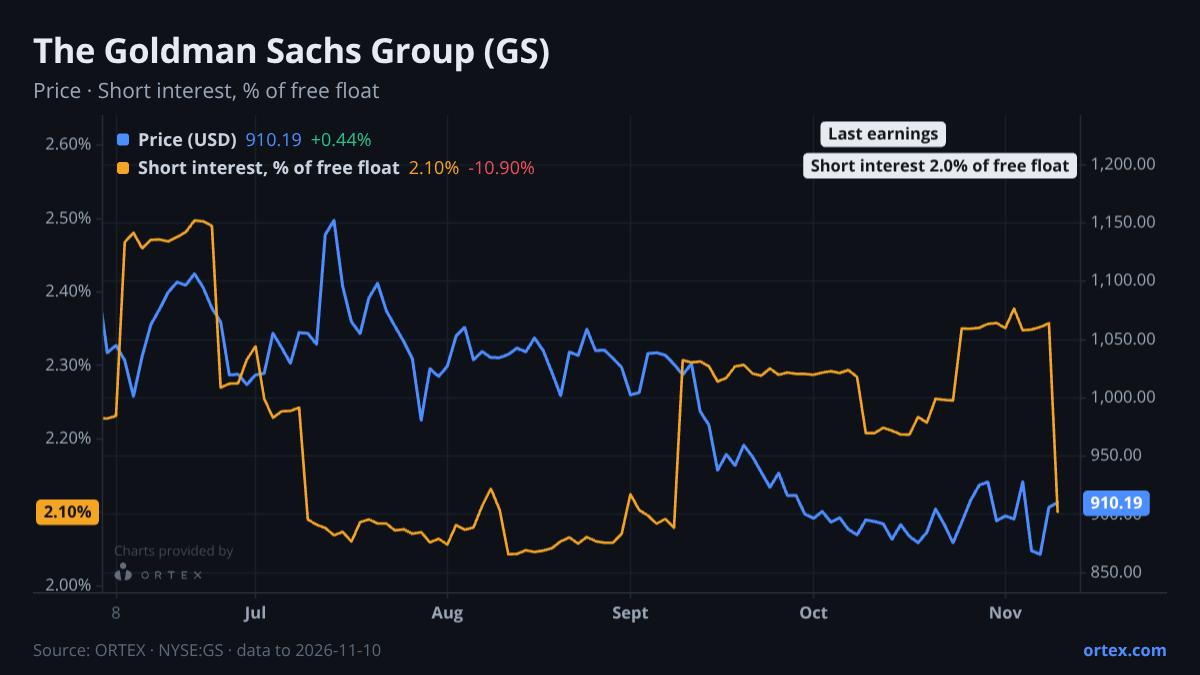
Goldman Sachs has recovered sharply from last week's underperformance, gaining 1.6% to $910.19, but the week's most distinctive data point is a short interest drop that is statistically unusual even for a stock this size.
Among GS's closest peers, short positioning looks notably lighter than elsewhere. Lazard surged 7.1% on the week, suggesting some short covering pressure in the advisory space, while Morgan Stanley edged up 0.8% and State Street added 1.1%. GS's 1.6% gain sits modestly above the peer median, but what sets it apart is the direction of the shorts: short interest fell 11.5% over the past week to roughly 2% of the free float, a move 2.8 standard deviations below GS's typical weekly change over the past year. That is not a marginal trim. It is a material retreat from a position that was already modest.
The borrow market reflects the same picture of low conviction on the short side. Availability is extraordinarily loose, with roughly 190 million shares available to borrow against a short book of around 6.3 million, leaving no meaningful squeeze risk in the lending pool. The cost to borrow has edged up 15% on the week to 0.35%, but that remains well within normal territory for a large-cap bank. Options positioning has normalised from last week's extreme call-side skew. The put/call ratio is 0.79, essentially in line with its 20-day average of 0.80 and within a fraction of a standard deviation of that mean. Last week's near-record low PCR of 0.77, which was flagged in the previous note, has reverted. The setup has moved from unusually bullish to neutral.
The Street is broadly cautious on valuation even as it acknowledges franchise strength. The bull case rests on Goldman's franchise durability: 35 consecutive quarters of long-term fee-based inflows, an 18.7% return on equity in Q3, and a CET1 ratio of 12.4%. The bear case centres on the volatility of its capital-markets revenues, with investment-related net revenues collapsing to $50 million in Q3 from $441 million the prior quarter, alongside a 30% year-on-year rise in operating expenses. Most recent analyst moves since the Q3 print have been target reductions. UBS maintained Neutral and trimmed to $1,000. Citi and RBC both cut targets while holding neutral-equivalent ratings. JP Morgan was an exception, nudging its target up to $970. The mean price target of $1,031 implies around 13% upside from current levels, but the direction of travel from the analyst community has been cautious rather than constructive.
The insider picture is worth noting precisely because it cuts against the recovering price action. CEO David Solomon sold approximately $11 million of stock on October 27, the week before the previous note was published, with no 10b5-1 plan declared, meaning these were discretionary sales rather than pre-scheduled. The Chief Administrative Officer also sold smaller amounts across the same period. Net insider sales over the past 90 days total roughly $12.2 million. The FDIC call report data from the ORTEX Alt Data layer adds some balance: Goldman's net loans and leases have risen for nine consecutive quarters, and total assets have grown for six consecutive quarters to $758.8 billion as of the most recent period. Buyback spend in Q2 was $4 billion, the largest second quarter on record since 2009 and 33% above the prior year. These are measures of balance-sheet momentum, not short-term earnings direction.
The next earnings event falls on January 19, 2027, 69 days away. With shorts at their lightest levels in months and options positioning back to neutral, the picture to watch is whether the insider selling and the analyst target-trimming trend continue even as the stock holds above $900.
Against its own history
This week's change in short interest is 2.8 standard deviations below the company's typical weekly move over the past year.
Against its peers
Shares moved +1.6% over the past week against a median of +1.0% for its closest peers.
Stocks in this article
See the live data behind this article on ORTEX.
Open GS on ORTEX →How this article was generated
- Generated
- 11 Nov 2026, 18:23
- Data as of
- 11 Nov 2026, 18:23
- Prompt version
- v1.0
- Data sources
- Short interestCost to borrowUtilizationOptions flowEarningsAnalyst consensusInstitutional positioningORTEX Alpha signalsRecent ORTEX notesAlt DataPrevious Mi Articles
ORTEX Market Intelligence content is generated by AI from a snapshot of ORTEX's proprietary data and reviewed by the ORTEX team. Content is informational only and does not constitute investment advice.