
Lilly's Short Sellers Retreat After Blowout Quarter
Produced automatically from ORTEX data and published under the ORTEX News editorial standards set by Peter Hillerberg, Editor, ORTEX News. How we publish
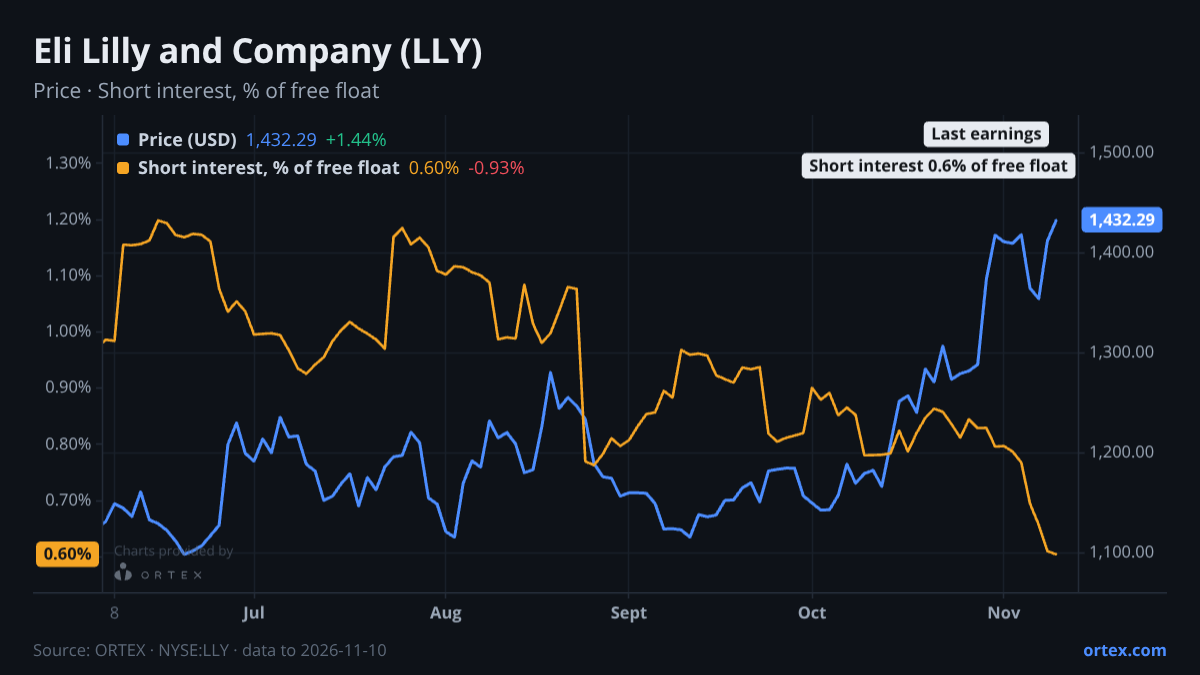
Eli Lilly and Company makes the GLP-1 drugs reshaping obesity treatment worldwide, and right now the investors betting against it are walking away at the fastest pace in at least a year.
Short interest has fallen 24% over the past week alone, dropping to 0.6% of the free float. That is the lowest bearish positioning the stock has seen in at least twelve months, and the month-on-month decline of 32% confirms this is not a one-week blip. The retreat tracks directly to the Q3 earnings print on October 29, when Mounjaro sales rose 65% to $10.72 billion and Zepbound climbed 49% to $5.35 billion, figures that knocked away the fundamental case for a short position. The borrowing market reflects the same picture: availability is effectively uncapped, with hundreds of millions of shares available to lend, and cost to borrow has drifted up slightly to 0.32% but remains in territory that signals no tension whatsoever. The ORTEX short score has also moved lower over the past two weeks, now at 28.6 from 30.0 on October 30, consistent with the direction of the underlying data.
Options positioning offers a sharper contrast. Put demand is running above its recent average, with the put/call ratio at 1.36, still well above the 20-day mean of 1.28, even though it has pulled back from the 1.43 peak reached on November 6. That peak was the highest reading of the past year. The pattern is worth noting: short sellers reduced exposure sharply after results, while options traders continued adding downside protection. The two camps are not telling the same story. One reads the Q3 print as confirmation of the bull case; the other is hedging against something, perhaps pricing pressure, competition, or the stock's premium valuation.
The Street is firmly in the first camp. Following the earnings release, almost every major firm raised its price target. JPMorgan lifted to $1,650, UBS to $1,625, Citigroup to $1,650, and Morgan Stanley to $1,596. This week Jefferies moved to $1,700, the highest published target in the recent cluster. The mean consensus target is $1,442, which at the current price of $1,432 implies only modest upside on paper, though many of the individual targets sit between $1,596 and $1,700, well above where the stock is trading. The bull argument centres on the incretin franchise still being early in penetration, patent protection running past 2035, and pipeline assets in obesity, oncology and immunology broadening the revenue base. The bear case rests on pricing pressure from competition and Medicare negotiation, the risk that Mounjaro and Zepbound growth slows faster than modelled, and valuation: the stock trades at a PE near 30 and EV/EBITDA of roughly 24, leaving limited cushion if earnings disappoint.
Momentum and analyst positioning factor scores rank in the 80s and 90s respectively, reflecting how thoroughly consensus has aligned with the growth story. The EPS momentum reading over both 30 and 90 days sits above the 80th percentile. The valuation factor is the outlier, scoring in the 28th percentile on EV/EBIT, confirming that the premium is acknowledged even by those holding the stock.
On the ownership register, Lilly Endowment remains the dominant holder at around 10% of shares, unchanged in its long-term character. BlackRock added roughly 1.2 million shares in the most recent reported period, and State Street added about 606,000. Insider activity in early November was largely routine: tax-withholding filings tied to option exercises, and one pre-arranged 10b5-1 plan sale by the General Counsel for $7 million. No open-market buying or selling from senior executives to flag.
The stock has recovered from the $1,354 close flagged in the previous note to $1,432 this week, a gain of 1.6%, slightly behind the 2.3% median of its closest peers. Johnson & Johnson and Royalty Pharma each gained between 4% and 5% on the week. The relative lag is modest rather than structural. What narrows or widens that gap next is the interplay between the still-elevated options hedging and the pace at which the analyst target repricing in the $1,600 to $1,700 range is absorbed by the market ahead of the next earnings date in February 2027.
Against its own history
This week's change in short interest is 2.3 standard deviations below the company's typical weekly move over the past year. Short interest is at its lowest level in at least a year.
Against its peers
Shares moved +1.6% over the past week against a median of +2.3% for its closest peers.
Stocks in this article
See the live data behind this article on ORTEX.
Open LLY on ORTEX →How this article was generated
- Generated
- 11 Nov 2026, 18:31
- Data as of
- 11 Nov 2026, 18:23
- Prompt version
- v1.0
- Data sources
- Short interestCost to borrowUtilizationOptions flowEarningsAnalyst consensusInstitutional positioningORTEX Alpha signalsRecent ORTEX notesAlt DataPrevious Mi Articles
ORTEX Market Intelligence content is generated by AI from a snapshot of ORTEX's proprietary data and reviewed by the ORTEX team. Content is informational only and does not constitute investment advice.