
Wells Fargo Shorts Spike While Peers Drift Higher
Produced automatically from ORTEX data and published under the ORTEX News editorial standards set by Peter Hillerberg, Editor, ORTEX News. How we publish
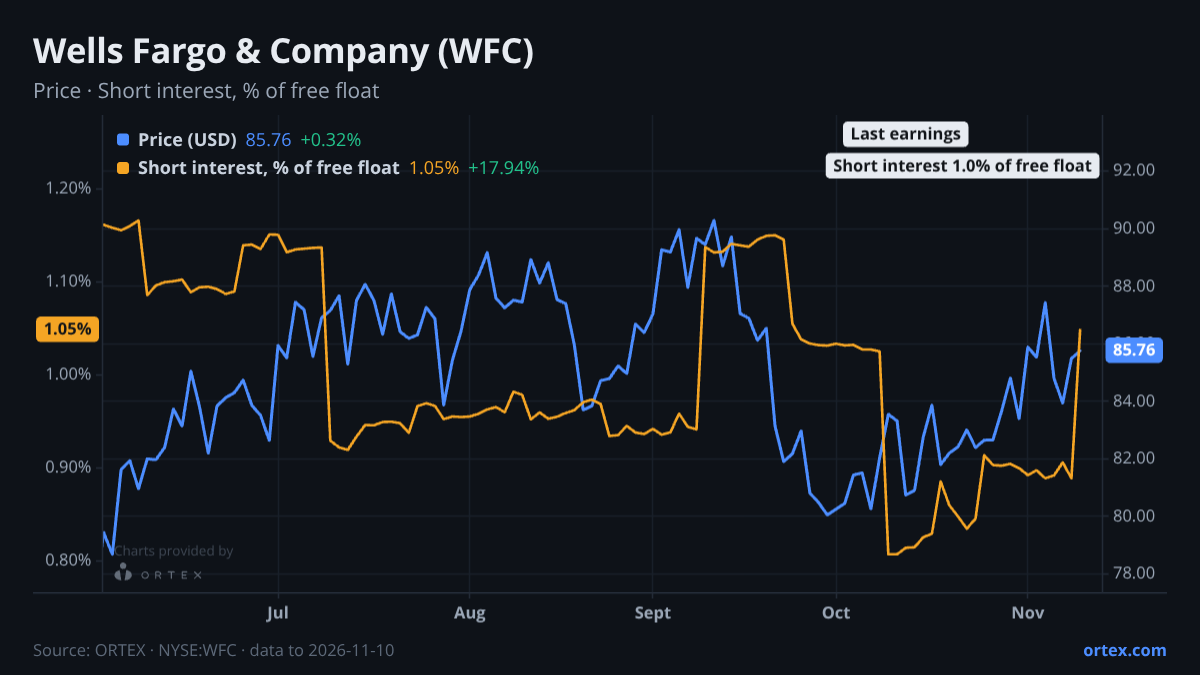
Wells Fargo is the most shorted name in its immediate peer group this week, by some distance, even as short interest in the broader large-cap banking sector stays low.
Short positions jumped 18% in a single session on November 10, lifting WFC's short interest to 1.0% of free float. That compares to a range that has held between 0.8% and 0.9% for most of the past six weeks. The move is roughly 2.1 standard deviations above the typical weekly change over the past year, making it the most statistically unusual short interest print for the stock in recent memory. Among close peers, BAC added 2.1% on the week and USB rose 1.4%. WFC managed just 0.3%, the softest performance in the group. Even so, in absolute terms a 1% short interest reading leaves WFC far from crowded territory. The jump is notable for its pace, not its level.
The lending market supports that read. Availability is effectively unlimited, with over 1.5 billion shares available to borrow at a cost of 0.47%, a figure that has drifted higher over the past month but remains near the bottom of any meaningful range. Nothing in the borrow market suggests forced covering or a supply squeeze. Options positioning has eased slightly from its most defensive readings. The put/call ratio is 1.50, still above the 52-week midpoint but a touch below its recent 20-day average of 1.55 and well off the year's high of 1.67 hit in late October. Taken together, the lending and options picture is consistent with routine hedging, not a building conviction short.
The Street remains cautious rather than hostile. The consensus is a hold, with nine analysts sitting on the sideline and four at outperform. Following October's quarterly print, Morgan Stanley upgraded to Overweight while simultaneously trimming its target to $101. RBC cut its target more sharply, from $100 to $92, and JP Morgan nudged its target to $92 at the end of October, both keeping their ratings unchanged. The mean target across recent moves sits in the $92 to $101 range against a current price of $85.76, implying modest upside on most scenarios. The bull case rests on book value growth, with book value per share up 9% year-on-year to $53.24, and core ROE of 13.3%. The bear case centres on the CET1 ratio slipping to 10.6% and noninterest income falling to $8.96 billion from $9.49 billion the prior quarter. Valuation is undemanding: the stock trades at 10.9 times earnings and 1.4 times book.
The company's own regulatory data adds texture to the credit side of that debate. FDIC call reports show total assets have risen for seven consecutive quarters, reaching $1.92 trillion as of April 2026, with net loans and leases also up for seven straight quarters at $990 billion. Consumer credit data from EDGAR ABS trust filings shows the gross charge-off rate has fallen for three consecutive months to 2.43% and the net charge-off rate has dropped to 1.92% over the same stretch. Neither dataset has yet accumulated enough history for ORTEX to test whether it leads Wells Fargo's reported figures, so these readings are descriptive rather than forward-looking. One counterpoint to the credit improvement: buyback spend has fallen for three consecutive quarters and hit its smallest Q2 reading in three years at $3.0 billion, suggesting capital deployment priorities have shifted.
The next earnings event is scheduled for January 14, 2027, 64 days away. The level to watch on short interest is whether this week's spike consolidates above 1% of float or retraces to the mid-0.8% range that prevailed through most of October, which would indicate the move was transactional rather than the start of a new positioning trend.
Against its own history
This week's change in short interest is 2.1 standard deviations above the company's typical weekly move over the past year.
Against its peers
Shares moved +0.3% over the past week against a median of +0.8% for its closest peers.
Stocks in this article
See the live data behind this article on ORTEX.
Open WFC on ORTEX →How this article was generated
- Generated
- 11 Nov 2026, 18:52
- Data as of
- 11 Nov 2026, 18:46
- Prompt version
- v1.0
- Data sources
- Short interestCost to borrowUtilizationOptions flowEarningsAnalyst consensusInstitutional positioningORTEX Alpha signalsRecent ORTEX notesAlt Data
ORTEX Market Intelligence content is generated by AI from a snapshot of ORTEX's proprietary data and reviewed by the ORTEX team. Content is informational only and does not constitute investment advice.