
Toyota borrow market rebuilds as Freedom Broker cuts to Hold
Produced automatically from ORTEX data and published under the ORTEX News editorial standards set by Peter Hillerberg, Editor, ORTEX News. How we publish
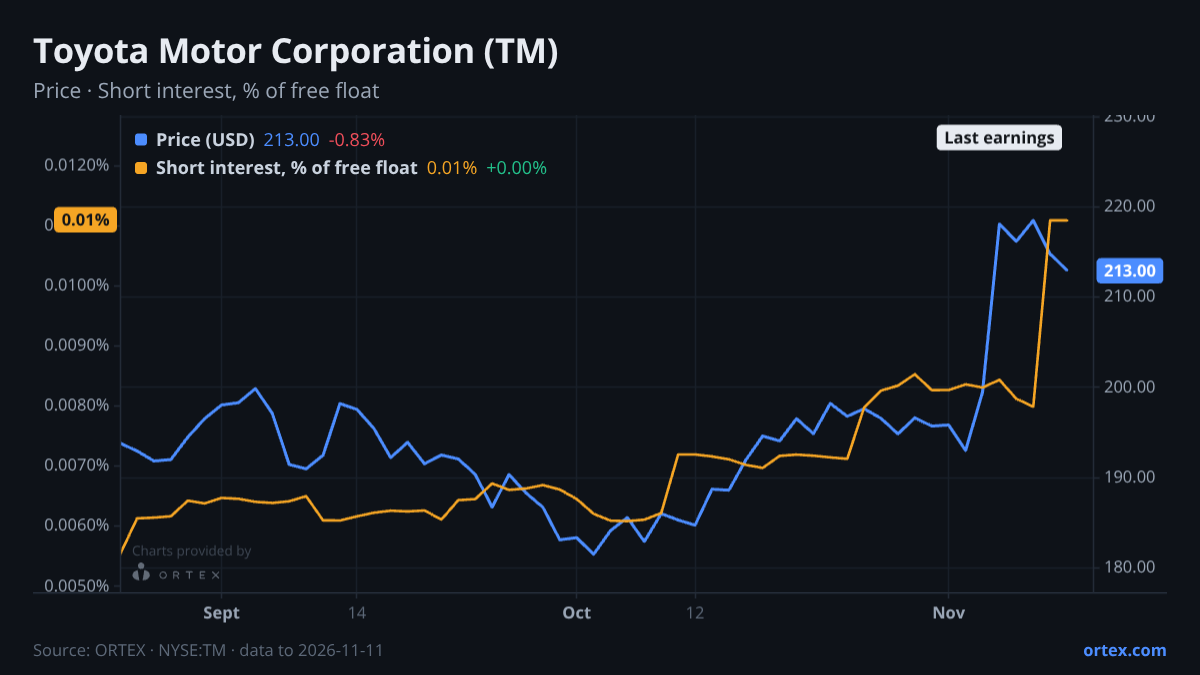
TM short interest has jumped 33% in one week to 1.69 million shares, the highest level since early October. That weekly swing is roughly 2.5 standard deviations above Toyota's typical move over the past year.
A third tightening cycle in six weeks
The borrow market has now gone through two full relief-and-squeeze cycles since the November 5 earnings print. The previous ORTEX convergence report documented availability collapsing to 2.4% in the days immediately after results landed. A brief recovery followed. Availability now stands at 38.2%, up sharply from the near-zero levels of early November but down from the loose conditions that preceded the pre-earnings squeeze.
For context: the 52-week low in availability is 0.23%, hit during the worst of the pre-earnings crunch. At 38.2%, the lending pool is tighter than it was through most of October, when availability regularly exceeded 80%. Short interest itself has risen 81% over the past month, though it remains a fraction of the peak borrow activity seen on the Tokyo-listed shares earlier in the year.
Cost to borrow sits at 0.96%, up 53% over the past month. That is still a low absolute rate for a stock with this borrow profile, but the direction of travel mirrors the tightening availability.
Freedom Broker steps back
Against this backdrop, Freedom Broker analyst Dmitriy Pozdnyakov today downgraded TM to Hold from Buy, setting a $230 price target. The stock traded at $213 as of Tuesday's close, up 6.8% over the past week and nearly 15% over the past month.
This is the same analyst and firm that cut the rating in November 2025, also to Hold, with a $221 target. That prior target has now been exceeded. The new $230 target sits 7.9% above the current price. The downgrade comes one week after Toyota reported Q2 net income of 2.83 trillion yen, beating forecasts and prompting the company to raise full-year guidance.
Put demand holds elevated
Options traders have been buying protection through this period. The put/call ratio reached 0.97 on November 10, more than two standard deviations above its 20-day mean of 0.88 at the time. As of November 11 the PCR sits at 0.97, against a 52-week range of 0.59 to 1.24. Put demand has been persistently above its recent average for the better part of two weeks.
The factor scorecard adds some texture. EPS momentum ranks in the 75th percentile over 30 days and the 80th over 90 days. The dividend score sits at the 99th percentile. The short score is 52.8, its highest reading in the past 10 days, up from 50.4 last Sunday.
Data summary
- Short interest: 1.69 million shares, up 33% week-on-week, up 81% over one month
- Borrow availability: 38.2%, versus 2.4% one week ago and a 52-week low of 0.23%
- Cost to borrow: 0.96%, up 53% over one month
- Put/call ratio: 0.97 on November 11, 20-day mean 0.88
- Freedom Broker: downgrade to Hold, $230 target, from Buy; stock at $213
- Next earnings: 4 February 2027
Against its own history
This week's change in short interest is 2.5 standard deviations above the company's typical weekly move over the past year. Short interest is at its highest level in at least a year.
Against its peers
Shares moved +6.8% over the past week against a median of +4.1% for its closest peers.
Stocks in this article
See the live data behind this article on ORTEX.
Open TM on ORTEX →How this article was generated
- Generated
- 12 Nov 2026, 13:09
- Data as of
- 12 Nov 2026, 13:02
- Prompt version
- v1.0
- Data sources
- Short interestCost to borrowUtilizationOptions flowEarningsInstitutional positioningORTEX Alpha signalsRecent ORTEX notesAlt DataPrevious Mi Articles
ORTEX Market Intelligence content is generated by AI from a snapshot of ORTEX's proprietary data and reviewed by the ORTEX team. Content is informational only and does not constitute investment advice.