
Elastic Shorts Climb at an Unusual Pace Before Earnings
Produced automatically from ORTEX data and published under the ORTEX News editorial standards set by Peter Hillerberg, Editor, ORTEX News. How we publish
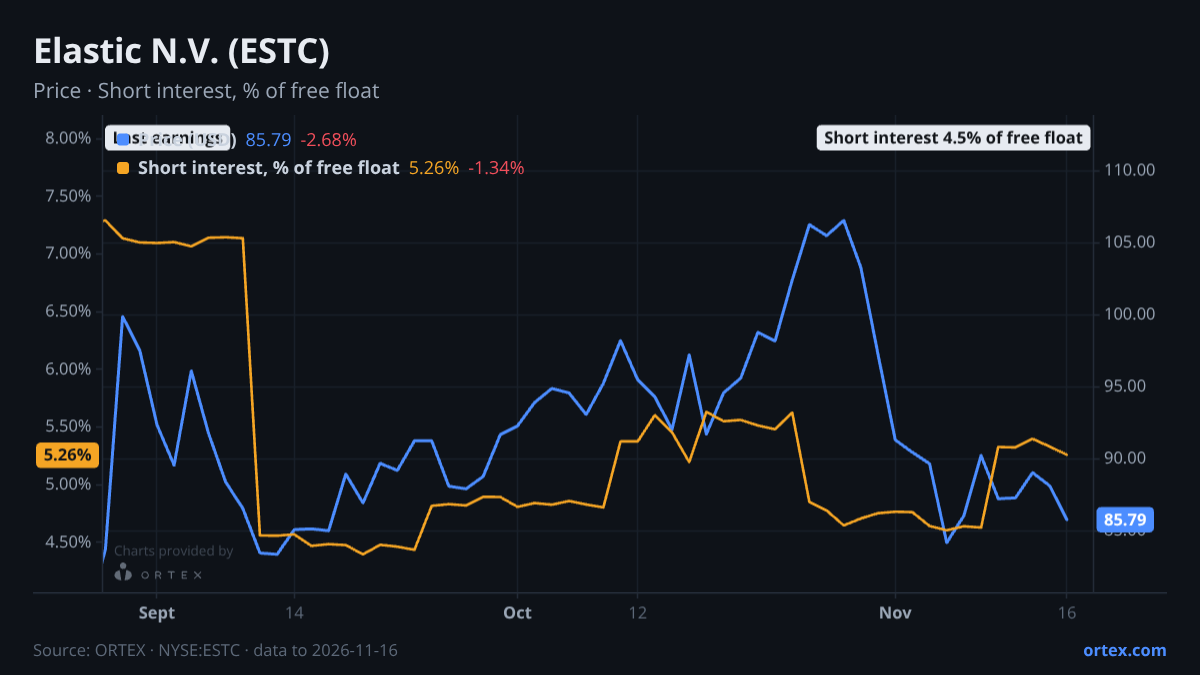
Elastic N.V. reports fiscal second-quarter results on November 19, and the most striking feature of the positioning data is not the size of the short book but how fast it has grown.
Short interest rose 13.4% in a week to 4.74 million shares, equal to 4.5% of the free float. That weekly move is roughly 1.5 standard deviations above Elastic's own historical pace of change, making this one of the more abrupt build-ups the stock has seen. The acceleration arrived while the stock slipped 6.5% over the past month to $88.15, though it clawed back 2.4% in the past week, a touch below the 3.6% median for its closest peers. Borrowing costs remain negligible at 0.48%, up about 12% week-on-week but still firmly in the cheap-to-borrow range. Availability is exceptionally loose at 2,858%, meaning there are roughly 29 shares available to lend for every one already borrowed, so the short build reflects deliberate positioning rather than a squeeze in the lending market. Options traders are not adding much heat: the put/call ratio of 0.28 is barely a rounding error above its 20-day average, and the z-score of 0.06 is as flat as it gets.
The debate going into the print centres on whether Elastic's platform consolidation story can survive a weaker consumption environment. The bull case rests on hard numbers from the last quarter: revenue up 15% year-on-year to $478 million, non-GAAP operating margin at 16.2%, and contracted remaining performance obligations growing 21% to $1.15 billion. The vector search and AI workload angle also gives bulls a credible growth narrative as customers reconsider fragmented data stacks. Bears counter that management already trimmed its long-term guidance, cloud consumption is exposed to macro softness, and the push into security against entrenched rivals requires fresh investment that complicates the margin story. Analyst opinion on the day before the print split between TD Cowen, which cut its target from $95 to $85 on November 17 while keeping a Hold, and Citigroup, which raised to $132 on November 12 while maintaining Buy. The consensus mean target of $112 sits 27% above the current price, though a cluster of neutrals and holds dilutes what that gap implies.
The ownership register adds texture to the bearish positioning. Co-founder Steven Schuurman sold 3.5 million shares in early October across two open-market transactions worth roughly $323 million combined, neither filed under a 10b5-1 plan, and his disclosed stake has since fallen from 5.8% to 2.4%. CTO Shay Banon also sold in September. Net insider activity over the past 90 days amounts to a net disposal of 4.6 million shares worth approximately $423 million. On the activist side, Pictet Asset Management filed a Schedule 13D amendment on October 27 disclosing it had trimmed from 5.2% to 4.9%. A fresh Schedule 13G filed November 16 by T. Rowe Price Associates reveals a 7.3% stake, the largest on the 13D/G register, though the timing and intent differ from an activist posture. BlackRock added 1.3 million shares as of late October.
The print will test whether the contracted backlog and margin trajectory are durable enough to justify a valuation that the bears, and apparently some insiders, have been questioning with real money.
Against its own history
This week's change in short interest is 1.5 standard deviations above the company's typical weekly move over the past year.
Against its peers
Shares moved +2.4% over the past week against a median of +3.6% for its closest peers.
Stocks in this article
See the live data behind this article on ORTEX.
Open ESTC on ORTEX →How this article was generated
- Generated
- 18 Nov 2026, 04:10
- Data as of
- 18 Nov 2026, 04:01
- Prompt version
- v1.0
- Data sources
- Short interestCost to borrowUtilizationOptions flowEarningsAnalyst consensusInstitutional positioningORTEX Alpha signalsRecent ORTEX notesAlt Data
ORTEX Market Intelligence content is generated by AI from a snapshot of ORTEX's proprietary data and reviewed by the ORTEX team. Content is informational only and does not constitute investment advice.