
Synopsys Short Interest Climbs to a One-Year High Before December Earnings
Produced automatically from ORTEX data and published under the ORTEX News editorial standards set by Peter Hillerberg, Editor, ORTEX News. How we publish
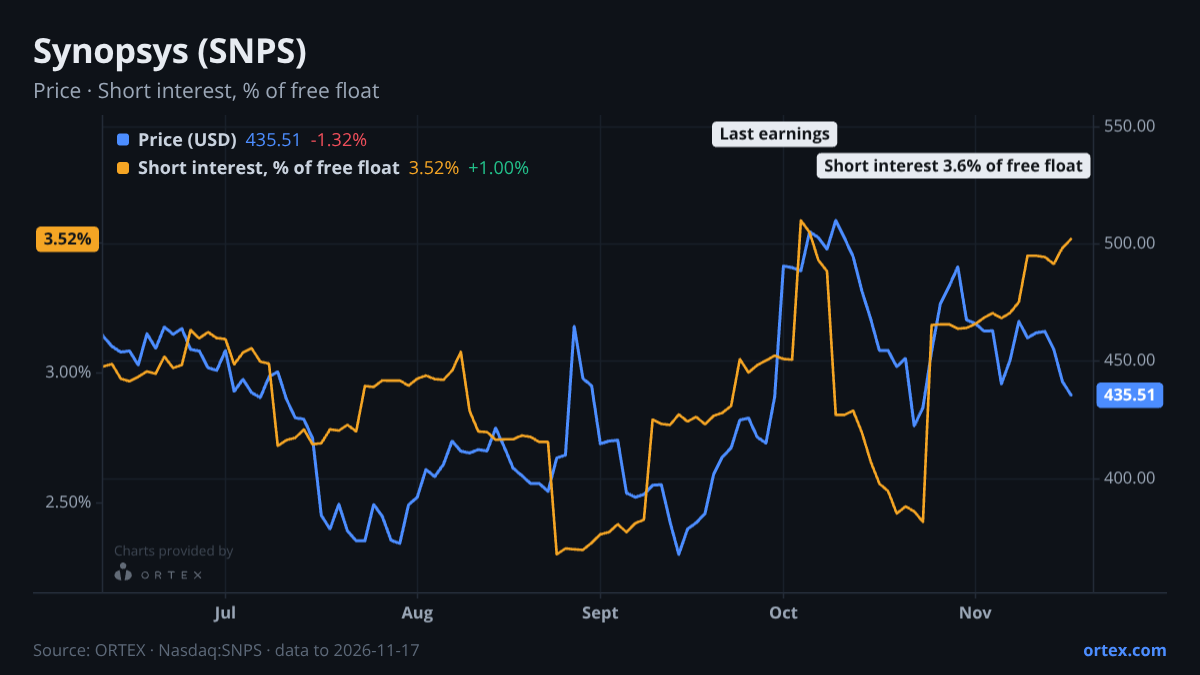
SNPS has shed 5.3% over the past week to $435.51, with short interest now at its highest level in at least a year, reaching 3.6% of the free float, up 24% over the past month.
The short interest build is the week's most striking data point. Shares shorted climbed from roughly 6.07 million on November 2 to nearly 6.70 million by November 17, a steady grind higher that accelerated after October 23. At 3.6% of the free float, this is not an extreme level in absolute terms, but the pace of accumulation, up 7.4% in one week and nearly a quarter in a month, marks the most aggressive bear-side positioning Synopsys has seen in over a year. The borrowing market, however, offers no support for a squeeze narrative. Availability is extremely loose at 6,121%, meaning roughly sixty-one shares remain available to borrow for every one already lent out. Cost to borrow has fallen 15% on the week to just 0.34%, near its lowest reading in the recent history. Shorts are adding with no friction whatsoever. Options positioning reinforces the picture: the put/call ratio of 0.62 sits slightly below its 20-day average of 0.64, suggesting options traders are less defensive than usual, an odd contrast to the growing short book.
The Street remains firmly positive on the stock despite the recent price weakness. The most recent analyst action came from Morgan Stanley on October 20, where Lee Simpson raised his price target from $500 to $574 while keeping an Overweight rating. Prior to that, a cluster of target increases followed Synopsys's September earnings print, with Wells Fargo, Keybanc, Rosenblatt and HSBC all lifting numbers. The consensus mean target of $587 implies roughly 35% upside from the current price. That gap is partly a valuation story: the stock trades at 24x trailing earnings and 20.8x EV/EBITDA, neither stretched by software standards, though the EV/EBIT factor score ranks in just the 8th percentile of the ORTEX universe, flagging an expensive earnings multiple on that basis. The 90-day forward EPS momentum score of 81 points to continued upward estimate revisions. The bull case centres on EDA complexity from AI chip design and the company's FY27 revenue target of $11.15 billion with non-GAAP operating margins near 44%. Bears focus on the risk that AI tools gradually commoditise EDA workflows, eroding Synopsys's pricing power over time, particularly given the company's partnership arrangement with OpenAI.
Insider activity over the past 90 days has run net negative, with roughly $51.4 million in net sales. The largest single transaction was CEO Ghazi Sassine selling 14,604 shares on October 15 for approximately $6.8 million, executed under a pre-arranged 10b5-1 trading plan. Planned sales carry far less informational weight than discretionary ones, and all of the CEO's recent activity appears to be plan-driven. Deputy CFO Sudhindra Kankanwadi sold $4.6 million of stock on October 6, outside of a 10b5-1 plan, which is worth noting, though the volume is modest relative to the company's $87 billion market cap. Among major holders, BlackRock added 338,000 shares as of October 30 and T. Rowe Price added 319,000, both moving in the opposite direction from the shorts.
The last two earnings prints produced unusually large one-day moves. The August 26 release drove a 13.7% single-day gain, and the September 30 release added 18.2% the following day. Both prints were followed by positive five-day windows as well. The closest peer, CDNS, fell 7.4% on the week, in line with SNPS, confirming this is sector-wide pressure rather than a company-specific re-rating. The next earnings date is December 2, with retail attention running well below its own recent average on the ORTEX attention measure, a z-score of negative 2.1 as of November 9.
The December 2 print is the specific thing to watch. With short interest at a one-year high and two consecutive earnings releases that moved the stock sharply higher, the question is whether the growing short book is a bet against that pattern or simply hedging ahead of a catalyst in a stock that has become harder to own after a rough month.
Against its own history
Short interest is at its highest level in at least a year.
Against its peers
Shares moved -5.3% over the past week against a median of -5.5% for its closest peers.
Stocks in this article
See the live data behind this article on ORTEX.
Open SNPS on ORTEX →How this article was generated
- Generated
- 18 Nov 2026, 18:47
- Data as of
- 18 Nov 2026, 18:47
- Prompt version
- v1.0
- Data sources
- Short interestCost to borrowUtilizationOptions flowEarningsInstitutional positioningORTEX Alpha signalsRecent ORTEX notesAlt Data
ORTEX Market Intelligence content is generated by AI from a snapshot of ORTEX's proprietary data and reviewed by the ORTEX team. Content is informational only and does not constitute investment advice.