
Matador Insiders Buy the Dip as Shorts Quietly Exit
Produced automatically from ORTEX data and published under the ORTEX News editorial standards set by Peter Hillerberg, Editor, ORTEX News. How we publish
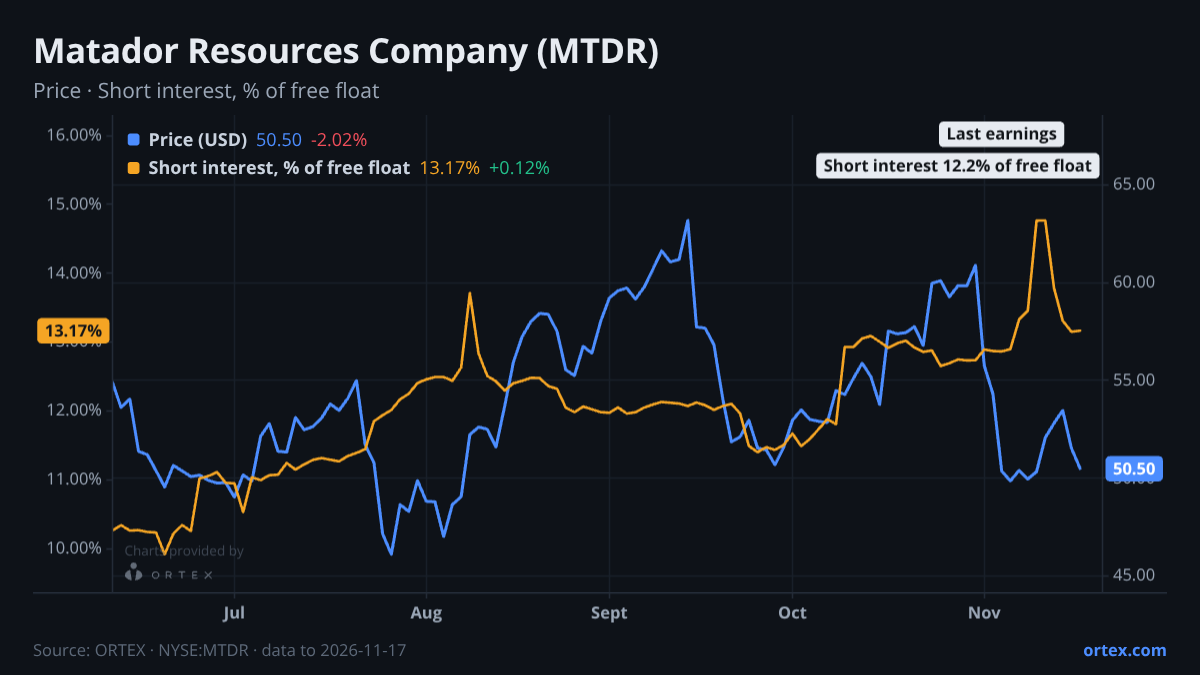
MTDR is a stock where insiders and short sellers are moving in opposite directions, and that divergence is the week's most telling signal.
Among closely correlated E&P peers, Matador's short positioning is relatively crowded. Short interest runs at 12.2% of the free float, above the levels at PR and COP, which are more lightly shorted names in the same group. That said, the direction of travel here has shifted. Short interest fell 2.1% over the past week, and the weekly change is roughly 2.2 standard deviations below MTDR's typical week-on-week move, meaning this week's reduction is unusually large by recent standards. The month-on-month picture still shows a small build of about 1.8%, but the week points the other way. The ORTEX short score, which had climbed to 71 on November 10, has since eased back to 64.2, retreating from what was a multi-month high. Borrowing remains cheap at 0.54%, barely changed from last month. Availability has loosened considerably, rising to 549% from around 255% a week ago, so there is no supply constraint pushing the borrow market tighter.
Options positioning adds an unusual wrinkle. The put/call ratio of 0.135 is statistically stretched, running nearly three standard deviations above its 20-day mean of 0.129. The ratio is very low in absolute terms, meaning calls far outnumber puts, but the recent move higher is sharp relative to its own quiet recent history. This is not classic defensive hedging. The 52-week high on the PCR is 1.22, so at 0.135 the market is overwhelmingly positioned for the upside. The z-score spike simply reflects that even a small shift toward puts looks unusual against a backdrop that has been almost entirely call-dominated.
The insider picture is the clearest signal in the dataset. In the ten days following the Q3 earnings release on November 3, every open-market transaction filed with the SEC was a purchase. Chairman and CEO Joseph Foran bought 5,000 shares on November 5 and another 2,500 on November 10, paying around $49 to $51 per share in discretionary trades with no 10b5-1 plan attached. The COO, President, two directors and an EVP of reservoir engineering all bought alongside him. Combined, the cluster totals over $630,000 in open-market purchases across a week when the stock was down sharply. None of these trades were pre-arranged plan sales; they represent discretionary conviction buying into a price the company's own management appears to view as low.
The stock dropped hard around earnings. The two most recent Q3 prints triggered day-one declines of 8.2% and 9.7%, and the five-day moves that followed were similarly negative. That history likely explains why short interest was building through October and early November. After a 12% decline over the past month, the stock closed Tuesday at $50.50, still roughly 28% below the analyst consensus target of $70.45. Morgan Stanley nudged its target to $70 on November 18 while keeping an Equal-Weight rating. Wells Fargo and UBS both trimmed targets modestly after earnings, but Wells Fargo holds Overweight with a $71 target. The Street broadly sees substantial upside from current levels, and the factor scores back that view on forward earnings: the 12-month forward EPS year-on-year improvement ranks in the 90th percentile. The EV/EBITDA multiple of 3.1x is undemanding for a company with this inventory depth. The bear case rests on commodity price risk, with the NAV framework depending on $60/bbl WTI, and the valuation leaving limited room if macro conditions deteriorate.
Buyback activity has been pulled back sharply. ORTEX Alt Data drawn from SEC EDGAR XBRL filings shows buyback spend in Q2 2026 came in at $11.4 million, down 74% on the same quarter a year earlier, with shares repurchased down 79% year-on-year to 225,000 shares. That redirection of capital away from buybacks, alongside the aggressive open-market buying by insiders at the individual level, sets up an interesting contrast: the company as an institution is spending less on repurchases, while executives are adding shares personally.
The next earnings date is February 16. Between now and then, the level to watch is whether short interest continues the week's unwinding trend or stabilises near 12%, and whether the insider cluster buying proves a one-off reaction to the post-earnings drop or the start of a broader accumulation pattern.
Against its own history
This week's change in short interest is 2.2 standard deviations below the company's typical weekly move over the past year.
Against its peers
Shares moved +0.3% over the past week against a median of +2.8% for its closest peers.
Stocks in this article
See the live data behind this article on ORTEX.
Open MTDR on ORTEX →How this article was generated
- Generated
- 18 Nov 2026, 19:56
- Data as of
- 18 Nov 2026, 19:47
- Prompt version
- v1.0
- Data sources
- Short interestCost to borrowUtilizationOptions flowEarningsAnalyst consensusInstitutional positioningORTEX Alpha signalsRecent ORTEX notesAlt Data
ORTEX Market Intelligence content is generated by AI from a snapshot of ORTEX's proprietary data and reviewed by the ORTEX team. Content is informational only and does not constitute investment advice.