
Costco's Short Interest Hits a Year High, Options Defensiveness Peaks
Produced automatically from ORTEX data and published under the ORTEX News editorial standards set by Peter Hillerberg, Editor, ORTEX News. How we publish
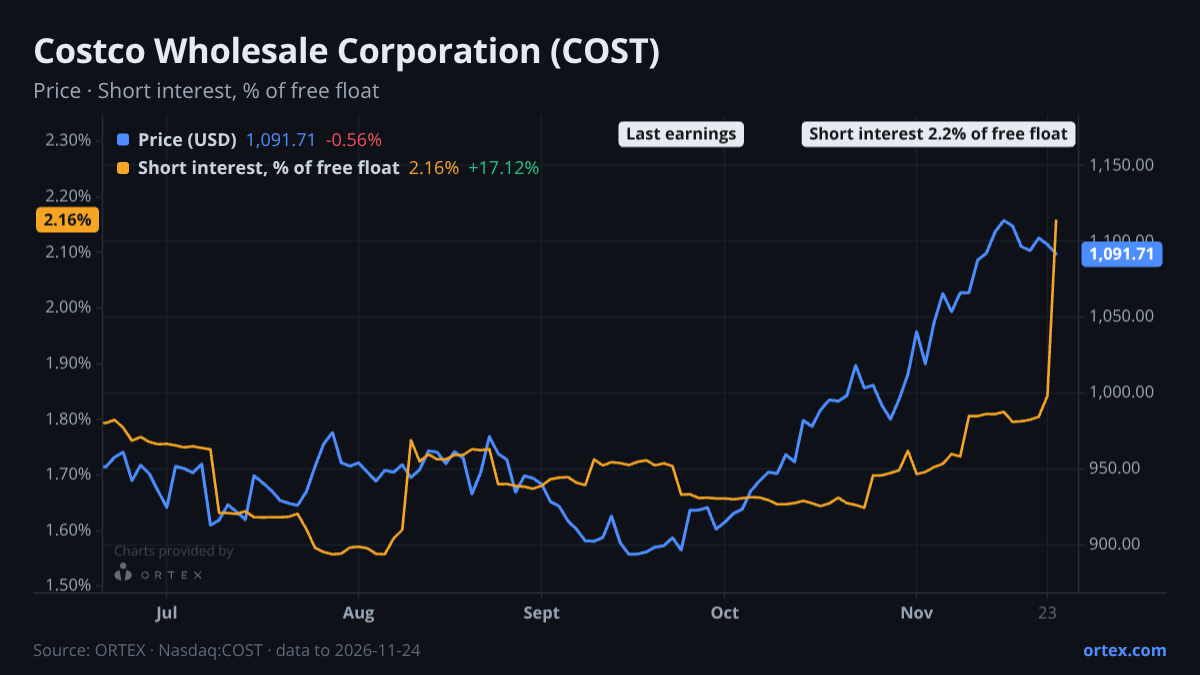
Costco is a $487 billion warehouse retailer with earnings in one week, a $30 special dividend payable in nine days, and a week in which short sellers built positions at the fastest pace in at least a year.
Short interest rose 19% in a single week to 2.15% of the free float, the highest reading in ORTEX's 30-day visible history and a move that runs 4.4 standard deviations above the company's typical weekly change. That is not a crowded short by absolute standards; 2.15% of float is low. But the pace of accumulation is unusual for a stock of this size, and the direction has been consistent: short interest is up 31% over the past month, adding roughly 2 million shares to the borrow. The lending market tells a different story. Availability remains extraordinarily loose, with roughly 365 million shares available to borrow against the 9.5 million already lent out. Cost to borrow has fallen 27% on the week to 0.31%, near its lowest level of the past year. This is not a borrow squeeze in progress. Shorts are adding exposure on easy terms, which points to conviction rather than mechanical pressure.
Options are where the tension sharpens. The put/call ratio hit 1.44 on Tuesday, the highest reading of the past 52 weeks, and running more than three standard deviations above its 20-day average of 1.12. That was a jump from 1.17 the prior session. The previous note, published two days ago, observed a PCR at 2.25 standard deviations above average and described it as the most defensive options posture since mid-August. That reading has now extended further, not eased. Demand for downside protection is rising, not unwinding, as the December 2 earnings date approaches. The stock itself closed at $1,091.71 on Tuesday, down 1.65% on the week, extending the drift from the November 17 intraweek high of $1,113.
The Street remains broadly positive but the consensus target has slipped below the current price. The mean analyst target is $1,084, fractionally below Tuesday's close of $1,091, meaning the stock is trading slightly through the Street's composite view. The most recent moves are bullish: Mizuho and Stifel both raised targets last week, with Stifel reinstating at a Buy and a $1,220 target. Evercore ISI lifted to $1,200. JP Morgan raised to $1,150 in early November. Against that, RBC's $1,000 Sector Perform target and Deutsche Bank's $1,079 Buy target anchor the lower end. The bull case centres on 84.1 million paid members, 92.3% domestic renewal rates, and digital comparable sales up roughly 20% in fiscal 2026. The bear case is simpler: a PE of 47x and an EV/EBITDA of 29x give little cushion if membership growth slows or margins come under pressure from labor costs and tariffs.
One alt-data point worth noting: the company's SEC-reported buyback authorisation has fallen for 13 consecutive quarters, reaching $1.36 billion as of April 2026, down 39% year on year. That streak does not point to a capital returns story built on repurchases. The $30 special dividend declared on November 10, payable December 4, is the more visible return vehicle this cycle. Insider activity in the 90 days to November 12 was net negative, with open-market sales by two Executive Vice Presidents totalling around $1.8 million across two days in November. Neither trade was flagged as a pre-arranged 10b5-1 plan. The net insider position over 90 days is a disposal of roughly 5,757 shares valued at $5.6 million, all compensation-related transaction codes aside from those two open-market sales.
The convergence of rising short interest, a PCR at its 52-week peak, and a share price now trading through the analyst consensus target all point to a market that is unusually cautious for a stock it broadly likes. What matters next is whether December 2's fiscal first-quarter results, and the same-day expiry of the special dividend's payment date, resolve that tension or extend it.
Against its own history
This week's change in short interest is 4.4 standard deviations above the company's typical weekly move over the past year. Short interest is at its highest level in at least a year.
Against its peers
Shares moved -1.7% over the past week against a median of -1.3% for its closest peers.
Stocks in this article
See the live data behind this article on ORTEX.
Open COST on ORTEX →How this article was generated
- Generated
- 25 Nov 2026, 18:11
- Data as of
- 25 Nov 2026, 18:03
- Prompt version
- v1.0
- Data sources
- Short interestCost to borrowUtilizationOptions flowEarningsAnalyst consensusInstitutional positioningORTEX Alpha signalsRecent ORTEX notesAlt DataPrevious Mi Articles
ORTEX Market Intelligence content is generated by AI from a snapshot of ORTEX's proprietary data and reviewed by the ORTEX team. Content is informational only and does not constitute investment advice.