
Autodesk Heads Into Earnings Down 16% With Analysts Trimming Targets
Produced automatically from ORTEX data and published under the ORTEX News editorial standards set by Peter Hillerberg, Editor, ORTEX News. How we publish
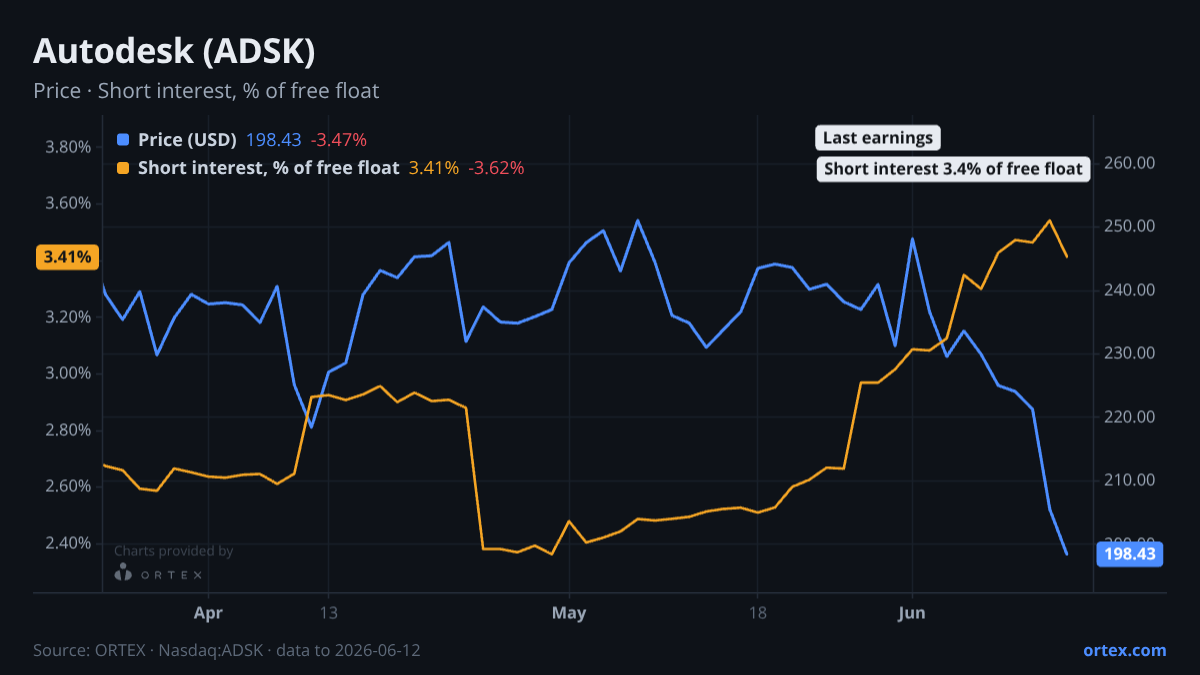
ADSK arrives at its June 17 earnings release having shed 16% over the past month, landing at $198.60 — a sharper decline than most of its software peers and one that frames the entire positioning story heading into the print.
The options market has actually grown less defensive during the selloff, which is the most interesting tension in the data. The put/call ratio has dropped to 1.23, running well below its 20-day average of 1.45 — nearly 1.6 standard deviations lighter than normal and close to the lowest defensive posture of the past year. That shift is notable: rather than hedging into a weakened stock, options traders appear to have unwound their downside protection as the price fell. Short interest reinforces that picture. Bears hold roughly 3.4% of the free float, a level that has risen 37% over the past month but remains modest in absolute terms — around 7.2 million shares. Borrow remains completely unconstrained, with availability running above 5,000%, meaning new shorts face zero friction. The lending market is simply not where the tension lives.
The analyst community tells the more charged story. Following last month's results, a cluster of firms trimmed price targets while holding positive ratings — Morgan Stanley cut to $315 from $350, Wells Fargo to $330 from $350, and RBC Capital to $305 from $335, all within days of each other. Citi, sitting at Neutral, nudged its target slightly higher to $252 on June 1. The consensus mean now sits near $319, implying roughly 60% upside from current levels — a gap that reflects either genuine conviction or targets that haven't fully caught up with the stock's deterioration. Bulls point to Autodesk's dominant position in BIM and CAD software, its MaintainX acquisition as evidence of platform expansion, and an ORTEX growth factor score of 87. Bears focus on macroeconomic pressure, intensifying competition from larger SaaS vendors, and a valuation that — even after the selloff — carries a price-to-earnings ratio near 15x on a forward basis with an EV/EBIT that recently ran near 29x.
The peer comparison adds further context. PTC fell 17% on the week, ADBE dropped 19%, while BSY and HUBS held closer to the group median. ADSK's decline is therefore roughly in line with its closest comps rather than an outlier — suggesting sector-wide pressure rather than a company-specific deterioration, though that distinction is precisely what Wednesday's print will be asked to clarify.
The chairman of the board bought approximately $794,000 worth of shares on May 29, the most recent insider activity, at prices around $230-$231 — well above where the stock trades now. That purchase, modest in scale but timely in timing, adds a layer of insider confidence that sits awkwardly alongside the broader selloff.
The print will test whether a 16% drawdown has already priced in the macro and competitive pressures the bears cite, or whether consensus estimates still carry expectations the business cannot meet at this moment in the cycle.
Against its own history
Short interest is at its highest level in at least a year.
Against its peers
Shares moved -11.7% over the past week against a median of -8.8% for its closest peers.
Stocks in this article
See the live data behind this article on ORTEX.
Open ADSK on ORTEX →How this article was generated
- Generated
- 16 Jun 2026, 04:01
- Data as of
- 16 Jun 2026, 04:00
- Prompt version
- v1.0
- Data sources
- Short interestCost to borrowUtilizationOptions flowEarningsInstitutional positioningORTEX Alpha signalsRecent ORTEX notes
ORTEX Market Intelligence content is generated by AI from a snapshot of ORTEX's proprietary data and reviewed by the ORTEX team. Content is informational only and does not constitute investment advice.