
T-Mobile Options Turn Defensive as Analysts Keep Trimming Targets
Produced automatically from ORTEX data and published under the ORTEX News editorial standards set by Peter Hillerberg, Editor, ORTEX News. How we publish
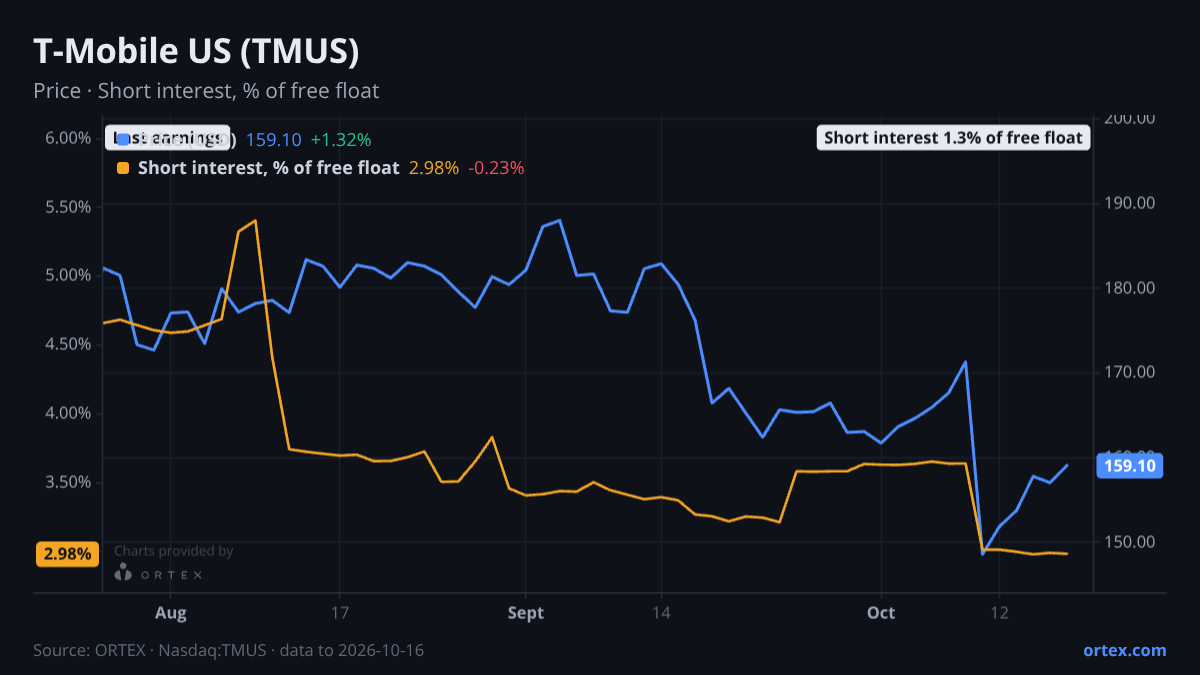
T-Mobile US heads into its October 22 Q3 print with options markets pricing more caution than usual, even as short sellers have been decisively reducing positions ahead of the release.
The clearest pre-earnings signal is in options. The put/call ratio has climbed to 0.76, almost two standard deviations above its 20-day average of 0.67, placing it near the higher end of the past year's range. That reflects a meaningful uptick in demand for downside protection relative to the stock's recent norm, not an extreme reading but a notable shift. It follows a difficult month for the stock: TMUS has fallen 7.2% in the past 30 days to close at $156.09, and is down roughly 24% year-to-date despite a 2.8% bounce over the past week. The borrow market tells a different story entirely. Short interest has dropped 18% over the past week to just 1.3% of the free float, and availability in the lending pool is at its maximum reading, meaning the market has taken essentially no structural short position ahead of earnings.
The analyst community has been cutting targets across the board, though the buy thesis remains intact. JPMorgan maintained Overweight but trimmed its target to $260 from $275 in late September. Barclays followed a similar path, moving to $200 from $215. Scotiabank has twice lowered its target within the past three weeks, bringing it from $232 down to $212. Raymond James bucked the trend, upgrading to Outperform last week. The consensus mean price target of $237 implies more than 50% upside to the current price, a gap that frames the debate precisely. Bulls point to postpaid service revenue up 13% year-on-year, EBITDA up 12%, record-low phone churn at 0.85%, and raised free cash flow guidance of $18.4bn to $18.8bn as evidence the fundamental engine is intact. Bears counter that Sprint integration risk, pricing pressure from cable MVNOs, and uncertainty around wholesale and fixed-wireless economics leave the growth story more fragile than the headline figures suggest.
One structural feature of the ownership picture is worth noting ahead of the print. Deutsche Telekom, filing on a Schedule 13D, holds approximately 53.7% of T-Mobile's shares, giving it effective control of the register. SoftBank Group, also a 13D filer, disclosed a stake of around 4.52% in its most recent filing from August 2025, reduced from 5.62% previously. These are event-driven disclosures around the 5% threshold, and stakes are as last disclosed. The concentration of ownership at the parent level means the float is relatively thin, which helps explain why even modest short interest reads at a low percentage of float despite the underlying share count.
T-Mobile's past two quarterly prints produced single-day declines of roughly 5% to 6%, both followed by further softness over the subsequent five days. The print on October 22 is therefore less a test of whether T-Mobile can grow and more a test of whether the rate of that growth, particularly in postpaid net additions and fixed-wireless subscriber momentum, is sufficient to close the gap between a $156 stock and a consensus target that still sits well above $200.
Against its peers
Shares moved +2.8% over the past week against a median of +3.6% for its closest peers.
Stocks in this article
See the live data behind this article on ORTEX.
Open TMUS on ORTEX →How this article was generated
- Generated
- 20 Oct 2026, 04:24
- Data as of
- 20 Oct 2026, 04:01
- Prompt version
- v1.0
- Data sources
- Short interestCost to borrowUtilizationOptions flowEarningsAnalyst consensusInstitutional positioningORTEX Alpha signalsRecent ORTEX notesAlt Data
ORTEX Market Intelligence content is generated by AI from a snapshot of ORTEX's proprietary data and reviewed by the ORTEX team. Content is informational only and does not constitute investment advice.