
Visa Options Turn Cautious as Stock Hits New High
Produced automatically from ORTEX data and published under the ORTEX News editorial standards set by Peter Hillerberg, Editor, ORTEX News. How we publish
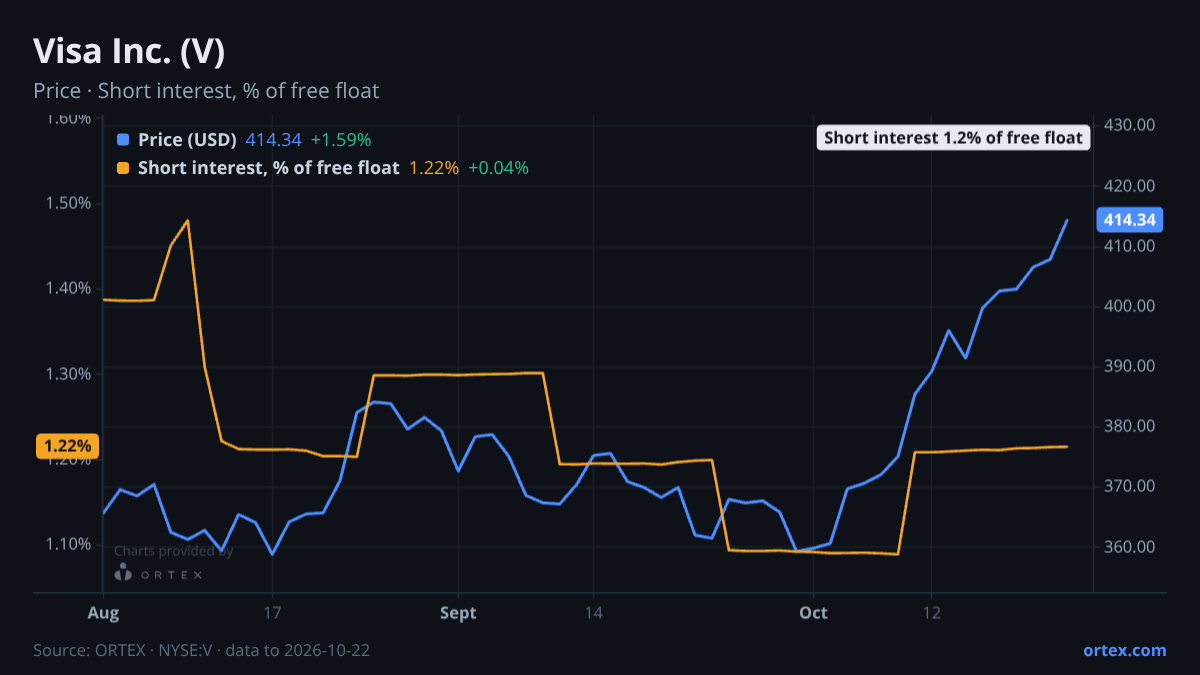
Options traders are hedging more aggressively into Tuesday's fiscal Q4 print than at any point in the past year, even as Visa closed Friday at $407.92, up 12.7% over the past month.
The clearest signal is the put/call ratio. It reached 1.0009 on Thursday, the highest reading in 52 weeks and nearly 1.9 standard deviations above its 20-day mean of 0.927. That is a meaningful step up from the 0.987 level flagged in last week's report, which itself was already described as a material shift. The stock has continued to climb since then, adding roughly another $6, but options traders have responded by reaching further for downside protection rather than chasing the rally with calls. Price action and options positioning are now pointing in opposite directions.
Analysts are firmly onside. Truist Securities lifted its target to $443 from $406 on Thursday, staying at Buy, and the broader Street consensus puts the mean target at $425, leaving modest implied upside from current levels. The bull case rests on 9% payment volume growth, strong international expansion, and low double-digit earnings growth guidance through fiscal 2026. Bears point to a 32x P/E multiple that leaves little margin for error, growing competition from fintech platforms and government-sponsored payment rails, and a stock that has now run 12.7% in a month. EPS momentum ranks in the 97th percentile over 30 days, suggesting the estimate revision cycle has been strongly positive, but EV/EBIT ranks in just the 18th percentile, a reminder that the valuation is stretched by historical standards.
The lending market remains entirely untroubled. Availability runs at roughly 2,934% of short interest, meaning around 29 shares are available to borrow for every one already shorted, down slightly from the 3,500% level reported last week but still far above the 52-week floor of 738%. Short interest itself is unchanged at 1.2% of the free float. Cost to borrow ticked up to 0.40% from the 0.29% low seen earlier this month, but remains near its cheapest levels of the past year. There is no structural short pressure here.
Insider activity adds little new signal. The CEO and General Counsel have both been selling shares in recent months, but every transaction carries a 10b5-1 plan disclosure, meaning the sales were pre-scheduled well in advance. They are compensation mechanics, not reads on conviction.
Visa's two most recent quarterly prints produced muted reactions: a 1.7% gain the day after July's results and a 2.0% decline after the prior quarter. The October 27 print will test whether a stock trading at its 52-week high, with options skewing defensively at their most cautious reading of the year, can deliver results that justify the $40 rally that preceded it.
Against its peers
Shares moved +1.3% over the past week against a median of +1.0% for its closest peers.
Stocks in this article
See the live data behind this article on ORTEX.
Open V on ORTEX →How this article was generated
- Generated
- 24 Oct 2026, 04:18
- Data as of
- 24 Oct 2026, 04:02
- Prompt version
- v1.0
- Data sources
- Short interestCost to borrowUtilizationOptions flowEarningsAnalyst consensusInstitutional positioningORTEX Alpha signalsRecent ORTEX notesAlt DataPrevious Mi Articles
ORTEX Market Intelligence content is generated by AI from a snapshot of ORTEX's proprietary data and reviewed by the ORTEX team. Content is informational only and does not constitute investment advice.