
TJX Options Turn Defensive as Analysts Trim Targets Before Q3 Print
Produced automatically from ORTEX data and published under the ORTEX News editorial standards set by Peter Hillerberg, Editor, ORTEX News. How we publish
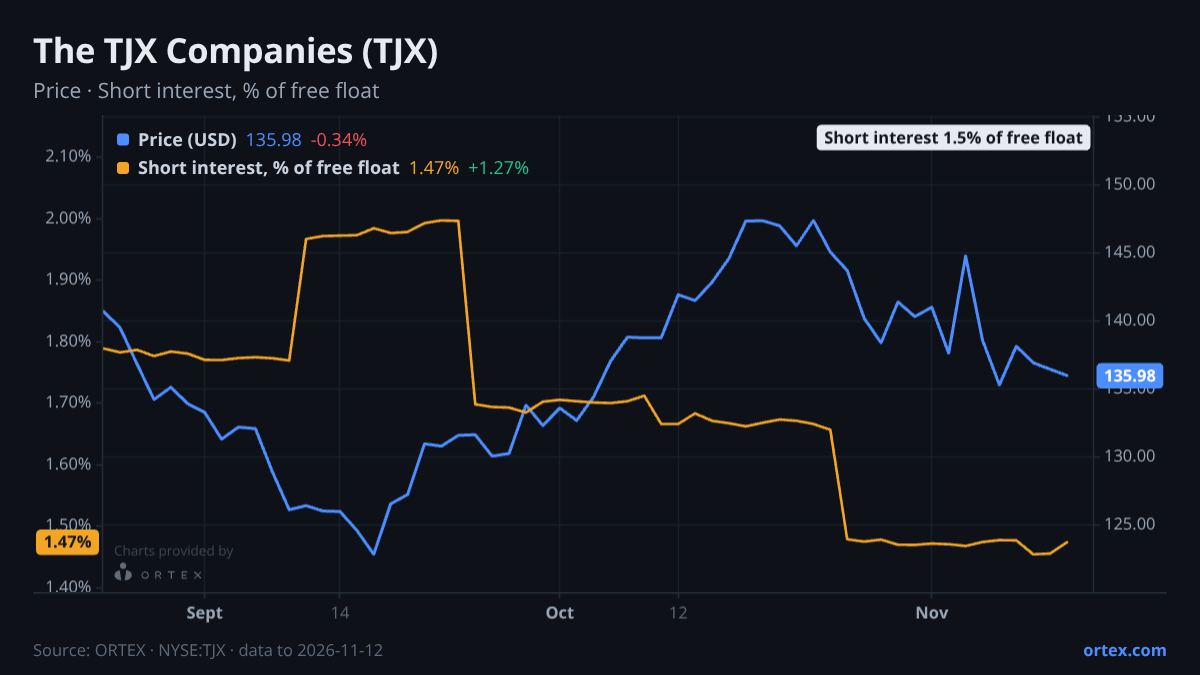
TJX shares have drifted 5% lower over the past month to $134.37, underperforming close peers: ROST edged up 0.3% over the past week while BURL fell 1.6% and TJX itself slipped 0.7%, leaving TJX the laggard in a mixed off-price group.
The clearest signal into Tuesday's Q3 print is in options, where positioning has turned more defensive than usual. The put/call ratio has climbed to 0.96, nearly 1.7 standard deviations above its 20-day average of 0.82. That is a notable shift: in October, the ratio was consistently below 0.76. The move in the PCR has coincided with the stock's slide and was preceded by a cluster of analyst target cuts. Wells Fargo trimmed its price target to $135 on November 13, almost exactly where the stock is trading, while UBS cut from $198 to $184 just days before. Both maintained their ratings. BofA also moved its target lower in late October, keeping a Buy but pulling the number to $170. Cantor Fitzgerald initiated coverage with a Neutral at $139. The consensus mean target of $167.50 implies meaningful upside from current levels, but the direction of travel across recent changes has been uniformly downward, and the new Wells Fargo target provides almost no cushion above the current price.
The debate centers on whether TJX's off-price model can maintain its value proposition in a more competitive retail environment. The bull case points to the company's scale, more than 5,000 stores and roughly $60 billion in annual sales, and its record of driving traffic through branded discounts that hold up across income groups. The most recent quarterly result showed gross margin at 31.4% and operating margin at 11.7%, which advocates cite as evidence the model is working. Bears counter that inventory sourcing could tighten if vendor appetite for the off-price channel wanes, and that rising e-commerce competition puts persistent pressure on merchandise margins. The P/E multiple has compressed about 2.4 points over the past month to 23.9x, reflecting the stock's re-rating lower, and the EV/EBITDA of 16.3x still prices in a business expected to compound steadily.
Short interest is not part of the story here. At 1.5% of the free float, it has been broadly stable and fell roughly 13% over the past month. The lending market is essentially unconstrained, with availability more than 7,000% of outstanding short interest and borrowing costs below 0.4%. Nothing in the positioning of short sellers suggests a directional conviction call.
The last Q2 print on August 19 sent the stock down 6.7% on the day and a further 9.3% over the following five days, the largest single-day earnings reaction in recent history. That result triggered downgrades from Jefferies and Citi and a string of target reductions. The Q3 report will test whether the company can stabilise expectations after that reset, and whether the gap between the analyst consensus and the current stock price reflects genuine upside or simply targets that have not yet caught up with the new trading range.
Against its peers
Shares moved -0.7% over the past week against a median of +0.1% for its closest peers.
Stocks in this article
See the live data behind this article on ORTEX.
Open TJX on ORTEX →How this article was generated
- Generated
- 15 Nov 2026, 04:06
- Data as of
- 15 Nov 2026, 04:00
- Prompt version
- v1.0
- Data sources
- Short interestCost to borrowUtilizationOptions flowEarningsAnalyst consensusInstitutional positioningORTEX Alpha signalsRecent ORTEX notesAlt Data
ORTEX Market Intelligence content is generated by AI from a snapshot of ORTEX's proprietary data and reviewed by the ORTEX team. Content is informational only and does not constitute investment advice.